Faith, Holiness, Jesus

Enduring Faith

Today, my friend came home. For the last three years he has been serving a prison sentence, unjustly in many people’s opinion – including mine.  This man… well, I could spend this entire post summing up the goodness of this man and the effect he had on me during our time of closer friendship. But that isn’t the purpose of this post. The purpose is to honor the way, during the last three years, he lived the Scripture, “Rejoice in hope, endure in affliction, persevere in prayer” (Romans 12:12).

I didn’t get an opportunity to visit Pete while he was in prison. I sent a handful of letters and cards and occasionally received a reply. The tone of those replies, the statements he made, added to the stories and descriptions I heard from his family and friends who did visit him, came as no surprise to me. They were true to Pete’s character. True to the young man I knew better years ago; true to the man I have always assumed he has continued to be since then. No, they did not surprise me, but that’s not to say they didn’t move me.

Smack dab in the middle of his doctorate studies, ongoing cancer research at his job, and plenty of other endeavors and activities, Pete was punished for circumstances outside his control. He had reason to despair. He had reason to wallow and slip into depression. He had reason for anger. Yet, beyond a reasonable level of righteous anger, he indulged in none of these things. I’m not saying he didn’t have to struggle against them. I don’t know if there were days when they tried to sneak into his heart and fill him with discouraged resignation. I do know that he did not allow them to take over.

Throughout the three years, Pete remained a man of hope. He remained a man of patience. He remained, above all, a man of faith. We are exhorted again and again in Scripture to endure trials and tribulations with the attitude of Christ. We are called upon to take up our crosses and carry them in the path of our Lord. In the Gospels, Jesus does not assure us that we will see justice prevail this side of Heaven. He does not promise to relieve from our lives the suffering that comes our way. Throughout the rest of the New Testament, the Apostles reinforce these realities of life in Christ.

We are assured instead that there will be crosses and trials. We are told flat out that “in the world [we] will have trouble” (John 16:33). The promised reward is only received in full when this life has finished. The justice is meted out according to God’s terms and timing, not ours. The relief from the suffering is not guaranteed until Paradise.

So many of us know these truths. We’ve heard them, read them, attempted to be accepting of them. In the moment though – the moment of darkness and pain – do we hold fast to them? There is no easiness in this aspect of the Christian life. It is why the stories of the martyrs and saints are such effective buoys of inspiration. We need to know it’s possible. We need to celebrate the lives of those who emanate the attitude of Christ as they carry their crosses. In them we gain encouragement to do likewise.

This is what Pete gives to those who know him. Whether he ever realized it or not, each day that Pete chose faith, hope, and charity in his attitude, thoughts, and actions during the last three years, he allowed Christ to make use of him. He became an extension of the example set by Christ for us all.

Pete isn’t a superhero. He’s not something other than what we are. Which means, we are all capable of acting in God’s grace to live with the attitude of Christ. In every circumstance – joy and suffering – from the most ordinary to the most extreme. By the Spirit of Christ, we are transformed. Let us live transformed lives. Let us honor those among us doing so right now.

Faith, Holiness, Scripture

The Look of Trust

Depending on the day, saying I trust in God can land anywhere on the spectrum of easy to difficult. In the best mindset though (note: not necessarily the best circumstances, but the best mindset), aware of God’s promises, of His nature, and of all the ways He’s cared for me in the past, I can readily say that I trust in God.

Trust in God for what? “I trust in God” is truly an unfinished statement. For what? With what?

Added to these questions is the wondering, “what does that look like?” When trust is real, when it accomplishes what it ought in my heart and mind, what does that look like? Surely a life lived with trust in God has some noticeable differences from a life lived without.

Today is as good a day as any for me to think through these questions as the trusting is landing somwhere near the more difficult-but-extremely-necessary end of the spectrum.

A couple nights ago, I started reading the Psalms to my son (via my belly). I thought about how all the books and folks say that baby in the womb can sense and react to the way Mom is feeling, especially when it comes to stress, anger, distress, fear, etc. It struck me that, because it doesn’t cause concern health-wise, it’s not talked about so much from the opposite angle. Does consistent peacefulness, a restful mind, a gentle spirit do as much good for the developing child as the opposite does harm? I like to think the answer to that is yes.

The words I read to my unborn son spoke frequently of trust, strength, peace, provision – all coming from the Lord. And that’s really what it comes down to, doesn’t it? That’s where the difference lies. A life lived in trust in God means I look to Him for what I need. I trust Him with the worries plaguing me. I trust Him with the potential joy or sorrow that could come of a relationship or experience. I trust Him with the ones I love and whom I wish I could save from every harm. I trust Him with my hopes. I trust Him with my self!

The peace of mind, the needs of each day, the strength and wisdom in each circumstance; I don’t look to anything or anyone before God. He may provide through other things and other people, but I look to Him first and above all. And when He provides by whatever means He chooses, I remember and am certain that the answers came from Him, not anywhere else. I don’t get chained down by worry and fear because a need placed in God’s hands means it is in His hands. In His care. A pretty notion? No, a powerful notion. If I can encourage my children not to worry or be afraid because they can rest assured that their mother and father are caring for them, how much more can a life changing example be set by the fact that I live in deliberate assurance that I am in God’s care!

A life lived in trust in God does look different. There is a steadiness to it, an unshakeable character that breeds confidence, peace, and endurance through the thickest and thinnest of life’s days. It shapes reactions, choices, words, and thoughts. The look of trust is the look that I pray will mark my features as a wife and mother.

To thee, O Lord, I lift up my soul. O my God, in thee I trust, let me not be put to shame. (Psalm 25:1-2a)
 
Vindicate me, O Lord, for I have walked in my integrity, and I have trusted in the Lord without wavering. (Psalm 26:1)
 
The Lord is my light and my salvation; whom shall I fear? The Lord is the stronghold of my life; of whom shall I be afraid? (Psalm 27:1)
Catholicism, Faith, Personal Reflection

In the Shadow of the Cross


Last night I began a post on the Feast of the Triumph of the Cross. It was left unfinished and I expected to wrap it up today. The words were full of hopeful things… the mystery of God’s masterful ways, the beauty of Christ’s humility, the wonder of what God can do when we are faithful even in suffering, the rich abundance of living as victors in Christ. I meant to finish it for you, whomever you are, but I find that I can’t. Not today. Today has morphed into a Jonah day. The morning brought stress and tiredness and a wish to hide away. Then the afternoon arrived with news of a family friend’s very unexpected and difficult to fathom death. I’ve kept my head bowed low over my workspace to hide the tears that keep falling each time it creeps across my thoughts. And so I find I can’t wrap up last night’s thoughts on the Triumph of the Cross. And yet the Triumph of the Cross is the only thing that matters on a day like this one. The only thing.


Faith, Holiness, Scripture

Feasting

To close my adoration hour this past Monday, I prayed Psalm 63. My eyes returned to verse 5 after I finished. I read the words over a second and then a third time. “My soul will feast and be satisfied, and I will sing glad songs of praise to you.” So read the Good News Translation which happened to be the version available in the adoration chapel. The NAB (verse 6, by the way) reads, “My soul shall savor the rich banquet of praise, with joyous lips my mouth shall honor you.”

Oh, those words! How truly they resonate. They reminded me of something my favorite Scripture professor, Dr. Gregory Vall, said as we studied Psalm 25. Verse 1 includes, “to you O Lord, I lift up my soul.” We discussed the notion of lifting our souls, our nephesh (Hebrew*), to God. Dr. Vall insightfully noted that “we are always lifting our nephesh to something.” Our souls are always seeking something and so we lift them up to whatever we think maybe, just maybe, will be what is sought. David, as he expresses in his psalm, chooses to lift his to the Lord. The verse that caught my attention so strongly in Psalm 63 seems to me like David’s follow up to that choice.

“My soul will feast and be satisfied.” Our souls – our innermost being that gives us our unique human intellect and free will, our ‘hearts’ that house our desires, our spiritual aspect – these souls of ours are incessantly hungry. Having been made for the purpose of eternal life with God, they are kept between the boundaries of this earthly life and so have an unshakeable restlessness for more. Hungry… and so our souls feed. Or rather, we feed our souls. Sometimes it is with the choice meats of prayer and authentic love. Other times, all too often, it is on the scraps of selfish pursuits or flawed pleasures. In some instances, we are quite aware that we are feeding our souls. We are convicted by the restlessness in us and so determinedly pursue contentment – be it in wise or unwise places. Then there are the instances of unawareness. We latch on to sources of pleasure, gnawing through them for the satisfaction they can’t give, and don’t even realize the malnourishment of our souls. This life offers an unending buffet for our consumption. Some soul foods are worth tasting and enjoying and will lend strength for the days ahead. Many are superb when taken in proper portions and at the right times. Others shouldn’t even touch your plate for they will only bring bitter, regrettable damage.

At all times though, our souls are feeding. They are never satiated. They cannot be. For it is only in the banquet halls of heaven that the “soul will feast and be satisfied.” One day… one day… the soul will long for no more for it will have all. In the meantime, feed it well, my friends.

(*Have to give credit to my friend Fr. Mike Chenier for correcting me when I first posted this and said nephesh is Latin. Can’t believe I made that mistake! I hope I didn’t shame Dr. Vall too badly.)

Faith, Hope, Intentionality

Rediscovering

On Saturday, I began reading Matthew Kelly’s Rediscover Catholicism and it has me all fired up in the best way. His message has me recalling my love for this sort of material – spiritually themed, practically applied and authentically communicated. Oh how I love the Church. I neglect that love sometimes, letting it fall to the back of the line of the things that occupy my days. This book is an effective rearranger of that line.

The pages of the first chapters already host plenty of underlined passages and small margin notations. Plenty of statements Kelly makes have struck me as significant with a lot of, ‘that is so true’ moments. The one that’s staying with me since yesterday reads, “God always wants our future to be bigger than our past. Not equal to our past, but bigger, better, brighter, and more significant. God wants your future and my future, and the future of the Church, to be bigger than the past. It is this bigger future that we need to envision” (pp. 23-24).

I’ve been thinking plenty about the future in recent days. Plenty. Sometimes I want to just stop thinking about it for a while and remember to be present in the present. However I can’t claim I’ve thought about the future in such terms as Kelly suggests. What I love about this declaration, that God wants our future to be “bigger, better, brighter, and more significant,” is the beautiful reality that when God wants something, He always, always makes a way for it to be possible. He doesn’t do it for us. He makes it possible. This means that I can have that future. You can have that future. If God desires it, He will provide means necessary for you to attain it. And He does, undoubtedly, desire it.

Faith, Jesus, Scripture

Seeds & Soil

I think it’s a combination of the yard work yesterday and the significant but unresolved discussion last night about the growth of faith. I woke up today with the parable of the Sower in my mind. It’s one of my very favorite passages, possibly my favorite parable, but I haven’t read it in quite some time.

Jesus is speaking, yet again, to a great crowd. He stands in a boat, just off the shore, while the crowd assembles on the beach, eager to hear from this great and mysterious teacher.

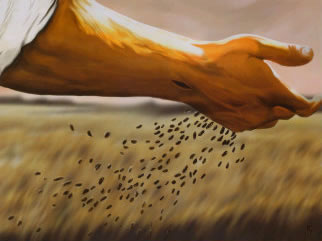
And he told them many things in parables, saying: “A sower went out to sow. And as he sowed, some seeds fell along the path, and the birds came and devoured them. Other seeds fell on rocky ground, where they had not much soil, and immediately they sprang up, since they had no depth of soil, but when the sun rose they were scorched; and since they had no root they withered away. Other seeds fell upon thorns, and the thorns grew up and choked them. Other seeds fell on good soil and brought forth grain, some a hundredfold, some sixty, some thirty.” (Matthew 13:3-8)

Later the crowd waits. Jesus is pausing in His preaching and His twelve disciples gather around Him. They question Him on His method. “‘Why do you speak to them in parables?’ And he answered them, ‘To you it has been given to know the secrets of the kingdom of heaven, but to them it has not been given.'” (13:10-11) They likely feel the weight of this privilege, but they realize that they too need help to understand what Jesus has told them. Later they will receive the powerful gift of the Holy Spirit to understand all truth (John 14:26; 16:13) and preach it themselves, but for now they depend upon Christ to enlighten them with His words.

Jesus knows this need and He proceeds to explain to the Twelve, “Hear then the parable of the sower. When any one hears the word of the kingdom and does not understand it, the evil one comes and snatches away what is sown in his heart; this is what was sown along the path. As for what was sown on rocky ground, this is he who hears the word and immediately receives it with joy; yet he has no root in himself, but endures for a while, and when tribulation or persecution arises on account of the word, immediately he falls away. As for what was sown among thorns, this is he who hears the word, but the cares of the world and the delight in riches choke the word, and it proves unfruitful. As for what was sown on good soil, this is he who hears the word and understands it; he indeed bears fruit, and yields, in one case a hundred-fold, in another sixty, and in another thirty.” (13:18-23)

There are so very many things that impress themselves on my mind from this teaching of Christ. I will keep myself to only two here though. One is the role of the Sower. The Sower of “the word of the Kingdom” is God, Himself. When we present ourselves to Him, admitting our need for Him and His Word, He sows. When we hear His Word proclaimed and taught, He sows. When we pray and entrust ourselves to Him, He sows. Even when we are not prepared, not certain, He sows. Faith is a gift of God. It is not created against our will and so we do hold a role in its inception in our hearts, but we cannot create it ourselves. We are to be soil, receivers of the seed of faith sown by our gracious and saving God. Pride would have us believe we can save ourselves. Woundedness would have us believe God will not come through. Modern mindsets would have us believe we can know all things by our own power. But it is God who created us and it is God who has made it clear that we need Him and His Word.

Secondly, the parable lays out a bluntly difficult scenario for those who receive the seeds of faith. Christ presents “whens,” not “ifs.” When the evil one attempts to steal away the seeds; when tribulations and persecutions come because of this faith; when the cares of the world and the desire for the things of this world rise up – these are not hypotheticals and the results when the faith has not yet taken root in good soil are not either. I’ve seen it and experienced it: the uprooting, the withering, the choking out. Good soil… understanding: this is the aim to be taken. To humbly open your heart and mind to truth as revealed by God and proclaimed by His teaching Church. To take up the work of understanding, of growing strong, lasting roots of faith. To let Him take hold by His Word. To “trust in the Lord with all your heart, and do not rely on your own insight. In all your ways make straight your paths.” (Proverbs 3:5-6) To avail yourself of the rich resources of faith. To be a member of the “household of God, which is the church of the living God, the pillar and bulwark of the truth.” (1 Timothy 2:15) To be good soil. And in good soil, oh the gloriousness of the fruit borne by those seeds sown by the Divine Sower.
Faith, Personal Reflection

Slowed

Oh, head cold, you have such a knack for slowing me down. Pressure and congestion and coughing… I am not a pretty sight this morning. As my sister put it after I was dressed for the day, “You look really nice, except for your face.” Throw together a handful of nights of too little sleep (and restless sleep, at that), some unexpected traveling and emotionally trying days and we have pitch perfect circumstances for getting under the weather.

One thing I will say about colds though, they are masters at making me settle down. I’ve wondered if anytime I catch a bad cold, God’s been trying to calm me down for a while but I miss His subtlty and so He allows for a more direct tactic. I wouldn’t put it past Him… or me. So, I’m giving in. Under a dizzy fog of Dayquil, I will lay low. I will rest. I will enjoy a few simple comforts – a favorite blanket, a mug of tea, a bowl of chicken soup. And I will wait.

I wouldn’t be surprised if that’s precisely the point the Lord is trying to make with me. Waiting: what I am not doing when I get ahead of myself, whether it be in actions taken or in mindsets and expectations; what I am not doing when I attempt to shape God’s will, letting Him know what He ought to be accomplishing in my life; what I may do better under duress of a head cold and a dosage of humility.