Music, Personal Reflection

The Best Part

Before dusk, I sat on a bench in my garage, the door open and the rain pouring on the driveway and trees outside. If there’s rain to be had, I highly recommend the sitting and listening method for discarding stress. It was exactly what I needed tonight. Even now, despite the chill coming through, I have the window open above my desk so I can continue to hear the rain.

Sitting on that bench, my thoughts wandered to the summer gone by. The schedule was busy. The commitments seemed higher than most summers. Work was… a lot. There were too few mornings in the kayak and afternoons at the beach. It wasn’t the summer I was aiming to have when it began. Yet, there were highlights and good things.

One of the really good things was playing saxophone in the Plymouth Municipal Band. And one of the best things was a particular night with the band.
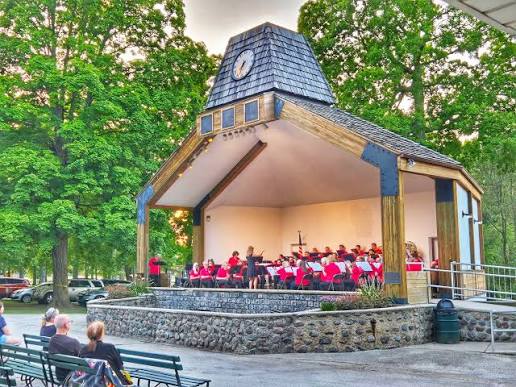
It was one of several Thursday night concerts we played in City Park. The chairs and music stands filled up the small bandshell in the park. Members of the community sat on the benches and grass facing the stage. There’s a straightforward kind of delight in a simple city band concert. Anyone there is there for the music. No frills or fireworks; just enjoyable arrangements of popular tunes and patriotic marches, with concessions and conversations between songs.

This night was intended to honor the band directors who served through the years in Plymouth. Some of our songs were led by guest directors; retirees from the high school and middle school in the last several decades. As each one took their turn, our announcer would describe their career, and after the song, he’d ask all of their former students to stand. It was one of these guest directors who transformed the night from fun to deeply memorable for me.

Art Pahr directed the Riverview Middle School band for 31 years. During the 1960s, he wrote a fight song when the school had none. He’s coming up on 90 years old soon, if I remember correctly. When his name was announced that night, he made his way to the bandshell, leaning on a cane and accepting help to ascend the steps. He was the only director for whom we made sure to have a chair so he wouldn’t need to balance and stand. Art took his seat, smiled at the band, and spotted some of his former students. Then he raised the baton and launched our performance of that fight song he’d composed long ago. In the second half of the song, the joyous energy radiating from this elderly man lifted him from his seat. He stood and directed us with gusto, his smile stretching across his face, filling it with light that rendered him young again for a few minutes.

It was beautiful. Absolutely beautiful.

I felt the privilege of my direct view of this man’s joy. My eyes were clouded with tears by the time we finished the song. The crowd cheered and clapped. In the days that followed, his aged, radiant face came back to me and put me on a recurring train of thought.

To spend the years I’m given on something that bears the fruit of such joy – such internal and shareable joy – and retains that joy still decades later, what a mighty life to live. If 90 isn’t too old to still engage in that joy and that life, then no age is too old to create them.
Catholicism, Easter, Eucharist, Faith, Good Friday, Gratitude, Holiness, Holy Thursday, Jesus, Lent, Love, Personal Reflection, Prayer, Scripture

These Lavishly Holy Days

The Triduum. My favorite days of the whole year. Holy Thursday has dawned here in Wisconsin with sleet and rain. There’s ice coating the tree branches outside my window. It’ll melt as the rain continues and the temperature rises, but for now, the weather is encouraging me to sit here at my desk with a blanket over my legs and a stack of thoughts to write down.

The first layer in the stack came a week ago, while I knelt in adoration of Jesus during a holy hour at church. There is no quiet so calming as the silent church with Jesus present, where “I look at Him and He looks at me,” as St. John Vianney put it. I opened my Bible to Isaiah, intending to read some familiar encouragement in chapter 55, but instead pausing at chapter 64.

“While you worked awesome deeds we could not hope for, such as had not been heard of from of old. No ear has ever heard, no eye ever seen, any God but you working such deeds for those who wait for him” (Isaiah 64:2-3, NAB).

I held that passage in my heart while I looked upon Jesus, upon God, hanging on a cross over a simple altar. I looked at Him on that little altar, in that mysterious, amazing Eucharist, and the marvelousness of His deeds rushed over my senses.

Look at how you are loved, the Holy Spirit whispered to my heart.

The whisper stayed with me as I went about the rest of my day and the days that followed. Then came Palm Sunday and during Mass my mind caught on one verse after another in the scripture readings of the Mass.

“The Lord God has given me a well-trained tongue, that I might know how to answer the weary a word that will waken them” (Isaiah 50:4, NAB)

“[Christ Jesus], though he was in the form of God, did not regard equality with God something to be grasped. Rather, he emptied himself, taking the form of a slave, coming in human likeness; and found human in appearance, he humbled himself, becoming obedient to death, even death on a cross” (Philippians 2:6-8, NAB).

Then came the Gospel passage. As the whole passion narrative from Matthew was proclaimed, I saw again and again the willingness of Christ. It was there quite plainly in His acceptance of His betrayer amongst His friends, in His passionate prayer in the garden, in His reception of the betrayer’s kiss and the arrest that followed. As the verses continued through Jesus’s testimony before the public and religious authorities, His beatings and abuse, and finally His steps toward the killing place, it was uninterrupted willingness. In our human language, we read of Jesus being led and placed where His enemies wanted Him to go, but all we know of His divinity tells us that no one could have moved Him without Him choosing to move. He allowed those whips to strike Him and that crown of thorns to draw His blood. He submitted to those nails driven through His skin and tissue and bones. Nothing and no one held power over Christ, yet He hung on a cross and surrendered His soul to death.

Through each piece of the story, I saw His ready obedience to the Father as a willing sacrificial lamb. When the simplest display of divine authority and power could have silenced every accusation and call for His destruction, He instead moved in humble vulnerability and total submission to the Father’s will.

A willing sacrificial lamb. This is what the Divine Word, by which all creation came to be, chose to become for our sake. From everlasting glory beyond our comprehension, He entered human history as a tiny, vulnerable child. He moved through the world He created as a son, a laborer, a friend, and eventually a teacher and miracle worker who took every step forward within the Father’s will, no matter the cost. In fact, He did all of it because of the cost.

The Sunday liturgy continued and I fought against tears as the images of His sacrifice continued flashing in my mind’s eye. I kept up the fight until I walked forward to receive the Eucharist. I returned to my seat with tears streaming down my cheeks. My shoulders shook a little as I knelt down to give thanks to Him who not only died for me but also gave me His own self to receive at every Mass, fulfilling His startling words in the gospel of John, chapter 6. It struck me deep in my heart that Jesus never stops offering Himself to us in the most humble and vulnerable ways. It is such a beautiful love by which He loves us, isn’t it?

After Mass, I wasn’t ready to leave. I knelt down again and prayed a Divine Mercy chaplet. While I meditated on Christ’s sacrifice, words from St. John came forth.

“See what great love the Father has lavished on us, that we should be called the children of God” (1 John 3:1a, NIV).

It was that particular translation of the verse that danced through my thoughts as I prayed. Lavish is an excellent word. Its synonyms include unrestrained, extravagant, and excessive. The lavishness of God’s love is worthy of awe and our own full submission to His perfect will. The lavishness of Christ’s sacrifice is worthy of humble but abundant thanksgiving on our part. And the lavishness of God’s grace flowing through the sacraments is an unrestrained, extravagant, excessive source of life for all who receive it.

As we embark on the holiest days of the year, I pray that all remnants of hesitation or indifference will fall away from our souls to be replaced with faith, gratitude, and a joyful, loving obedience to the Father, the Son, and the Holy Spirit.

Catholicism, Faith, Hope, Jesus, Personal Reflection, Prayer, Saints, Scripture

The Heart of Jesus – Pt 2

Thirty minutes ago, I decided to do a little writing. My ancient laptop takes several minutes to turn on and load up before I can open the browser, then another few minutes to load the website and move from link to link to reach this page where I can type up this post. So, I pressed the power button and walked away to retrieve my notebook from downstairs. As I reached the living room, I figured I had plenty of time to finish putting away the clean dishes which for some reason I’d only halfway done before my shower. In putting said dishes in their cupboard homes, I noticed how badly the trays in the silverware drawer needed to be washed. So I emptied those trays, made some soapy water in the sink, and washed them up. Next, I thought I really should comb out my hair since it was wrapped in a towel atop my head. My hair combed, I remembered my notebook still stowed in a bag in the living room. Reaching that room yet again, I noticed how hungry I felt as the noon hour approached. I thought I ought to have a snack or I’d end up with a headache as I so often do. Selecting something from the pantry, I headed back upstairs and promptly remembered my notebook again.

Now, here I sit. My dishes put away, silverware trays washed, hair combed, a bag of trail mix sitting beside that finally retrieved notebook, and my brain scrambling to recall the thoughts that prompted me to write in the first place.

Oh, how the fallenness inside me feeds on distraction. How busy the enemy of our souls prefers to keep us. I had a single thought on the goodness of the heart of God, followed by a thought of sharing that truth with you, and that enemy knew exactly what to do. Distract! Detour! Show her all the lesser matters that could have her attention, and convince her they deserve to have it!

No thanks to me and all thanks to the Holy Spirit, I do remember what prompted the urge to write though. It was a compilation of thoughts that have accumulated for three months now. Ever since the church’s celebration of the Sacred Heart of Jesus in late June, I keep returning to these matters. On that mid-summer morning, I sat down to read the scripture passages for Mass and found myself surprised and a little perplexed. I expected straightforward verses on the love of God, or perhaps on the nature of love itself.

God is love. Love is patient. Love is kind. Faith, hope, and love remain, and the greatest of these is love. For God so loved the world that He gave His only Son. All of these seemed obvious choices for the day’s readings. Instead I found a theme I did not predict: the Good Shepherd.

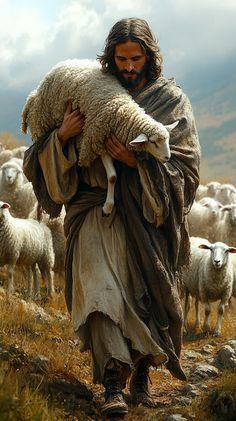
The first reading was from Ezekiel 34. While I have long been familiar with and fond of the Gospel passages about Jesus as the Good Shepherd, I tend to forget that His claim on that title was a direct fulfillment of God’s portrayal of Himself in the Old Testament. It is a portrayal of both tenderness and leadership.

I myself will look after and tend my sheep…. I will rescue them from every place where they were scattered when it was cloudy and dark…. I will lead them…. I will bring them back… and pasture them…. I myself will give them rest, says the Lord God. The lost I will seek out, the strayed I will bring back, the injured I will bind up, the sick I will heal, but the sleek and the strong I will destroy, shepherding them rightly (Ezekiel 34:11-16, edited).

This is not a distant, aloof God. This is a dedicated, leading, determined, caring God. And this is the same God who spoke in that day’s gospel passage, inviting the citizens of heaven to rejoice with Him over the repentance and restoration of a single one of His beloved flock (Luke 15:6-7).

The Sacred Heart of Jesus, the seat of His love and mercy, is the heart of a shepherd – of the Good Shepherd.

A couple weeks ago, we celebrated a beloved saint, St. Pio of Pietrelcina, mostly known as Padre Pio. He spoke countless wise words in his lifetime and one of my favorite quotes is a favorite of many: “Pray, hope, and don’t worry. Worry is useless. Our merciful Lord will listen to your prayer.” I imagine that if Padre Pio shared such advice with any of the men and women who sat before him during the up to 10 hours of daily confessions he used to hear, many of them would have asked ” how?” How do we not worry? How is that possible?

When I asked that question myself in prayer, the Spirit whispered immediately, “Because you are cared for by a shepherd with a perfect heart of love.”

A shepherd does not let his sheep wander where harm awaits them. He provides boundaries that do not restrict but rather clarify where they are provided for and safe. When his sheep do stray, he does not write them off and abandon them. He seeks them out. He combats the peril they’ve walked into and restores them to where they belong. The shepherd keeps watch. The sheep do not need to worry. They need only remain in the presence of their shepherd.

Do not worry. The One who watches over you never sleeps. (Psalm 121:3-4) Do not be afraid. The Lord who loves you is your rock, fortress, refuge, and shield. (Psalm 18:2) Cast aside anxiety and undue stress. He leads you to rest and restoration. (Psalm 23:2-3)

Do not worry. You are loved and led by the Good Shepherd.

Catholicism, Faith, Holiness, Jesus, Love, Personal Reflection, Prayer

The Heart of Jesus – Pt 1

By human understanding and language, the heart is the seat of love. It is the place from which comes goodness and virtue. When we speak passionately or honestly, we are speaking from the heart. When we love someone to a particularly high degree, we give them our hearts and it is considered the most valuable gift one can offer another.

Jesus, fully God and fully human, loves us with divine love from his human heart. In the Sacred Heart – our ancient and holy title for the seat of our savior’s love – resides his perpetual care and desire for us, as well as his glorious character. All virtues and fruits of life, all in which we could seek to grow in our own hearts, exist in perfection and fullness in the Lord’s heart. Be it courage, wisdom, generosity, understanding, honesty, strength, or any other trait we might pursue, it flows from the bottomless well of the Sacred Heart of Jesus.

Great and wondrous, selfless and sacrificial, God’s remarkable love is offered by way of his heart. As a groom offers himself to a bride at the marriage altar, and the bride matches him in return, Jesus holds his heart out to us. He offers his wholehearted devotion, his mercy, his protection – all that makes up his love – by giving us his beautiful heart.

He invites us to match him in the offering. We cannot match Jesus in the perfection and fullness, yet that does not lessen his desire to receive our hearts, our devotion, and our love.

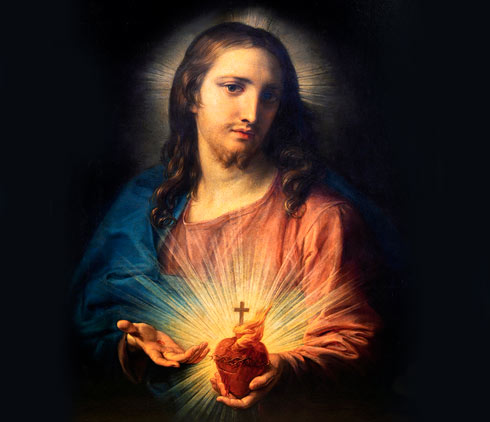
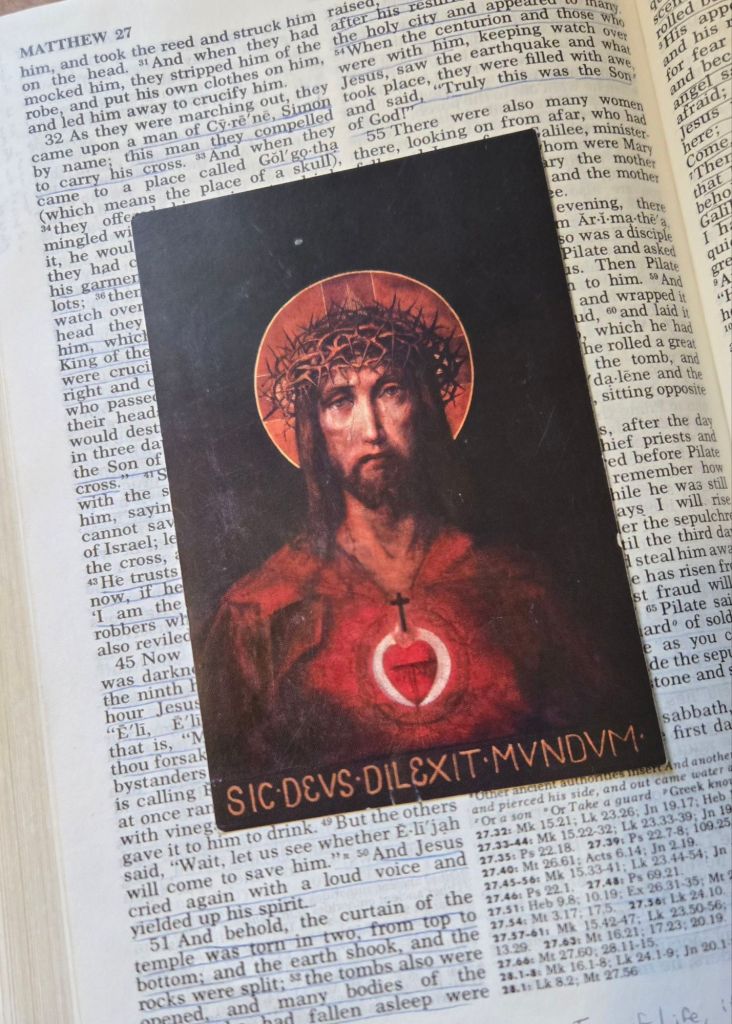
These realities course through my thoughts as I sit before an image of Jesus. It is a mere copy of a lovely old painting; one artist’s imagining of the gentle, solicitous expression of our savior offering his love to us in the symbolic seat of that love. His heart, radiant with light and wrapped in the crown of thorns worn when he died for us, is held out in invitation. Take it, he whispers to my soul. I am yours and you are mine, if you so choose.

The Sacred Heart of Jesus by Pompeo Batoni, 1767
Personal Reflection, The Hidden Legacy, Writing

From Scratch

There’s a longing in my spirit to write. Let me be specific. I long to write consistently, fruitfully, confidently, and readily. Each of these descriptors that applied to my writing life now feels lost. When I think of how it used to be, how easily I could sit down with a pen and a notebook and write, it feels like a devastating defeat to be where I am now. It feels like I am nowhere.

How often what is felt is not the whole truth. Sometimes it is not the truth at all.

Now I find myself seemingly even more fixed in this low spot. The publisher of my novel is closing its doors. The wonderful couple who founded and ran the company are retiring and they are not seeking new ownership or leadership. Simply put, this means The Hidden Legacy will become an out-of-print book. I will use a significant portion of my savings to purchase copies so I can continue to promote and sell it myself. That will be the end of them though. The rights to the original manuscript will revert to me, giving me the opportunity to seek a new publisher or self-publish it.

When I received this news last week, the defeat felt solidified. No matter how full I am of the discouragement that has accumulated over the last five years though, the ache to write never leaves. I carry an enduring certainty that it is a key piece of the person God designed when He created me. The desire to create via the written word, and the joy that sparks into little flames on the rare occasions I do write; these have not left me. The entire situation would be easier by a longshot if I were free of that pull inside me.

It is painful, to be frank. But if the struggle is painful, how much worse it would be to wave the white flag. The resignation, the acceptance of defeat as a writer, is a darkness I refuse to step into. I live with it hovering in my presence and I am in a constant fight to keep my back to it.

With some darknesses, the only way through is through. That was the case with the griefs that took me into these dry years. That is the case with the restoration the Lord is working in me. The temptation is to wait out this darkness and dryness, counting on the ease and inspiration to eventually return. That is the temptation, yes, but it is the opposite of the Lord’s prompting each time I take it to prayer.

I will count on consistency. I will count on discipline and accountability. I will count on trust. I will count on God’s promises to fulfill the desires He has written on our hearts. I will count on Him bearing fruit where I no longer know how to bear it.

Why share this here? Why is this anything other than a personal journal entry? I suppose it’s because I’m tired of meeting every “Are you still writing?” inquiry with a shrug, a false half-smile, and “Yeah, it’s just going slowly.” Oh, the countless times I’ve had that exact exchange! Always with the temptation to instead say, “No, I’ve failed at that. It’s done.” Always with my mind packed full of discouraging words of disappointment in myself. I come away from that exchange every single time feeling like a liar; like I’ve misled the person and eventually they will discover the deception. That is why I’m putting these sentences here instead of in my journal. There is no deception here. No misleading. Only honesty and open admission of the realness of where I am as a writer.

Starting from scratch then, here I am. I refuse to put away the pen. May the Lord bring what He will from it.

Catholicism, Faith, Good Friday, Holiness, Hope, Jesus, Lent, Personal Reflection, Prayer, Scripture

The Good of That Friday

My sins are nailed on the cross with my Jesus.

My mistakes.

My failures.

My shortcomings.

My selfishness.

My self-loathing.

My rejections.

My punishments.

My shame.

They are nailed to the cross in the hands of Jesus and thus I can no longer hold them in mine.

With the repentant criminal beside him, I plead “Jesus, remember me when you come into your kingdom,” and he assures me that he does. He remembers me. He remembers the me known by the Father even before I was formed in my mother’s womb, stripped of the sins that mar that creation. With his arms spread on the bloody cross, he moves my sin and shame away from me, as far as east is from west.

This is the redemption of Christ. This is the good of that incredible, unmerited Friday.

Faith, Personal Reflection, Prayer, Scripture

The Two Faces of Still

I have spent what feels like plenty of time growing my knowledge of the effects of trauma, the stages of healing from it, and the gentle patience required to do so. No matter the amount of understanding though, there are days when it all seems to be taking too long. How can these things of the past still weigh so heavily? How do they still influence my emotions as often as they do? Why am I still discovering what sets off my trauma responses?

Still, still, still.

“It’s taking too long, Lord!” I have cried out on more than one occasion.

In those instances, He patiently reminds me that the time spent healing is still small; still disproportionate to the years spent on the receiving end of the relevant experiences. My therapist’s words repeat in my mind, “It’s still early.”

Still, still, still.

How tremendously often that word arises. It happened again last night. I was caught up in the undesirable realities that linger. I am still not writing with any ease. I am still fearful of connection and relationship. I still can’t fall asleep many nights. I still succumb to overwhelm in the face of trauma-triggering circumstances.

“It’s still taking too long, Lord!”

This morning, God invited me to push back and flip that word around. He nudged me to claim it for better things.

“The Lord will fight for you; and you have only to be still” (Exodus 14:14, RSV).

“Be still, and know that I am God; I am exalted among the nations, I am exalted in the earth!” (Psalm 46:10, RSV).

“He awoke and rebuked the wind, and said to the sea, ‘Peace! Be still!’ And the wind ceased, and there was a great calm” (Mark 4:39, RSV).

“Now therefore, stand still and see this great thing which the Lord will do before your eyes” (1 Samuel 12:16, RSV).

How different “still” can be from one meaning to the next. I wrestle with all that I strive to release and from which I long to be free. God instructs and invites me, even commands me, to be still.

Me. The storms. The discontent, the fighting, and the fear. Be still.

One detail I note from those verses and others is the stillness occurs in the presence of the Lord as well as right in the circumstances requiring His grace. Amongst the waves and in the thick of the waiting, when what lies ahead remains unknown, and in the face of the fight at hand, I can come before Him and be still.

Be still. God is present.

Be still. God fights.

Be still. God calms.

Be still. God restores.

Be still. God reigns.

Photo by Carrie Sue Barnes