Catholicism, Easter, Eucharist, Faith, Good Friday, Gratitude, Holiness, Holy Thursday, Jesus, Lent, Love, Personal Reflection, Prayer, Scripture

These Lavishly Holy Days

The Triduum. My favorite days of the whole year. Holy Thursday has dawned here in Wisconsin with sleet and rain. There’s ice coating the tree branches outside my window. It’ll melt as the rain continues and the temperature rises, but for now, the weather is encouraging me to sit here at my desk with a blanket over my legs and a stack of thoughts to write down.

The first layer in the stack came a week ago, while I knelt in adoration of Jesus during a holy hour at church. There is no quiet so calming as the silent church with Jesus present, where “I look at Him and He looks at me,” as St. John Vianney put it. I opened my Bible to Isaiah, intending to read some familiar encouragement in chapter 55, but instead pausing at chapter 64.

“While you worked awesome deeds we could not hope for, such as had not been heard of from of old. No ear has ever heard, no eye ever seen, any God but you working such deeds for those who wait for him” (Isaiah 64:2-3, NAB).

I held that passage in my heart while I looked upon Jesus, upon God, hanging on a cross over a simple altar. I looked at Him on that little altar, in that mysterious, amazing Eucharist, and the marvelousness of His deeds rushed over my senses.

Look at how you are loved, the Holy Spirit whispered to my heart.

The whisper stayed with me as I went about the rest of my day and the days that followed. Then came Palm Sunday and during Mass my mind caught on one verse after another in the scripture readings of the Mass.

“The Lord God has given me a well-trained tongue, that I might know how to answer the weary a word that will waken them” (Isaiah 50:4, NAB)

“[Christ Jesus], though he was in the form of God, did not regard equality with God something to be grasped. Rather, he emptied himself, taking the form of a slave, coming in human likeness; and found human in appearance, he humbled himself, becoming obedient to death, even death on a cross” (Philippians 2:6-8, NAB).

Then came the Gospel passage. As the whole passion narrative from Matthew was proclaimed, I saw again and again the willingness of Christ. It was there quite plainly in His acceptance of His betrayer amongst His friends, in His passionate prayer in the garden, in His reception of the betrayer’s kiss and the arrest that followed. As the verses continued through Jesus’s testimony before the public and religious authorities, His beatings and abuse, and finally His steps toward the killing place, it was uninterrupted willingness. In our human language, we read of Jesus being led and placed where His enemies wanted Him to go, but all we know of His divinity tells us that no one could have moved Him without Him choosing to move. He allowed those whips to strike Him and that crown of thorns to draw His blood. He submitted to those nails driven through His skin and tissue and bones. Nothing and no one held power over Christ, yet He hung on a cross and surrendered His soul to death.
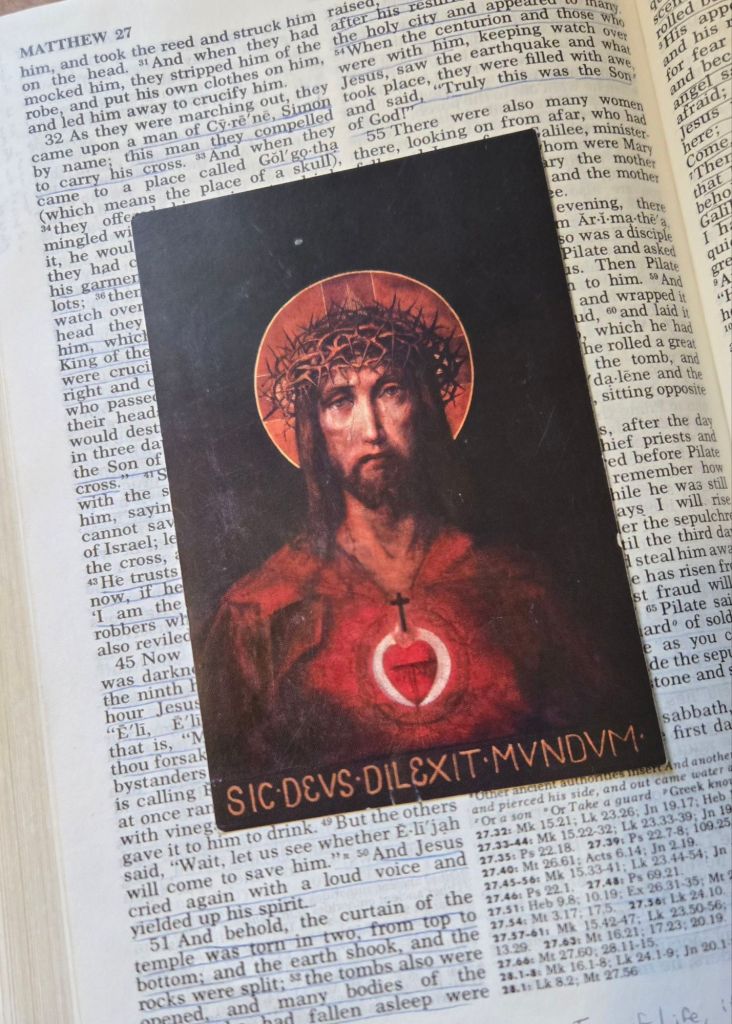
Through each piece of the story, I saw His ready obedience to the Father as a willing sacrificial lamb. When the simplest display of divine authority and power could have silenced every accusation and call for His destruction, He instead moved in humble vulnerability and total submission to the Father’s will.

A willing sacrificial lamb. This is what the Divine Word, by which all creation came to be, chose to become for our sake. From everlasting glory beyond our comprehension, He entered human history as a tiny, vulnerable child. He moved through the world He created as a son, a laborer, a friend, and eventually a teacher and miracle worker who took every step forward within the Father’s will, no matter the cost. In fact, He did all of it because of the cost.

The Sunday liturgy continued and I fought against tears as the images of His sacrifice continued flashing in my mind’s eye. I kept up the fight until I walked forward to receive the Eucharist. I returned to my seat with tears streaming down my cheeks. My shoulders shook a little as I knelt down to give thanks to Him who not only died for me but also gave me His own self to receive at every Mass, fulfilling His startling words in the gospel of John, chapter 6. It struck me deep in my heart that Jesus never stops offering Himself to us in the most humble and vulnerable ways. It is such a beautiful love by which He loves us, isn’t it?

After Mass, I wasn’t ready to leave. I knelt down again and prayed a Divine Mercy chaplet. While I meditated on Christ’s sacrifice, words from St. John came forth.

“See what great love the Father has lavished on us, that we should be called the children of God” (1 John 3:1a, NIV).

It was that particular translation of the verse that danced through my thoughts as I prayed. Lavish is an excellent word. Its synonyms include unrestrained, extravagant, and excessive. The lavishness of God’s love is worthy of awe and our own full submission to His perfect will. The lavishness of Christ’s sacrifice is worthy of humble but abundant thanksgiving on our part. And the lavishness of God’s grace flowing through the sacraments is an unrestrained, extravagant, excessive source of life for all who receive it.

As we embark on the holiest days of the year, I pray that all remnants of hesitation or indifference will fall away from our souls to be replaced with faith, gratitude, and a joyful, loving obedience to the Father, the Son, and the Holy Spirit.
Catholicism, Faith, Holiness, Jesus, Love, Personal Reflection, Prayer

The Heart of Jesus – Pt 1

By human understanding and language, the heart is the seat of love. It is the place from which comes goodness and virtue. When we speak passionately or honestly, we are speaking from the heart. When we love someone to a particularly high degree, we give them our hearts and it is considered the most valuable gift one can offer another.

Jesus, fully God and fully human, loves us with divine love from his human heart. In the Sacred Heart – our ancient and holy title for the seat of our savior’s love – resides his perpetual care and desire for us, as well as his glorious character. All virtues and fruits of life, all in which we could seek to grow in our own hearts, exist in perfection and fullness in the Lord’s heart. Be it courage, wisdom, generosity, understanding, honesty, strength, or any other trait we might pursue, it flows from the bottomless well of the Sacred Heart of Jesus.

Great and wondrous, selfless and sacrificial, God’s remarkable love is offered by way of his heart. As a groom offers himself to a bride at the marriage altar, and the bride matches him in return, Jesus holds his heart out to us. He offers his wholehearted devotion, his mercy, his protection – all that makes up his love – by giving us his beautiful heart.

He invites us to match him in the offering. We cannot match Jesus in the perfection and fullness, yet that does not lessen his desire to receive our hearts, our devotion, and our love.

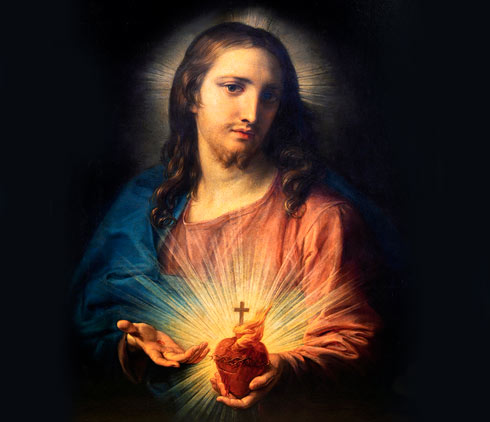
These realities course through my thoughts as I sit before an image of Jesus. It is a mere copy of a lovely old painting; one artist’s imagining of the gentle, solicitous expression of our savior offering his love to us in the symbolic seat of that love. His heart, radiant with light and wrapped in the crown of thorns worn when he died for us, is held out in invitation. Take it, he whispers to my soul. I am yours and you are mine, if you so choose.

The Sacred Heart of Jesus by Pompeo Batoni, 1767
Advent, Catholicism, Christmas, Faith, Hope, Jesus, Love, Prayer, Scripture

Nothing Will Be Impossible – Advent Reflection, December 24th

Week 4, Sunday – December 24th

For nothing will be impossible for God.

Luke 1:37

With God, it is possible. These words from the archangel Gabriel are the only ones he needed to speak when Mary asked, “how can this be?”

Gabriel explained some things first, helping Mary to understand and thus helping us many generations later. He gave Mary insight into how she would bear the Son of God. He went on to offer a bit of supporting evidence in Elizabeth’s pregnancy, which Mary could confirm for herself and thus build her confidence in the angel’s message. Yet it is only his final words to her that answered the question of how these things could occur.

“For nothing will be impossible for God.” This alone elicits Mary’s fiat, her yes to God’s invitation to take up her incredible and unique role in humanity’s salvation. It is likewise the only truth necessary to elicit my own fiat.

To whatever God asks of me; to what work of His hands He calls me to participate in; to whom He asks me to serve; my yes arises from knowing that nothing is impossible for Him. I am not asked to do any of it on my own abilities and strength alone. I am invited to count on Him.

Hardships. Hurt. Illness. Grief. Trauma. Every single cross I am invited to carry in my following of Him. No less, the joys and successes; the opportunities, adventures, and marvelous blessings as I walk with Him. Every single one can be taken up with the hopeful cry, “Nothing is impossible for You, Lord!”

In all things requiring faith, my faith must stand upon two simultaneous truths: nothing is impossible for God, and God is love. In these I know and believe that God is capable of accomplishing what He sets out to do – no matter how impossible it may seem to me – and that what He sets out to do is always for my greatest good.

Is there any finer example of these great truths than the Incarnation? God becoming man in the humblest manner. God coming to live with us, serve our punishment of death, and defeat its hold on our souls. God opening the gates of heaven to every person who chooses to follow and believe. It is a most impossible plan, absurdly defying human logic and wisdom. Yet He does it, and He does it all for love of us.

With God, it is all possible. With God. it is all love.

Advent, Catholicism, Christmas, Gratitude, Jesus, Love, Prayer, Saints, Scripture

Good to Be Here – Advent Reflection, December 21st

Week 3, Thursday – December 21st

When Elizabeth heard Mary’s greeting, the infant leaped in her womb, and Elizabeth, filled with the Holy Spirit, cried out in a loud voice and said, “Most blessed are you among women and blessed is the fruit of your womb. And how does this happen to me, that the mother of my Lord should come to me?”

Luke 1:41-43

I write this from a seat in my local parish church, putting my pen to the page in between gazes at my Lord in the Eucharist. There are a dozen or more others scattered through the pews, each in quiet prayer of adoration. I see only Him though, held in a shining, golden monstrance on the altar. The words of St. Peter on the mountain of Christ’s transfiguration keep repeating in my ears.

Lord, it is good for us to be here. It is good for us to be here.

After some time, the Holy Spirit shifts the words in my mind.

How good it is of you, Lord, to be here with us.

With the Incarnation of the Son on the first Christmas, God came to live among us. In baptism, He makes our souls His dwelling place. In the Eucharist, He becomes the Bread of Life to sustain us.

What goodness, what generosity, what love there is in the Lord’s choice to be here. How kind and merciful. How marvelous. When the Lord came to her, Elizabeth’s soul and even the child within her recognized His presence. She responded with joy and awe, speaking in grateful praise. I pray that my soul responds similarly to Christ’s presence.

How good it is that He comes to us. How good it is of Him to be Emmanuel, God With Us.

Advent, Catholicism, Christmas, Faith, Hope, Jesus, Love, Prayer, Scripture

Like Sheep, or Cows, or Humans – Advent Reflection, December 9th

Week One, Saturday – December 9th

At the sight of the crowds, his heart was moved with pity for them because they were troubled and abandoned, like sheep without a shepherd.

Matthew 9:36, NAB

Cows used to wander into our yard from the neighboring farm when I was growing up in Michigan. The cows escaped the grazing field’s fences a few times a year and clomped up the road to my parents’ property. Vehicles needed to avoid them, their hooves tore up our grass, and one even kicked a large, lovely dent in our car door. Oh, and they pooped. A lot.

It was messy and aggravating. Yet, I always felt a little sorry for those wandering cows. When the farmer showed up to herd them back home, usually with my dad’s assistance, I imagined the cows felt the cow version of relief, and that the familiar ground and boundaries of the farm brought a sense of safety. “This is where I belong. It is good to be here with you,” they’d say in the language of Moos as they gazed at the farmer with their big, dark eyes.

Maybe if Jesus hailed from the Midwest, the crowds of people would have reminded Him of cows without a farmer. No matter the livestock comparison though, Jesus looks on us the same way. He sees us break through boundaries that only exist for our wellbeing. He understands our curiosity and tendency to wander, and He is aware of the resulting wounds. Like a caring shepherd or farmer, He goes out to find us. He meets us not with anger and condemnation, but with compassion and wisdom.

I have a picture on my wall that says, “Dear one, you are not being condemned. You are being rescued.” I put it up while I was deep in the turmoil of changing my life. The changes couldn’t come without acknowledgement of the ways I’d chosen to walk away from God and the life I was meant to lead. With that acknowledgement came the great gift of forgiveness, yet I struggled every day with harsh judgment of myself. God had cast aside my sin as soon as I asked, but I still clung to it and let it slow down every step I was making toward Him.

Like Jesus looking at the crowd in the Gospel story, He looked on me with pity. Through times in prayer and reading God’s word, and through voices sent into my life to speak truth and share love, Jesus met me where I stood in the crowd. He and the ones He sent reached out to untangle my feet from the briars of sin and its aftermath. He saw me as worthy of rescuing, and for that I thank Him daily.

We’re all in the crowd. We’re all in need of our divine shepherd. In preparing for Christmas, let us prepare for the great celebration of our shepherd’s arrival. He comes to rescue. He comes to heal. He comes to love.

Advent, Catholicism, Christmas, Faith, Jesus, Love, Saints, Scripture

The Wonder of God’s Choice – Advent Reflection, December 8th

Week One, Friday – December 8th

Brothers and sisters: Blessed be the God and Father of our Lord Jesus Christ, who has blessed us in Christ with every spiritual blessing in the heavens, as he chose us in him, before the foundation of the world, to be holy and without blemish before him.

Ephesians 1:3-4, NAB

Say it about yourself.

This was advice I received once when I was struggling to see the promises of God as applicable to me. I felt like I was watching the goodness from a distance. I’m susceptible to reading and speaking of the marvelous love and works of God only in large scale, all-humanity terms. Doing so protects me from the vulnerability of the personal nature of divine love. In a contemplative vision of Jesus, St. Teresa of Avila once heard Him say that He would create the universe again just to hear her say that she loves Him. A love that deep is entirely personal and invites the vulnerable surrender of my heart to His. Since vulnerability scares the daylights out of me, I’m learning to look that fear in the face and say the truth about myself.

Blessed be the God and Father of my Lord Jesus Christ.

He has blessed me in Christ with every spiritual blessing.

He chose me in Him, before the foundation of the world.

He chose me. He chose me. I get stuck on that one (in a good way) and find it only makes sense from God’s perspective, not mine.

I wonder if Mary got stuck on it too. It’s easy enough to imagine. After the angel Gabriel’s declaration that she had found favor with God, she may have marveled, “He chose me.” With her massive act of faith in saying yes to God’s plans , she perhaps let it sink in – the honor of it all – with the thought, “He chose me.” And “He chose me” might have been the reassurance she rested upon while facing the questions of how and why and what was to come.

God didn’t choose me to be the mother of my Lord, but He did choose me to be who I am. He prepared the avenue for my existence from farther back than centuries of generations. He ordained the ways my life could build the Kingdom of God, if I say yes to His plans. The people I have the opportunity to love, God saw fit to make me the one to give that love. He placed in me the voice I carry and its potential to deliver truth, beauty, and goodness. He designed by His hand the spiritual gifts I could possess.

He chose Mary.

He chose Joseph.

He chose Peter.

He chose John.

He chose Paul.

He chose me.

He chose you.

From before the foundation of the world.

Say it about yourself: He chose me. I choose Him.

Advent, Catholicism, Faith, Jesus, Love, Prayer, Scripture

Build It on the Rock – Advent Reflection, December 7th

Week One, Thursday – December 7th

Everyone who listens to these words of mine and acts on them will be like a wise man who built his house on rock.”

Matthew 7:24, NAB

“Why didn’t you tell me?!”

“I did tell you!”

If I had a nickel for every time I’ve been in that argument, I’d pay all my bills in nickels. Of course, I’ve occupied both sides of it, and since it only ever happens between me and another imperfect person, I’ve been both in the right and in the wrong.

There is only one person with whom I could never possibly win this argument. I can picture it now… me standing beside Jesus on the edge of heaven while He speaks of my life in full truthfulness. “Why didn’t you tell me?” I’d exclaim. Jesus would give me that look that says, “Really?” and I’d know better than to continue.

How awful it feels when I’m on the “why didn’t you?” side of the debate. There is a feeling of helplessness when I realize I didn’t know what I needed to know. It’s compounded by the aspect of betrayal when I also discover that someone did know and didn’t tell me. No matter how minor or major the missing information, it stings each time.

God loves us too much to not tell us. He loves us too perfectly to leave us vulnerable to that unsettling experience. He is never negligent. He is not forgetful or subject to error. He gives us the truth in love and will not let us be caught unaware.

In speaking of the one who “listens to these words and acts on them,” the Lord sets the expectation. I read that passage and hear Jesus whispering in my heart.

Yes, the truth of the gospel should change things. You aren’t imagining it. My love really is what makes all the difference. And if it doesn’t make a difference, your house is on the sand.

The truth should prompt action. I don’t get to hear of God’s saving love for me and remain unchanged. At least, not if I want to meet the open gaze of my savior and say to him, “Lord, Lord,” as He leads me into the splendor of heaven.

There will be storms, with buffeting winds and waves, on the way there. Yet faith tells me I do not need to be afraid of any change God may lead me into. In listening to Him, I am equipped to build a storm-surviving house on the rock. His words are meant for me. The arrival of Jesus is not only the turning point for the individuals who encounter Him on the gospel pages, it is my turning point. It must be.

Lord, be my turning point. Be the cause of every change You desire to effect in me. May I listen and act, and stand upon You, my rock and my salvation.