
Catholicism, Easter, Eucharist, Faith, Good Friday, Gratitude, Holiness, Holy Thursday, Jesus, Lent, Love, Personal Reflection, Prayer, Scripture

These Lavishly Holy Days

The Triduum. My favorite days of the whole year. Holy Thursday has dawned here in Wisconsin with sleet and rain. There’s ice coating the tree branches outside my window. It’ll melt as the rain continues and the temperature rises, but for now, the weather is encouraging me to sit here at my desk with a blanket over my legs and a stack of thoughts to write down.

The first layer in the stack came a week ago, while I knelt in adoration of Jesus during a holy hour at church. There is no quiet so calming as the silent church with Jesus present, where “I look at Him and He looks at me,” as St. John Vianney put it. I opened my Bible to Isaiah, intending to read some familiar encouragement in chapter 55, but instead pausing at chapter 64.

“While you worked awesome deeds we could not hope for, such as had not been heard of from of old. No ear has ever heard, no eye ever seen, any God but you working such deeds for those who wait for him” (Isaiah 64:2-3, NAB).

I held that passage in my heart while I looked upon Jesus, upon God, hanging on a cross over a simple altar. I looked at Him on that little altar, in that mysterious, amazing Eucharist, and the marvelousness of His deeds rushed over my senses.

Look at how you are loved, the Holy Spirit whispered to my heart.

The whisper stayed with me as I went about the rest of my day and the days that followed. Then came Palm Sunday and during Mass my mind caught on one verse after another in the scripture readings of the Mass.

“The Lord God has given me a well-trained tongue, that I might know how to answer the weary a word that will waken them” (Isaiah 50:4, NAB)

“[Christ Jesus], though he was in the form of God, did not regard equality with God something to be grasped. Rather, he emptied himself, taking the form of a slave, coming in human likeness; and found human in appearance, he humbled himself, becoming obedient to death, even death on a cross” (Philippians 2:6-8, NAB).

Then came the Gospel passage. As the whole passion narrative from Matthew was proclaimed, I saw again and again the willingness of Christ. It was there quite plainly in His acceptance of His betrayer amongst His friends, in His passionate prayer in the garden, in His reception of the betrayer’s kiss and the arrest that followed. As the verses continued through Jesus’s testimony before the public and religious authorities, His beatings and abuse, and finally His steps toward the killing place, it was uninterrupted willingness. In our human language, we read of Jesus being led and placed where His enemies wanted Him to go, but all we know of His divinity tells us that no one could have moved Him without Him choosing to move. He allowed those whips to strike Him and that crown of thorns to draw His blood. He submitted to those nails driven through His skin and tissue and bones. Nothing and no one held power over Christ, yet He hung on a cross and surrendered His soul to death.
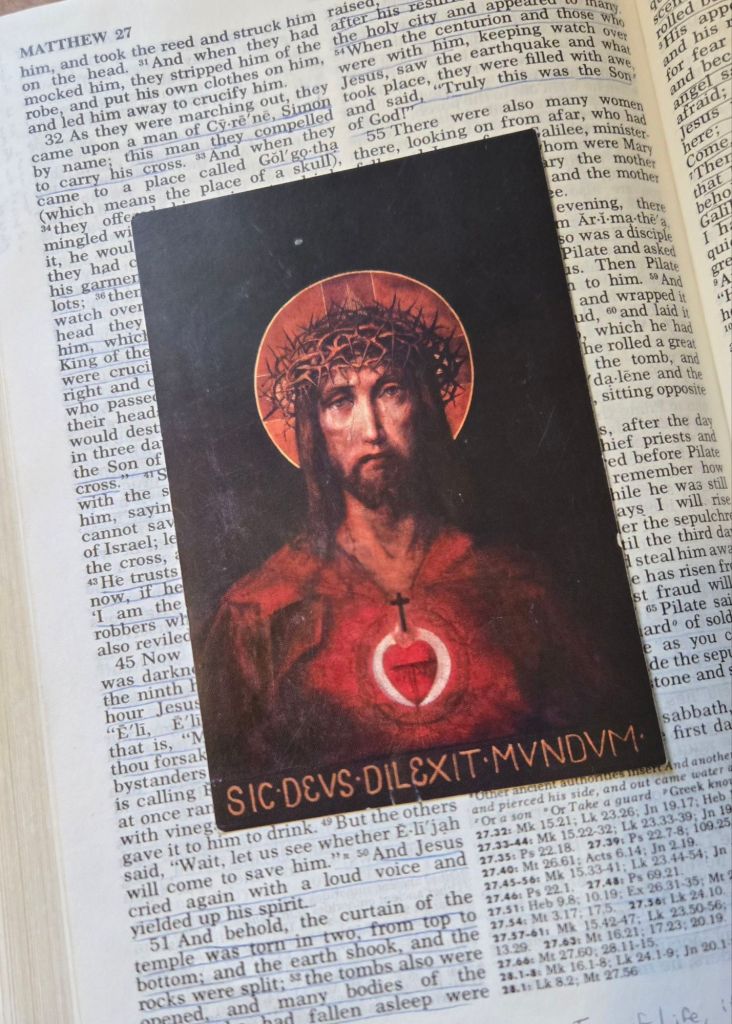
Through each piece of the story, I saw His ready obedience to the Father as a willing sacrificial lamb. When the simplest display of divine authority and power could have silenced every accusation and call for His destruction, He instead moved in humble vulnerability and total submission to the Father’s will.

A willing sacrificial lamb. This is what the Divine Word, by which all creation came to be, chose to become for our sake. From everlasting glory beyond our comprehension, He entered human history as a tiny, vulnerable child. He moved through the world He created as a son, a laborer, a friend, and eventually a teacher and miracle worker who took every step forward within the Father’s will, no matter the cost. In fact, He did all of it because of the cost.

The Sunday liturgy continued and I fought against tears as the images of His sacrifice continued flashing in my mind’s eye. I kept up the fight until I walked forward to receive the Eucharist. I returned to my seat with tears streaming down my cheeks. My shoulders shook a little as I knelt down to give thanks to Him who not only died for me but also gave me His own self to receive at every Mass, fulfilling His startling words in the gospel of John, chapter 6. It struck me deep in my heart that Jesus never stops offering Himself to us in the most humble and vulnerable ways. It is such a beautiful love by which He loves us, isn’t it?

After Mass, I wasn’t ready to leave. I knelt down again and prayed a Divine Mercy chaplet. While I meditated on Christ’s sacrifice, words from St. John came forth.

“See what great love the Father has lavished on us, that we should be called the children of God” (1 John 3:1a, NIV).

It was that particular translation of the verse that danced through my thoughts as I prayed. Lavish is an excellent word. Its synonyms include unrestrained, extravagant, and excessive. The lavishness of God’s love is worthy of awe and our own full submission to His perfect will. The lavishness of Christ’s sacrifice is worthy of humble but abundant thanksgiving on our part. And the lavishness of God’s grace flowing through the sacraments is an unrestrained, extravagant, excessive source of life for all who receive it.

As we embark on the holiest days of the year, I pray that all remnants of hesitation or indifference will fall away from our souls to be replaced with faith, gratitude, and a joyful, loving obedience to the Father, the Son, and the Holy Spirit.

Advent, Catholicism, Christmas, Faith, Holiness, Jesus, Prayer, Saints, Scripture

Like Joseph Did – Advent Reflection, December 18th

Week 3, Monday – December 18th

When Joseph awoke, he did as the angel of the Lord had commanded him and took his wife into his home.

Matthew 1:24

Each time I read a gospel passage involving Joseph, I wish he’d speak up. This man lived with Jesus and Mary! He was the human father figure for the Son of God! Imagining his experiences fascinates me. For goodness’ sake, I want to hear from him!

Sorry, didn’t mean to get so worked up there.

Having no record of Joseph’s words does not mean he didn’t say anything. That’s a silly notion. So, why are there no statements or dialogue from him? Believing in the divine inspiration of sacred scripture, I come to one conclusion: what I read of Joseph is what God wanted me to get from Joseph.

Matthew writes that Joseph is a righteous man, and from this righteousness comes his planned course of action: to divorce Mary quietly after he found out about her pregnancy. For though they had already entered a marriage bond by Jewish betrothal, they did not yet live together or have relations as husband and wife. A righteous man among the Jewish people was one who followed God’s laws and commandments. Joseph would have been lawful to not only divorce Mary for her assumed infidelity but also to publicly shame her and even call for her to be stoned to death.

Joseph’s righteousness, however, is clearly coupled with compassion. He does not wish to associate himself with apparent sin and scandal but he also does not desire to publicly punish Mary. A quiet divorce was an act of mercy when Joseph’s possible choices are considered.

I am certain Joseph, being prone to righteousness and mercy, took such serious matters to prayer. I expect he sought out God for guidance. No record of his prayers are in the pages of scripture. What is recorded is God’s answer, and Joseph’s response to it.

God sent an angel while Joseph was asleep. Joseph went to bed that night with a decision made, then awoke with that decision trumped by God’s explanations and instructions. There, at that awakening, is where I am most eager to emulate Joseph.

He did not wake up and write off God’s message as irrational to follow. He didn’t hem and haw, mulling over doubts about what would happen if he did as God said to do.

Joseph awoke and did as God commanded. Once God made the way clear, Joseph stepped into it and no longer considered the other ways he could go, even though they likely felt safer and more reasonable.

From Joseph, I learn of faith producing the necessary fortitude to be who God calls me to be in the grand story of salvation. Joseph’s faith told him to listen to God and to trust in what he heard. It does not take a single word from Joseph for him to tell me likewise. That’s the might of authentic faith. That’s the fruit such faith bears.

Joseph’s piece in the story demonstrates that complex situations reach their best outcomes when submitted to God’s will. Like Joseph, I am not necessarily called to figure it all out and determine the best course of action by my reasoning alone. I am called to seek the guidance of God, and respond with trusting obedience to Him. It is encouraging that, in practicing this, that reasoning of mine can grow little by little to resemble the wisdom of God.

No matter the gap between my answers and the Lord’s, I pray that any time I am awakened to the instructions of God, I will rise and obey with a heart full of faith. Like Joseph did.

Advent, Christmas, Faith, Jesus, Prayer, Saints, Scripture

The Soul’s Joy – Advent Reflection, December 17th

Week 3, Sunday – December 17th

I rejoice heartily in the Lord, in my God is the joy of my soul.

Isaiah 61:10a, NAB

During my last conversation with my oldest sister, she lie in bed sapped of physical strength, enduring pain without pause, and speaking to me of joy. Joy. She held my hand and told me how important joy was to life. She begged me to guard and grow joy for myself and my children. My spirit was weighed down with grief. There was no cheerfulness in that room. Sadness saturated my heart. And still we spoke of joy.

I’m not sure anything could have been more effective in deepening my understanding of joy; of what it is and what it is not.

Mary had joy in her soul while she waited to know if Joseph would marry her or call for her to be stoned for her pregnancy. Paul had joy in his soul while he endured prison. Pope John Paul II had joy while he hid his priestly ministries from the communist authorities in Poland. Mother Teresa had joy while she was surrounded by endless, unquenchable needs of the ill and impoverished in Calcutta. My sister had joy while cancer stole away the years we all expected her to have on this earth.

God plants joy in the soul, and nurtures it there through the work of the Holy Spirit. Moments of goodness strengthen it, but only God is its true source. It is not an emotion or a state of mind dependent on circumstances.

Joy stands alongside the hope of salvation and the peace of Christ as the pillars of the temple of my soul. It is the condition I can exist in through every storm of suffering. Then in the shining times of happiness, it is the spotlight of perspective. Whether in shadow or sunshine, I have Jesus. I have eternity in the presence of God waiting for me. Therein lies lasting joy.

This third week of Advent is traditionally dedicated to joy. The arrival of Jesus is the arrival of joy in a brand new way. All the many and varied bits of joyfulness God provides are surpassed by the gift of His Son.

When I am exhausted by the work of this season, Lord, anchor me in the abundant joy of Christmas.

When I have reason to smile, Lord, spread the roots of Your joy in my soul.

When my mouth and ears fill with laughter, Lord, let it water the fruit of joy.

When suffering comes my way, Lord, sustain me with the joy of Your promises.

When I am mistreated or rejected, Lord, remind me I am secure in the joy of knowing You.

When I encounter others’ need for You, Lord, make my soul’s joy into a light leading them to You.

Advent, Christmas, Faith, Prayer, Scripture

Splendor and Might – Advent Reflection, December 14th

Week 2, Thursday – December 14th

Let all your works give you thanks, O Lord, and let your faithful ones bless you. Let them make known to men your might and the glorious splendor of your Kingdom.

Psalm 145:10, 12, NAB

I see glorious splendor in every sunrise and sunset. I see it when I sit on the water in my kayak, or stand with my eyes on the twinkling stars. The splendor is there in every season: when the leaves change color and when the frost sparkles on the tree boughs; when flowers bud with new life and when the sun soaks the earth in warmth.

The might of God looms in the mountain peaks and in the canyons carved into the earth. His might sounds across the lands in orchestras of rain and thunder.

As the psalmist describes, the works of God do make Him known to us. The way they point our thoughts and emotions toward goodness – and to God as their source – is how those works thank, glorify, and reveal Him all at once. How generous of our Lord to provide such an endless supply of connection to Him. He must be intensely determined that we know Him and His love.

No work of His hands reveals Him more than the crown of creation: the human person. Every face I look upon, from the tiniest child to the oldest adult, is a glimpse of the face of God. Each smile and each touch hold the splendor of His kingdom. Readily, I recognize the splendor and might in the earth’s great wonders, yet how inconsistent I am in recognizing the same in my brothers and sisters on that earth – and in myself.

As His precious handiwork, I am included in the invitation to make God known to the rest of His creation. I can get caught up in the question of how I can stand in the same category as the incredible displays of God’s beauty, creativity, and intelligence. Or, I can believe that God equips me for anything to which He calls me.

Even when the days and nights feel like drudgery, my life can make God known.

Through the exciting peaks and painful valleys, my life can reveal Him.

If I spread joy, or encourage, or create good from my talents, or forgive, or speak truth in love, my life can give glimpses of the Kingdom of God.

Christmas is the day when God’s splendor and might were revealed in an incredible manner. They were heard in the words of wondrous angels in shepherds’ fields, and they were contained in a beautiful infant messiah asleep on humble hay. Christmas is when we are reminded that God will reveal Himself by His wisest designs, and we need only give our yes for Him to involve us in doing so.

Lord, thank you for making Yourself wholly knowable in Jesus Christ. Keep my eyes upon the gift of every person You create, and the opportunity to encounter You in each one. I pray that You open my eyes to how my life can reveal You to others. Grant me the wisdom and courage to eliminate anything in my thoughts, words, and actions that is an obstacle to my and others’ view of You.

Advent, Catholicism, Christmas, Faith, Gratitude, Prayer, Scripture

All That He Is – Advent Reflection, December 13th

Week 2, Wednesday – December 13th

Do you not know or have you not heard? The Lord is the eternal God, creator of the ends of the earth. He does not faint or grow weary, and his knowledge is beyond scrutiny.

Isaiah 40:28

This passage is as familiar as my favorite sweater. I, like many others, find reassurance in it; a reassurance that has carried me through moments made for weariness. It dawned on me today how much of my fondness for the passage comes from the verses that follow, rather than from the one I quoted here. Those verses speak of soaring and running with renewed strength. They speak of what God does for me.

How can there be so much reassurance in what the scriptures say God can and will do for me? Why am I bolstered by every reminder that the Lord is my strength, or that in Him I can be courageous? The answer, simple and true, is because of who God is. Every facet of His nature builds the most reliable of fortresses.

God’s promises are worth my attention. There is no fault in standing on the grounds of what He has done for me, what He is doing for me, and what He will do for me. In fact, it is what should occur if I am the woman of faith I aim to be.

However, for those grounds to remain standing through the most trying lows, they need to be laid upon the bedrock of God’s nature. In all that He is, I can see both how and why He does what He does. Knowledge of Him leads to glorifying Him, and both lead to a sustained faith across every hill and valley.

Lord, with every praise I might offer, may I love you more for who You are than for what You may accomplish for my sake. In this way, You will render me able to love as You love me.

You are all good. I praise You, Lord.

You are perfect love. I submit to You, Lord.

You are all knowing. I trust You, Lord.

You are eternal. I worship You, Lord.

You are present through the heavens and the earth, without exception. I bow before you, Lord.

You are the creator and sustainer of all life. I owe everything to You, Lord.

You are God, in whose image I am made. I glorify You, Lord.

Advent, Christmas, Jesus, Prayer, Scripture

Behold He Comes, the Shepherd King – Advent Reflection, December 10th

Week 2, Sunday – December 10th

Here comes with power the Lord God, who rules by his strong arm; here is his reward with him, his recompense before him. Like a shepherd he feeds his flock; in his arms he gathers his lambs, carrying them in his bosom, and leading the ewes with care.

Isaiah 40:10-11

More than once in the Bible, it’s pointed out that human understanding is not the same as God’s understanding. His ways differ from our ways, and His wisdom far surpasses ours. One of the best representations of this truth, to my mind, is when I consider the contrasts within God’s nature.

God is the all powerful ruler of the universe. God is a gentle shepherd feeding His sheep.

God is the final judge of all. God is mercy.

God demands justice. God forgives.

And on and on.

Already I’ve defaulted to a limited understanding, for I call these contrasts… contradictions… incongruencies, and those are not words to describe the nature of God.

In God, I find perfect love. In perfect love, I find the harmonious coexistence of authority and judgement with patience and mercy. He is my king. He is my shepherd. When I try to confine God within the walls of my own flawed wisdom, these combinations are mind boggling. Impossible, even.

Thankfully, God cannot be confined. The limitations humanity struggles under – how to seek justice and how to be merciful, for instance – are not limitations to Him. It’s why I can trust Him with the justice I cannot achieve by my own efforts. It is how I can approach God with deep repentance and regret of my sins, and unshakeable confidence that He will welcome me into His loving arms.

Lord, help me to see myself and others in light of who You are, instead of the other way around. I entrust myself to Your judgement and Your mercy. I revere You and I joyfully run to You. Overshadow my wisdom with Yours, my king and my savior.

Advent, Catholicism, Christmas, Faith, Hope, Jesus, Love, Prayer, Scripture

Like Sheep, or Cows, or Humans – Advent Reflection, December 9th

Week One, Saturday – December 9th

At the sight of the crowds, his heart was moved with pity for them because they were troubled and abandoned, like sheep without a shepherd.

Matthew 9:36, NAB

Cows used to wander into our yard from the neighboring farm when I was growing up in Michigan. The cows escaped the grazing field’s fences a few times a year and clomped up the road to my parents’ property. Vehicles needed to avoid them, their hooves tore up our grass, and one even kicked a large, lovely dent in our car door. Oh, and they pooped. A lot.

It was messy and aggravating. Yet, I always felt a little sorry for those wandering cows. When the farmer showed up to herd them back home, usually with my dad’s assistance, I imagined the cows felt the cow version of relief, and that the familiar ground and boundaries of the farm brought a sense of safety. “This is where I belong. It is good to be here with you,” they’d say in the language of Moos as they gazed at the farmer with their big, dark eyes.

Maybe if Jesus hailed from the Midwest, the crowds of people would have reminded Him of cows without a farmer. No matter the livestock comparison though, Jesus looks on us the same way. He sees us break through boundaries that only exist for our wellbeing. He understands our curiosity and tendency to wander, and He is aware of the resulting wounds. Like a caring shepherd or farmer, He goes out to find us. He meets us not with anger and condemnation, but with compassion and wisdom.

I have a picture on my wall that says, “Dear one, you are not being condemned. You are being rescued.” I put it up while I was deep in the turmoil of changing my life. The changes couldn’t come without acknowledgement of the ways I’d chosen to walk away from God and the life I was meant to lead. With that acknowledgement came the great gift of forgiveness, yet I struggled every day with harsh judgment of myself. God had cast aside my sin as soon as I asked, but I still clung to it and let it slow down every step I was making toward Him.

Like Jesus looking at the crowd in the Gospel story, He looked on me with pity. Through times in prayer and reading God’s word, and through voices sent into my life to speak truth and share love, Jesus met me where I stood in the crowd. He and the ones He sent reached out to untangle my feet from the briars of sin and its aftermath. He saw me as worthy of rescuing, and for that I thank Him daily.

We’re all in the crowd. We’re all in need of our divine shepherd. In preparing for Christmas, let us prepare for the great celebration of our shepherd’s arrival. He comes to rescue. He comes to heal. He comes to love.