Faith, Jesus, Scripture

Seeds & Soil

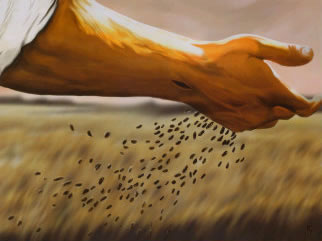
I think it’s a combination of the yard work yesterday and the significant but unresolved discussion last night about the growth of faith. I woke up today with the parable of the Sower in my mind. It’s one of my very favorite passages, possibly my favorite parable, but I haven’t read it in quite some time.

Jesus is speaking, yet again, to a great crowd. He stands in a boat, just off the shore, while the crowd assembles on the beach, eager to hear from this great and mysterious teacher.

And he told them many things in parables, saying: “A sower went out to sow. And as he sowed, some seeds fell along the path, and the birds came and devoured them. Other seeds fell on rocky ground, where they had not much soil, and immediately they sprang up, since they had no depth of soil, but when the sun rose they were scorched; and since they had no root they withered away. Other seeds fell upon thorns, and the thorns grew up and choked them. Other seeds fell on good soil and brought forth grain, some a hundredfold, some sixty, some thirty.” (Matthew 13:3-8)

Later the crowd waits. Jesus is pausing in His preaching and His twelve disciples gather around Him. They question Him on His method. “‘Why do you speak to them in parables?’ And he answered them, ‘To you it has been given to know the secrets of the kingdom of heaven, but to them it has not been given.'” (13:10-11) They likely feel the weight of this privilege, but they realize that they too need help to understand what Jesus has told them. Later they will receive the powerful gift of the Holy Spirit to understand all truth (John 14:26; 16:13) and preach it themselves, but for now they depend upon Christ to enlighten them with His words.

Jesus knows this need and He proceeds to explain to the Twelve, “Hear then the parable of the sower. When any one hears the word of the kingdom and does not understand it, the evil one comes and snatches away what is sown in his heart; this is what was sown along the path. As for what was sown on rocky ground, this is he who hears the word and immediately receives it with joy; yet he has no root in himself, but endures for a while, and when tribulation or persecution arises on account of the word, immediately he falls away. As for what was sown among thorns, this is he who hears the word, but the cares of the world and the delight in riches choke the word, and it proves unfruitful. As for what was sown on good soil, this is he who hears the word and understands it; he indeed bears fruit, and yields, in one case a hundred-fold, in another sixty, and in another thirty.” (13:18-23)

There are so very many things that impress themselves on my mind from this teaching of Christ. I will keep myself to only two here though. One is the role of the Sower. The Sower of “the word of the Kingdom” is God, Himself. When we present ourselves to Him, admitting our need for Him and His Word, He sows. When we hear His Word proclaimed and taught, He sows. When we pray and entrust ourselves to Him, He sows. Even when we are not prepared, not certain, He sows. Faith is a gift of God. It is not created against our will and so we do hold a role in its inception in our hearts, but we cannot create it ourselves. We are to be soil, receivers of the seed of faith sown by our gracious and saving God. Pride would have us believe we can save ourselves. Woundedness would have us believe God will not come through. Modern mindsets would have us believe we can know all things by our own power. But it is God who created us and it is God who has made it clear that we need Him and His Word.

Secondly, the parable lays out a bluntly difficult scenario for those who receive the seeds of faith. Christ presents “whens,” not “ifs.” When the evil one attempts to steal away the seeds; when tribulations and persecutions come because of this faith; when the cares of the world and the desire for the things of this world rise up – these are not hypotheticals and the results when the faith has not yet taken root in good soil are not either. I’ve seen it and experienced it: the uprooting, the withering, the choking out. Good soil… understanding: this is the aim to be taken. To humbly open your heart and mind to truth as revealed by God and proclaimed by His teaching Church. To take up the work of understanding, of growing strong, lasting roots of faith. To let Him take hold by His Word. To “trust in the Lord with all your heart, and do not rely on your own insight. In all your ways make straight your paths.” (Proverbs 3:5-6) To avail yourself of the rich resources of faith. To be a member of the “household of God, which is the church of the living God, the pillar and bulwark of the truth.” (1 Timothy 2:15) To be good soil. And in good soil, oh the gloriousness of the fruit borne by those seeds sown by the Divine Sower.
Catholicism, Faith, Hope, Jesus, Love, Scripture

The Fundamental Decision

(originally written for/printed in “The Bells of St. Mary” parish newsletter)

If questioned on what it means to call yourself a Christian, how might you respond? Do any of the responses that come to mind reach to the heart of what it means to live under the title of Christian?

Pope Benedict XVI looks to the disciple, John, for an answer: “We have come to know and to believe in the love God has for us” (1 John 4:16). This, our pope states, is “a kind of summary of the Christian life.” Indeed, coming to this belief in God’s love is the “fundamental decision” of the Christian’s entire life. Caught up in the ways of the world and settling for rote prayers and surface-only principles, many men and women carry the title of Christian their whole lives without facing this decision. But for those who do face it, this decision brings transformation.

Faith and hope are made possible; perspective on this life in the context of eternity is gained; obedience to God’s commandments becomes an honor; worship provides nourishment of the soul; prayer holds the rich depths of personal conversation with the Holy Trinity. By this fundamental decision to believe in God’s unwavering, self-offering love, the grace gained in the soul at baptism is activated and all aspects of living as a Christian are infused with meaning.

This single fundamental decision can then be reaffirmed in each particular decision to love, serve, obey and worship. In the daily circumstances of family and work and play, all can be placed under the sovereignty of God. A person can then, with practice and maturity, love as a response to Love. Virtue will be preferred to vice not merely to avoid ill consequences but because the heart recognizes and honors the great, unmerited gift of God’s saving love.

For some, the fundamental decision to believe with the whole heart and mind in God’s love is met with hesitation. There are what might be dubbed “fundamental doubts.” (1) How is it possible, with me being me and God being God, that He could love me so completely? (2) Can I ever be sure in my belief? (3) Do I have the capacity to respond well enough if I dare admit the extent of God’s love for me?

To those struggling with the first doubt, Jesus Christ, who is the embodiment of God’s love, points out that He did not come “to call the righteous, but sinners to repentance.” Awareness of our unworthiness need not produce despair but rather humility and a determination to abandon that which would hold us back from the full acceptance of God’s transforming love. It is not in God’s nature to be inconstant or to love partially. Though we know we are undeserving, we need never entertain the question of whether God wholly loves us.

And to the second doubt is offered the response that faith can indeed be certain. Our world equates faith with superstition or unrealistic idealism but truly the faith of the Christian, when understood and experienced, does not fall into either category. Certainty can be gained in the heart as a gift of the Holy Spirit through prayer and self-surrender. Certainty can be gained in the mind by committed, ongoing growth in knowledge and understanding. When there is a question or an instance of confusion, face it and seek answers. A sincere search for truth will always find truth. The authors of Scripture, the writings and lives of the martyrs and the saints, the summary of the faith found in the Catechism of the Catholic Church – all offer their insights for the sake of our edification in faith.

Thirdly, to the question of our capacity to love in response to God’s infinite love, God Himself answered at the dawn of creation: “Let us make man in our image, after our likeness” (Genesis 1:26). Made in the image of God, we are created with the capacity to love as He loves. We can grow ever more faithful, generous, joyful, merciful and forgiving as He is all these things to the fullest degree. There is no limit to our capacity to image Him and therefore honor Him.

The fundamental decision to believe in God’s love is a matter of saying yes to who God is and who we are as our truest selves. It is carried out in simple, humble ways as we move through our days, relate to one another, and worship with our brothers and sisters in Christ. It is a decision, if reaffirmed unto the last hour, which will carry us into eternal life.

Holiness, Jesus, Scripture

Put On

Put on then, as God’s chosen ones, holy and beloved, heartfelt compassion, kindness, humility, gentleness, and patience, bearing with one another and forgiving one another, if one has a grievance against another; as the Lord has forgiven you, so must you also do. And over all these put on love, that is, the bond of perfection. And let the peace of Christ control your hearts, the peace into which you were also called in one body. And be thankful. Let the word of Christ dwell in you richly, as in all wisdom you teach and admonish one another, singing psalms, hymns, and spiritual songs with gratitude in your hearts to God. And whatever you do, in word or in deed, do everything in the name of the Lord Jesus, giving thanks to God the Father through him. (Colossians 3:12-17)

It’s tough to settle on just one or two pieces of this favorite passage to focus on in this post. Even the very first phrase brings me into deep contemplation. “Put on then…” Living a holy life, a beautiful life, a pure life, a good life – it’s a choice of your free will. It is not put on you by someone else; it is not lived by default. Consciously, willfully, purposefully… that is how we are to daily put on the new life in God that we receive by Baptism. Whether I put it on yesterday or the day before or ever before, today I can put it on. Everything that follows (or has the potential to follow with God’s grace and our efforts) hinges on us first choosing to live that life. Each day… each situation… each relationship; in all circumstances we can choose to live according to the truth of who we are as children of God, made in His image, redeemed by Him, possessing dignity beyond measure and a purpose beyond this world. We make that choice to cloak ourselves in the love, grace and discipline of Christ and we open the gates to all that God wishes to make of our lives.

Faith, Hope, Scripture

Not Go Empty

The brook near where Elijah was hiding ran dry, because no rain had fallen in the land. So the LORD said to Elijah: “Move on to Zarephath of Sidon and stay there. I have designated a widow there to provide for you.” He left and went to Zarephath. As he arrived at the entrance of the city, a widow was gathering sticks there; he called out to her, “Please bring me a small cupful of water to drink.” She left to get it, and he called out after her, “Please bring along a bit of bread.”
She answered, “As the LORD, your God, lives, I have nothing baked; there is only a handful of flour in my jar and a little oil in my jug. Just now I was collecting a couple of sticks, to go in and prepare something for myself and my son; when we have eaten it, we shall die.” Elijah said to her, “Do not be afraid. Go and do as you propose. But first make me a little cake and bring it to me. Then you can prepare something for yourself and your son. For the LORD, the God of Israel, says, ‘The jar of flour shall not go empty, nor the jug of oil run dry, until the day when the LORD sends rain upon the earth.’” She left and did as Elijah had said. She was able to eat for a year, and Elijah and her son as well; the jar of flour did not go empty, nor the jug of oil run dry,as the LORD had foretold through Elijah.
1 Kings 17:7-16

This is the first reading for Mass today. I was reading it this morning while I ate waffles and put off thoughts of the workday for a few more minutes. It is one of my favorite Old Testament passages because of its portrayal of the providence of God. A prophet traveling through the land, dependent upon others to support him but meeting persecution in many places; a widowed mother enduring the famine and fully aware of the direness of her conditions; a command from God to count on Him… Like weights on a scale, the risk of trusting God will come through sits heavily in the heart of the woman. She cannot see what, if anything, will be set on the opposite end of the scale. Will her need be met? Will the risk be balanced?

It wouldn’t be risk and it wouldn’t be trust if she could forsee exactly how God might provide for her.

She risks and she trusts and God does not merely balance things out but truly overwhelms the need and anxiety by His generosity and faithfulness.

Faith, Jesus, Love, Scripture

Gift

Although the Church at large celebrated the great feast of the Ascension of the Lord this past Sunday, I found myself that morning reading the Mass readings for the 7th Sunday of Easter. Those details don’t mean much to you unless you’re familiar with the Catholic liturgical calendar. My point is that before anyone else in the house woke up on Sunday, I tucked myself into the corner of the couch and read through a selection from the Gospel of John, chapter 17. How many times have I read or listened to that chapter? How many times have I contemplated or studied that marvelous prayer of Christ in the hours before His arrest? Dozens, at least. Yet never has my attention been caught by what snatched it up this past Sunday morning.

“Father, they are your gift to me. I wish that where I am, they also may be with me, that they may see my glory that you gave me, because you loved me before the foundation of the world.” (John 17:24)

I didn’t skip over this verse in all the other instances. Even so, I felt like I was reading the initial statement of the verse for the very first time. “Father, they are your gift to me.” At this point in the prayer, Jesus is praying for all the believers in Him who would come down the road of time. The ones who would come to faith through the evangelization of the Church, who would be brought into the fold for however many generations will come and go until the end of the age. He was praying for you and me.

It’s possible that I was especially in need of this message in that particular hour of that particular day and that’s why it stood out to me. The words continue to ring in my ears since then though. “They are your gift to me.” The Lord, Most High considers me a gift to Him. He desires that I be with Him, in His presence, enjoying His everlasting glory. Me. You. A gift to Him. The notion soaks into me like the warmest sunshine.

Pride shooed away for a moment, we can all admit in our hearts that we long to be treasured… to be loved so exquisitely and unconditionally that the lover desires that we always be with them, near them, sharing in their lives. The lover’s own joy is multiplied because we are theirs. Their glory, so to speak, is magnified by our presence.

Turns out, we are loved exactly so.

Scripture, Simplifying

Keep It Simple

Did you know that your big toe has only two bones in it while the rest of your toes each have three? Well, you do now. That was the fun fact on my Snapple cap today and it got my friend and I thinking. We both thought that seemed a bit backwards. Could be a sad lack of remembrance of our high school biology lessons, or it could be something more. After all, the big toe is, well, big. It’s important; it seems to do more than the little toes when it comes to balance. Surely it’s more complex on the inside!

I realize this is a stretching of the simile but please let me say it: the big toe isn’t so different from life’s big things. I tend to assume that every occupant of the “things that matter most” category is complicated. They must require a great deal of deliberation, maneuvering and so on and so forth. Could it be that the inner workings of the big things are actually simple? It seems too good to be true for a girl who tends to over-think most everything. In the way that my background tends to influence me, my thoughts on the big toe analogy brought me around to Scripture and the beautiful yet challenging simplicity of life in Christ. Here more than anywhere else, “simple” does not equal small or inconsequential. The calls placed on our lives, the commandments we receive, they’re a big deal. They’re an eternally huge deal. Yet Christ keeps it simple.

  • “Follow me…” (Matthew 5:19)
  • “Let your light so shine before men…” (Matthew 5:16)
  • “Lay up for yourselves treasures in heaven…” (Matthew 6:20)
  • “Do not be anxious about your life…” (Matthew 6:25)
  • “Come to me…” (Matthew 11:28)
  • “Listen to him [Christ]…” (Matthew 17:5)
  • “Love the Lord your God with all your heart, and with all your soul, and with all your mind…” (Matthew 22:37)
  • “Love your neighbor as yourself…” (Matthew 22:39)
  • “Make disciples of all nations…” (Matthew 28:19)
  • “You must be born anew… of water and the Spirit…” (John 3:7, 5)
  • “Go, and do not sin again…” (John 8:11)
  • “You also should do as I have done to you…” (John 13:15)
  • “Abide in my love…” (John 15:9)
  • “Be of good cheer, I have overcome the world…” (John 16:33)
  • “Make love your aim…” (1 Corinthians 14:1)
  • “Be imitators of god as beloved children. And walk in love, as Christ loved us and gave himself up for us…” (Ephesians 5:1-2)
  • “Do nothing from selfishness or conceit but in humility count others better than yourselves…” (Philippians 2:3)
  • “Rejoice…” (Philippians 4:4)
  • “Seek the things that are above, where Christ is…” (Colossians 3:1)
  • “With confidence draw near to the throne of grace…” (Hebrews 4:16)
  • “Do right and let nothing terrify you…” (1 Peter 3:6)
  • “LET YOUR MANNER OF LIFE BE WORTHY OF THE GOSPEL OF CHRIST…” (Philippians 1:27)
Am I now oversimplifying? Over compensating for my overthinking? Well, perhaps it’s not that the situations, the decisions, the relationships, the risks and so on are all that simple and straightforward. They can all be plenty complicated and difficult. The lens through which we view them though, the avenue by which we approach them, that’s where the simplicity rescues us from ourselves.
Faith, Scripture

A Voice Shall Sound

Each morning I start my day with three things: a shower, St. Patrick’s Lorica prayer, and reading the day’s Mass readings and a meditation on them. I don’t function well without the shower first. When I skip the prayer and Scriptures, the morning might go alright but the rest of the day seems to fall apart. Starting my day with God and His Word, that’s the anchor of my day. On the days when I set it aside and go about my business without paying heed to the Lord, in the back of my mind I know I’ve done myself a disservice. Pride can rationalize so many things, including excusing myself from prayer, but it can’t truly silence the Holy Spirit who dwells in me.

Yesterday morning the meditation was on the first reading, from Isaiah, and it closed with a little prayer. The words of the prayer were simple enough yet they stopped me in my tracks. “Increase my perception of your power, of your plan…” That phrase has been sounding in my ears since I read it. “Increase my perception…” Not speak louder, Lord, or move in bigger ways, or give me more knowledge of your plans, or be clearer in your guidance. Increase my perception; I feel like someone has physically turned me to look upon the same horizon from a new direction.

For one, this perspective on the “I need to know You’re near and You’re active in my life” prayer has me breathing a long sigh of relief. Like standing in a cool, steady shower after weeks of heat, I am fortified. The question of whether He’s near, whether He’s moving and acting and working and blessing – that question isn’t even necessary. It’s a matter of perceiving God – standing in the stronghold of confidence in Him, awakening my senses to Him.

For another, it casts a light on something I must face. To perceive another’s nearness or handiwork, without them announcing it, requires a great deal of familiarity. I can’t recognize one of Bach’s “Unacccompanied Cello Suites” used in a television commercial if I haven’t listened carefully to those compositions again and again. I can’t see a small painting and know it’s a detail of a Monet if I haven’t already looked upon the larger work of art. I can’t hear the influence of St. Thomas Aquinas in my friend’s discussions if I haven’t had at least a bit of experience with his work myself. The correlation between perception of the Lord and familiarity with Him is indisputable. And my familiarity with the Lord – not so much knowledge of Him or a personal history of experiences but ‘in the present’ intimacy – is not what it once was. As I consider my perception of His presence and movements, I know this is true. Faced with this admission, I found myself at the Eucharistic chapel at 10 o’clock last night. I just needed to be near Him. As I sat before my Savior, I thought about how amazingly easy it used to be to perceive His closeness, notice His movements, hear His voice, detect His guiding hand, rest in His protection… I could blame plenty of things in the last several years for robbing me of that intimacy, and while they all might rightfully carry a share of that blame I know that ultimately I didn’t fight for it.

I feel like I’m fighting now. My senses are heightened. The prayer, “Lord, increase my perception of You,” is repeated. This morning I found myself praying differently than I have for months, maybe even years. Lord, grant me the grace I need for today; the grace for the spiritual battle of today; the protection I need today; the mercy I require today; the clarity I need today; the wisdom for living today; the faith, hope and love in order to believe, trust and serve the way You call me to today. Lord, increase my perception of You today. Not Your plan for my future, not the blessings I’m looking for ‘someday’ but only what You are doing, how you are guiding, what you are asking of me here and now.

“For thus said the Lord GOD, the Holy One of Israel: By waiting and by calm you shall be saved, in quiet and in trust your strength lies… The Lord will give you the bread you need and the water for which you thirst. No longer will your Teacher hide himself, but with your own eyes you shall see your Teacher, While from behind, a voice shall sound in your ears: ‘This is the way; walk in it,’ when you would turn to the right or to the left.”
(Isaiah 30:15, 20-21)