Catholicism, Faith, Hope, Jesus, Personal Reflection, Prayer, Saints, Scripture

The Heart of Jesus – Pt 2

Thirty minutes ago, I decided to do a little writing. My ancient laptop takes several minutes to turn on and load up before I can open the browser, then another few minutes to load the website and move from link to link to reach this page where I can type up this post. So, I pressed the power button and walked away to retrieve my notebook from downstairs. As I reached the living room, I figured I had plenty of time to finish putting away the clean dishes which for some reason I’d only halfway done before my shower. In putting said dishes in their cupboard homes, I noticed how badly the trays in the silverware drawer needed to be washed. So I emptied those trays, made some soapy water in the sink, and washed them up. Next, I thought I really should comb out my hair since it was wrapped in a towel atop my head. My hair combed, I remembered my notebook still stowed in a bag in the living room. Reaching that room yet again, I noticed how hungry I felt as the noon hour approached. I thought I ought to have a snack or I’d end up with a headache as I so often do. Selecting something from the pantry, I headed back upstairs and promptly remembered my notebook again.

Now, here I sit. My dishes put away, silverware trays washed, hair combed, a bag of trail mix sitting beside that finally retrieved notebook, and my brain scrambling to recall the thoughts that prompted me to write in the first place.

Oh, how the fallenness inside me feeds on distraction. How busy the enemy of our souls prefers to keep us. I had a single thought on the goodness of the heart of God, followed by a thought of sharing that truth with you, and that enemy knew exactly what to do. Distract! Detour! Show her all the lesser matters that could have her attention, and convince her they deserve to have it!

No thanks to me and all thanks to the Holy Spirit, I do remember what prompted the urge to write though. It was a compilation of thoughts that have accumulated for three months now. Ever since the church’s celebration of the Sacred Heart of Jesus in late June, I keep returning to these matters. On that mid-summer morning, I sat down to read the scripture passages for Mass and found myself surprised and a little perplexed. I expected straightforward verses on the love of God, or perhaps on the nature of love itself.

God is love. Love is patient. Love is kind. Faith, hope, and love remain, and the greatest of these is love. For God so loved the world that He gave His only Son. All of these seemed obvious choices for the day’s readings. Instead I found a theme I did not predict: the Good Shepherd.

The first reading was from Ezekiel 34. While I have long been familiar with and fond of the Gospel passages about Jesus as the Good Shepherd, I tend to forget that His claim on that title was a direct fulfillment of God’s portrayal of Himself in the Old Testament. It is a portrayal of both tenderness and leadership.

I myself will look after and tend my sheep…. I will rescue them from every place where they were scattered when it was cloudy and dark…. I will lead them…. I will bring them back… and pasture them…. I myself will give them rest, says the Lord God. The lost I will seek out, the strayed I will bring back, the injured I will bind up, the sick I will heal, but the sleek and the strong I will destroy, shepherding them rightly (Ezekiel 34:11-16, edited).

This is not a distant, aloof God. This is a dedicated, leading, determined, caring God. And this is the same God who spoke in that day’s gospel passage, inviting the citizens of heaven to rejoice with Him over the repentance and restoration of a single one of His beloved flock (Luke 15:6-7).

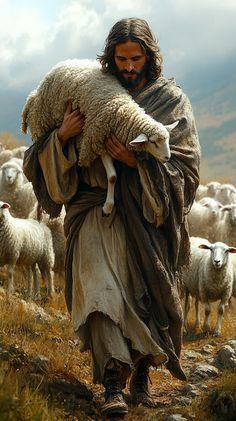
The Sacred Heart of Jesus, the seat of His love and mercy, is the heart of a shepherd – of the Good Shepherd.

A couple weeks ago, we celebrated a beloved saint, St. Pio of Pietrelcina, mostly known as Padre Pio. He spoke countless wise words in his lifetime and one of my favorite quotes is a favorite of many: “Pray, hope, and don’t worry. Worry is useless. Our merciful Lord will listen to your prayer.” I imagine that if Padre Pio shared such advice with any of the men and women who sat before him during the up to 10 hours of daily confessions he used to hear, many of them would have asked ” how?” How do we not worry? How is that possible?

When I asked that question myself in prayer, the Spirit whispered immediately, “Because you are cared for by a shepherd with a perfect heart of love.”

A shepherd does not let his sheep wander where harm awaits them. He provides boundaries that do not restrict but rather clarify where they are provided for and safe. When his sheep do stray, he does not write them off and abandon them. He seeks them out. He combats the peril they’ve walked into and restores them to where they belong. The shepherd keeps watch. The sheep do not need to worry. They need only remain in the presence of their shepherd.

Do not worry. The One who watches over you never sleeps. (Psalm 121:3-4) Do not be afraid. The Lord who loves you is your rock, fortress, refuge, and shield. (Psalm 18:2) Cast aside anxiety and undue stress. He leads you to rest and restoration. (Psalm 23:2-3)

Do not worry. You are loved and led by the Good Shepherd.

Catholicism, Faith, Holiness, Jesus, Love, Personal Reflection, Prayer

The Heart of Jesus – Pt 1

By human understanding and language, the heart is the seat of love. It is the place from which comes goodness and virtue. When we speak passionately or honestly, we are speaking from the heart. When we love someone to a particularly high degree, we give them our hearts and it is considered the most valuable gift one can offer another.

Jesus, fully God and fully human, loves us with divine love from his human heart. In the Sacred Heart – our ancient and holy title for the seat of our savior’s love – resides his perpetual care and desire for us, as well as his glorious character. All virtues and fruits of life, all in which we could seek to grow in our own hearts, exist in perfection and fullness in the Lord’s heart. Be it courage, wisdom, generosity, understanding, honesty, strength, or any other trait we might pursue, it flows from the bottomless well of the Sacred Heart of Jesus.

Great and wondrous, selfless and sacrificial, God’s remarkable love is offered by way of his heart. As a groom offers himself to a bride at the marriage altar, and the bride matches him in return, Jesus holds his heart out to us. He offers his wholehearted devotion, his mercy, his protection – all that makes up his love – by giving us his beautiful heart.

He invites us to match him in the offering. We cannot match Jesus in the perfection and fullness, yet that does not lessen his desire to receive our hearts, our devotion, and our love.

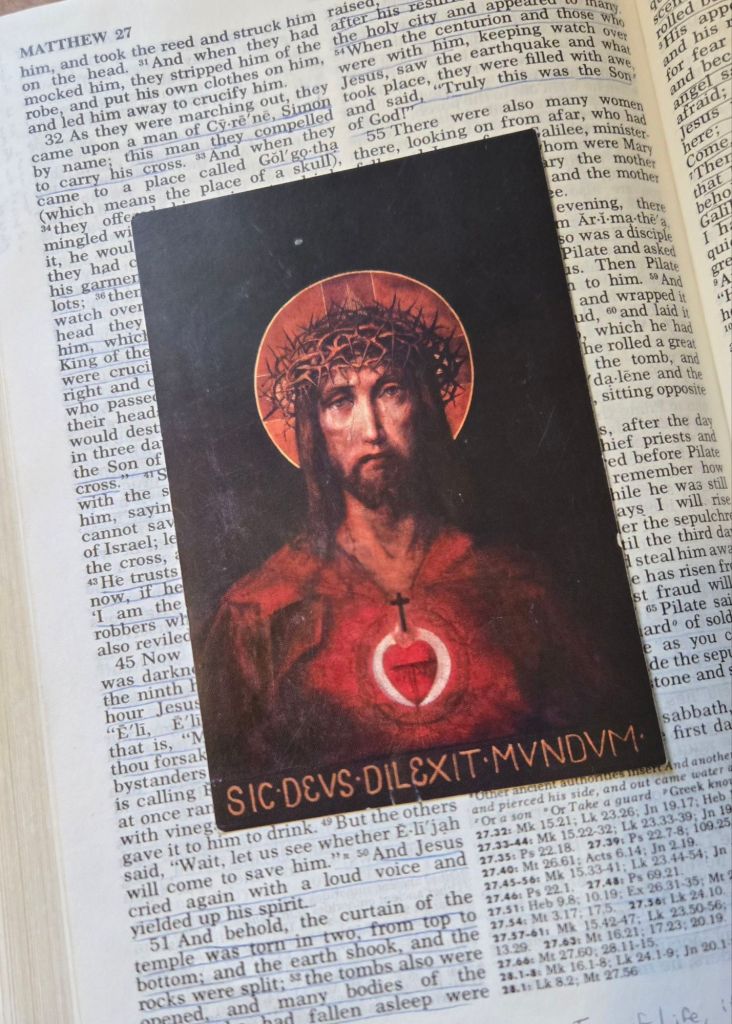
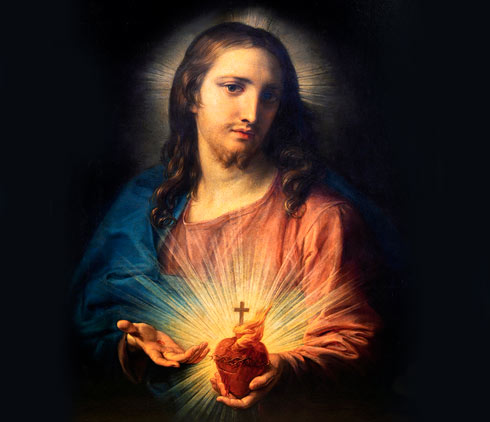
These realities course through my thoughts as I sit before an image of Jesus. It is a mere copy of a lovely old painting; one artist’s imagining of the gentle, solicitous expression of our savior offering his love to us in the symbolic seat of that love. His heart, radiant with light and wrapped in the crown of thorns worn when he died for us, is held out in invitation. Take it, he whispers to my soul. I am yours and you are mine, if you so choose.

The Sacred Heart of Jesus by Pompeo Batoni, 1767
Catholicism, Faith, Good Friday, Holiness, Hope, Jesus, Lent, Personal Reflection, Prayer, Scripture

The Good of That Friday

My sins are nailed on the cross with my Jesus.

My mistakes.

My failures.

My shortcomings.

My selfishness.

My self-loathing.

My rejections.

My punishments.

My shame.

They are nailed to the cross in the hands of Jesus and thus I can no longer hold them in mine.

With the repentant criminal beside him, I plead “Jesus, remember me when you come into your kingdom,” and he assures me that he does. He remembers me. He remembers the me known by the Father even before I was formed in my mother’s womb, stripped of the sins that mar that creation. With his arms spread on the bloody cross, he moves my sin and shame away from me, as far as east is from west.

This is the redemption of Christ. This is the good of that incredible, unmerited Friday.

Catholicism, Easter, Eucharist, Faith, Holiness, Holy Thursday, Jesus, Lent, Prayer, Scripture

To Whom Shall We Go – Holy Thursday Reflection

Jesus said to the twelve, “Will you also go away?

Simon Peter answered him, “Lord, to whom shall we go? You have the words of eternal life; and we have believed, and have come to know, that you are the Holy One of God.”

John 6:67-69

Simon Peter’s statement of commitment and faith comes after Jesus’s bewildering explanation of his being the Bread of Life. Surrounded by a crowd that followed him across a sea to continue hearing him teach and to witness his miracles, Jesus boldly declared that he is “the true bread from heaven,” “the living bread,” and “if anyone eats of this bread, he will live forever.”

As the verses pile up through John, chapter six, we hear these incredible words from Jesus and the unsurprising objections of his listeners. With each murmured doubt from the crowd, Jesus deepens his teaching. He reinforces it and makes no move to backpedal or soften the truth he is delivering to them – and to us.

Jesus is “the bread of life,” “true food” and “true drink” to be consumed by those who believe he is the way to eternal life. He is the fulfillment of every sacrifice and ceremonial meal of the Old Testament. He is the manna sent by the Father to feed God’s people, not for a day but for eternity.

When he finishes this discourse, the response that rose above the noise was, “This is a hard saying; who can listen to it?”

Isn’t that the question for me? For us?

It is the question that comes with the real presence of Christ in the Eucharist, and the necessity of that miraculous and baffling sacrament.

Just the same, the question accompanies every “hard saying” in the moral teachings of Christ and his church. It is heard behind the disciplines and virtues within the call to imitate Christ, which often fly in the face of what is deemed acceptable or good by the rest of society. From the unflinching declaration of Jesus that he is the way, the truth, and the life, the question comes in the appeal of the wide array of other ways, partial truths, and opposing lives I could live.

Who can listen to it? Who can accept it? Who can live it? The question arises from the voices around me and from deep within my own soul. I hear it echoing through times of suffering and confusion. When I don’t understand where to find God or what he is doing, it is heard above the noise.

“This is a hard saying; who can listen to it?”

Like the followers then, I, his follower now, can respond as many did when they “drew back and no longer went about with him.” Or I can speak in harmony with Peter – with imperfect yet wholehearted faith.

I can walk with Jesus with questions on my tongue, and still thoroughly convinced by all I do know and all I have seen and heard. I can trust that greater insight will come further down the road, just as it did for the disciples when the earlier words of Jesus replayed in their ears as he lifted the bread and wine at the Last Supper: “Take, eat; this is my body…. Drink of it, all of you; for this is my blood of the covenant, which is poured out for the forgiveness of sins” (Matthew 26:26b, 27b-28).

It is from this place of faith and trust that I gaze at the body of my Lord on the Cross and in the Eucharist. With that gaze comes a swell of love, awe, and peace. With that gaze, my soul sees its savior and answers, “Lord, to whom shall we go? You have the words of eternal life; and we have believed and come to know, that you are the Holy One of God.”

Advent, Catholicism, Christmas, Faith, Hope, Jesus, Love, Prayer, Scripture

Nothing Will Be Impossible – Advent Reflection, December 24th

Week 4, Sunday – December 24th

For nothing will be impossible for God.

Luke 1:37

With God, it is possible. These words from the archangel Gabriel are the only ones he needed to speak when Mary asked, “how can this be?”

Gabriel explained some things first, helping Mary to understand and thus helping us many generations later. He gave Mary insight into how she would bear the Son of God. He went on to offer a bit of supporting evidence in Elizabeth’s pregnancy, which Mary could confirm for herself and thus build her confidence in the angel’s message. Yet it is only his final words to her that answered the question of how these things could occur.

“For nothing will be impossible for God.” This alone elicits Mary’s fiat, her yes to God’s invitation to take up her incredible and unique role in humanity’s salvation. It is likewise the only truth necessary to elicit my own fiat.

To whatever God asks of me; to what work of His hands He calls me to participate in; to whom He asks me to serve; my yes arises from knowing that nothing is impossible for Him. I am not asked to do any of it on my own abilities and strength alone. I am invited to count on Him.

Hardships. Hurt. Illness. Grief. Trauma. Every single cross I am invited to carry in my following of Him. No less, the joys and successes; the opportunities, adventures, and marvelous blessings as I walk with Him. Every single one can be taken up with the hopeful cry, “Nothing is impossible for You, Lord!”

In all things requiring faith, my faith must stand upon two simultaneous truths: nothing is impossible for God, and God is love. In these I know and believe that God is capable of accomplishing what He sets out to do – no matter how impossible it may seem to me – and that what He sets out to do is always for my greatest good.

Is there any finer example of these great truths than the Incarnation? God becoming man in the humblest manner. God coming to live with us, serve our punishment of death, and defeat its hold on our souls. God opening the gates of heaven to every person who chooses to follow and believe. It is a most impossible plan, absurdly defying human logic and wisdom. Yet He does it, and He does it all for love of us.

With God, it is all possible. With God. it is all love.

Advent, Catholicism, Christmas, Faith, Jesus, Prayer, Saints, Scripture

Teach Me, O Lord – Advent Reflection, December 23rd

Week 3, Saturday – December 23rd

Your ways, O Lord, make known to me; teach me your paths, guide me in your truth and teach me, for you are God my savior.

Psalm 25:4-5ab, NAB

I am 42 years old and have been a Christian my entire life, and I still need God to teach me. Deeply and often, I am aware of that need. I have read and studied the scriptures with varying consistency since I was in grade school, and I still need the Lord to make His ways known to me. I have a degree in theology and spend time reading spiritual and theological works, and I still need Him to guide me in truth. Every single day, the need is there.

These aspects of my life are capable of lulling me into contentment with already knowing and doing plenty to live as a follower of Christ. They are also the reasons I continue to bump up against what I do not yet know or fully comprehend.

How often I say, “I don’t get it, Lord! I do not understand.” In these times, I find three options typically at hand: to humbly and eagerly seek Him out as my greatest teacher; to assume in pride that I will figure it out and explain it away within the limits of human comprehension; or to deem the matter not worth the effort it might take, whether by His guidance or my own knowledge, to find understanding.

It’s a critical choice every time. And, my oh my, do the results differ tremendously from the first option versus the others.

When I pray as the psalmist did – Lord, teach and guide me. Make yourself and your ways known to me. Help me understand – I am heard by the One who never ceases to share Himself with me. The truths I know are deepened and clarified. The natures of God, of me who is made in His image, and of human life in the grand and the minute are all more deeply revealed. Each time I approach him with the desire to learn from Him, I am both rewarded and humbled.

St. Thomas Aquinas was one of the greatest intellectual writers in Christian history. His contributions are vast in the realms of theology, philosophy, and scriptural studies for over 750 years. He also suddenly ended his writing endeavors a few months before his death, with a statement that all he had written seemed “like straw” compared to God’s revelations to him. No matter how extensive Thomas’s knowledge and understanding grew to be, God still had more to reveal and Thomas still sat before the Lord as one in need of His teaching.

Every day is an opportunity to follow St. Thomas’s example, and none more so than the days of great celebration in the Church. In the seasons of Advent and Lent, and in the feast days of Christmas, Easter, Pentecost, and everything in between, the works of God are brought to the foreground for us to consider with renewed attention. We are invited to hear, contemplate, and respond to God’s revelations. We are offered the opportunity to intimately know the One whom we worship.

All the Christmases I have celebrated, with readings of the Christmas story and sermons on the Incarnation year after year, and still what I comprehend of their meaning is miniscule. This Christmas season, I commit to the Lord that I will approach with a humble but firm belief that He wants me to know Him through the things I celebrate. He has more for me. He has insight and beautiful clarity to offer. He has love to reveal.

I am here to learn from You. I am here to learn of You. Teach me, O Lord.

Advent, Catholicism, Christmas, Gratitude, Jesus, Love, Prayer, Saints, Scripture

Good to Be Here – Advent Reflection, December 21st

Week 3, Thursday – December 21st

When Elizabeth heard Mary’s greeting, the infant leaped in her womb, and Elizabeth, filled with the Holy Spirit, cried out in a loud voice and said, “Most blessed are you among women and blessed is the fruit of your womb. And how does this happen to me, that the mother of my Lord should come to me?”

Luke 1:41-43

I write this from a seat in my local parish church, putting my pen to the page in between gazes at my Lord in the Eucharist. There are a dozen or more others scattered through the pews, each in quiet prayer of adoration. I see only Him though, held in a shining, golden monstrance on the altar. The words of St. Peter on the mountain of Christ’s transfiguration keep repeating in my ears.

Lord, it is good for us to be here. It is good for us to be here.

After some time, the Holy Spirit shifts the words in my mind.

How good it is of you, Lord, to be here with us.

With the Incarnation of the Son on the first Christmas, God came to live among us. In baptism, He makes our souls His dwelling place. In the Eucharist, He becomes the Bread of Life to sustain us.

What goodness, what generosity, what love there is in the Lord’s choice to be here. How kind and merciful. How marvelous. When the Lord came to her, Elizabeth’s soul and even the child within her recognized His presence. She responded with joy and awe, speaking in grateful praise. I pray that my soul responds similarly to Christ’s presence.

How good it is that He comes to us. How good it is of Him to be Emmanuel, God With Us.