The Triduum. My favorite days of the whole year. Holy Thursday has dawned here in Wisconsin with sleet and rain. There’s ice coating the tree branches outside my window. It’ll melt as the rain continues and the temperature rises, but for now, the weather is encouraging me to sit here at my desk with a blanket over my legs and a stack of thoughts to write down.
The first layer in the stack came a week ago, while I knelt in adoration of Jesus during a holy hour at church. There is no quiet so calming as the silent church with Jesus present, where “I look at Him and He looks at me,” as St. John Vianney put it. I opened my Bible to Isaiah, intending to read some familiar encouragement in chapter 55, but instead pausing at chapter 64.
“While you worked awesome deeds we could not hope for, such as had not been heard of from of old. No ear has ever heard, no eye ever seen, any God but you working such deeds for those who wait for him” (Isaiah 64:2-3, NAB).
I held that passage in my heart while I looked upon Jesus, upon God, hanging on a cross over a simple altar. I looked at Him on that little altar, in that mysterious, amazing Eucharist, and the marvelousness of His deeds rushed over my senses.
Look at how you are loved, the Holy Spirit whispered to my heart.
The whisper stayed with me as I went about the rest of my day and the days that followed. Then came Palm Sunday and during Mass my mind caught on one verse after another in the scripture readings of the Mass.
“The Lord God has given me a well-trained tongue, that I might know how to answer the weary a word that will waken them” (Isaiah 50:4, NAB)
“[Christ Jesus], though he was in the form of God, did not regard equality with God something to be grasped. Rather, he emptied himself, taking the form of a slave, coming in human likeness; and found human in appearance, he humbled himself, becoming obedient to death, even death on a cross” (Philippians 2:6-8, NAB).
Then came the Gospel passage. As the whole passion narrative from Matthew was proclaimed, I saw again and again the willingness of Christ. It was there quite plainly in His acceptance of His betrayer amongst His friends, in His passionate prayer in the garden, in His reception of the betrayer’s kiss and the arrest that followed. As the verses continued through Jesus’s testimony before the public and religious authorities, His beatings and abuse, and finally His steps toward the killing place, it was uninterrupted willingness. In our human language, we read of Jesus being led and placed where His enemies wanted Him to go, but all we know of His divinity tells us that no one could have moved Him without Him choosing to move. He allowed those whips to strike Him and that crown of thorns to draw His blood. He submitted to those nails driven through His skin and tissue and bones. Nothing and no one held power over Christ, yet He hung on a cross and surrendered His soul to death.
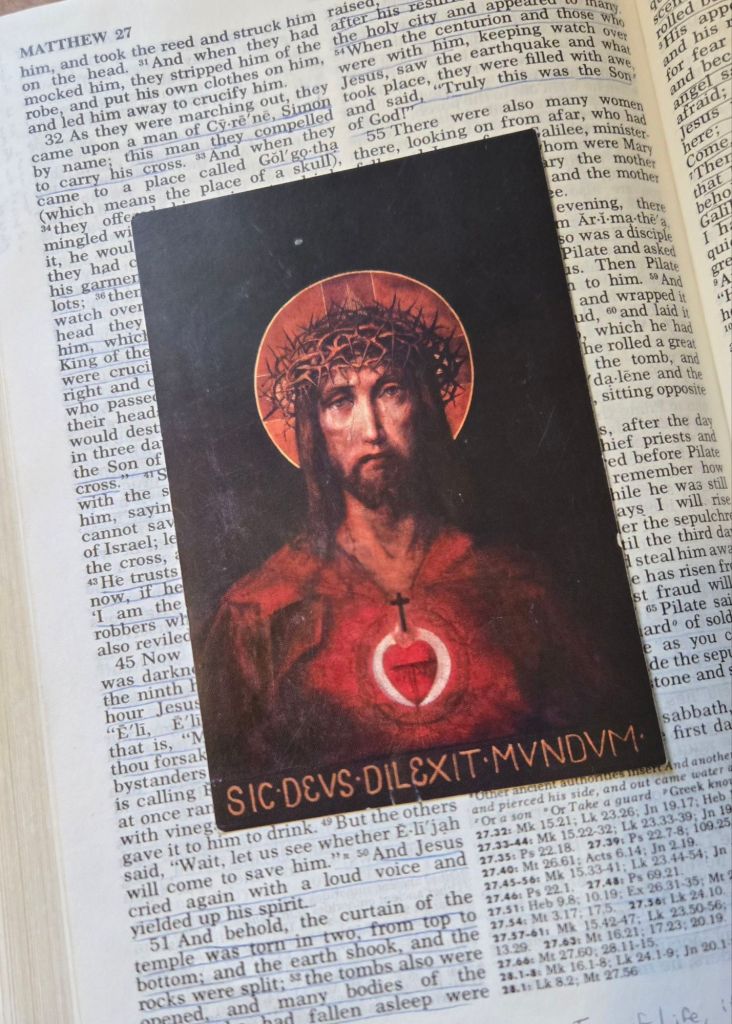
Through each piece of the story, I saw His ready obedience to the Father as a willing sacrificial lamb. When the simplest display of divine authority and power could have silenced every accusation and call for His destruction, He instead moved in humble vulnerability and total submission to the Father’s will.
A willing sacrificial lamb. This is what the Divine Word, by which all creation came to be, chose to become for our sake. From everlasting glory beyond our comprehension, He entered human history as a tiny, vulnerable child. He moved through the world He created as a son, a laborer, a friend, and eventually a teacher and miracle worker who took every step forward within the Father’s will, no matter the cost. In fact, He did all of it because of the cost.
The Sunday liturgy continued and I fought against tears as the images of His sacrifice continued flashing in my mind’s eye. I kept up the fight until I walked forward to receive the Eucharist. I returned to my seat with tears streaming down my cheeks. My shoulders shook a little as I knelt down to give thanks to Him who not only died for me but also gave me His own self to receive at every Mass, fulfilling His startling words in the gospel of John, chapter 6. It struck me deep in my heart that Jesus never stops offering Himself to us in the most humble and vulnerable ways. It is such a beautiful love by which He loves us, isn’t it?
After Mass, I wasn’t ready to leave. I knelt down again and prayed a Divine Mercy chaplet. While I meditated on Christ’s sacrifice, words from St. John came forth.
“See what great love the Father has lavished on us, that we should be called the children of God” (1 John 3:1a, NIV).
It was that particular translation of the verse that danced through my thoughts as I prayed. Lavish is an excellent word. Its synonyms include unrestrained, extravagant, and excessive. The lavishness of God’s love is worthy of awe and our own full submission to His perfect will. The lavishness of Christ’s sacrifice is worthy of humble but abundant thanksgiving on our part. And the lavishness of God’s grace flowing through the sacraments is an unrestrained, extravagant, excessive source of life for all who receive it.
As we embark on the holiest days of the year, I pray that all remnants of hesitation or indifference will fall away from our souls to be replaced with faith, gratitude, and a joyful, loving obedience to the Father, the Son, and the Holy Spirit.
 Carrie In Writing