Catholicism, Easter, Faith, Intentionality, Scripture

Missing Your Chance… Or Not

I have a vivid memory of sitting on my sister’s living room floor watching her open her birthday gifts. One from me was a bookmark with a George Eliot quote that read, “It is never too late to be what you might have been.” She unwrapped and read it then looked at me with wet eyes and asked, “Do you really believe that?” I nodded. She was in her early thirties and was at the start of a remarkable overhaul of her life. She was among the first people to convince me that there is never a good excuse to believe you’ve missed your chance to be who you long to be.

Which brings me to Easter. I intended to write a blog for Easter. A few non-coalesced themes floated around my mind. I even told myself it’d be best to write it early and schedule it to post on Easter. Hours and days passed and then the chance was gone. It was Monday and Tuesday and Wednesday and now, here I am talking about my unfulfilled intentions.

And it is still Easter.

In the faith I practice and believe in wholeheartedly, we celebrate Easter for a full season. This season happens to be fifty days. Fifty days of joy, of a special call to gratitude for the gift of salvation, and of reflecting inwardly on the great miracle of Easter.

The memory of my sister and the reality that I missed my chance yet didn’t miss my chance to write something for you all for Easter has me boarding a train of thought I’ll ask you to ride with me. Here it is: could anything possibly be more appropriate to Easter than to consider how what we might assume is missed or finished is far from being so?

An arrest and beating; a turning of the tide of popularity and acceptance; a crucifixion and a grave: all indeed appeared finished.

We forget that our knowledge is partial. We cannot see the full picture or understand the complete, intricate plan. We forget that the shocking empty grave and mystical appearance of the resurrected Christ was not a shock to the One who orchestrated it all. If Easter is teaching me a particular lesson this year it is to never assume that the chance has come and gone to be who I am meant to be and live as I am called to live. The dream, the goal, the change: whatever it might be that you have resigned to past opportunities and assumed must be let go, think again.

The Father above ordained the day of your beginning. Do not concern yourself with identifying endings along the way, or even the final ending He also ordains (which even then will not be a true ending, if grace allows). He gives us our chances in abundance. Some we squander and some we take. Forgive yourself the former and be encouraged by the latter. Then start taking more and squandering less, and leave the rest to God.

Family, Motherhood, Scripture, Worthy

To Annabelle, Now and Every Tomorrow

Dear Annabelle,
Look at you. Football jersey, princess slippers, can’t-sleep-without-them animals, and a smile brighter than a sunbeam. Lunging at me in jubilation. Certain I will embrace you. Certain I will laugh with you.

You didn’t see it but last night as I laid you in your crib, relaxed and content after our mutual favorite lullaby, there were tears in my eyes. You didn’t notice the catch in my voice as I said goodnight.

Something in the sight of you at that moment clarified reality. You are finishing up being my baby. You are ready to be my little girl instead. My little girl who will grow into my big girl and my young lady.

The realization filled my chest with a wave of panic. The wave passed, swept out into the ocean of mixed emotions in a mother’s heart as she watches her child change right before her eyes. There’s no stopping you and so there are some things I must say before my voice isn’t the one you’re most eager to hear every morning, noon, and night.

Your face in this photo, along with a million instances of the privilege I have to see your smile, gives me a flash into the future. I am convinced you will be a woman who is “clothed in strength and dignity, and laughs at the days to come” (Proverbs 31:25). Please don’t lose that light that fills your features.

Keep your hair out of your gorgeous eyes, so you can see clearly but also so you may better be seen. You ought to be seen.

When you feel the kick of an urge to smile at someone across the room, the way you do for me, don’t resist it. You have no idea the kindness it is to offer that smile to another.

And the way you never doubt that I and your Daddy will hear your calls? Have that confidence in your heavenly Father and the days to come won’t be able to silence your laughter.

The time will come when you doubt this so I’ll try to remind you of it often: you are “fearfully and wonderfully made” (Psalm 139:14). Your soul, your mind, your body. Every aspect of the whole Annabelle is a wondrous gift from God. Do not belittle any part of that gift, nor listen to those who would try to tell you otherwise. Know that you deserve what is true and beautiful and good, then seek it out fervently.

Among my greatest hopes for you is that you become a woman who, like the very breath and wisdom of God, “is more precious than rubies, and nothing [anyone might] desire can compare to her” (Proverbs 3:15).

Your character is a wellspring of untold worth. The potential for generosity and kindness, humor and boldness, passion and earnestness, understanding and creativity – unearth that treasure, my girl. Every person you touch will be better for it and you will pass your years living instead of waiting to live.
Be the princess you are, Annabelle, and be that only in the truest sense of the title. Be a daughter of the King. There is “an inheritance that is imperishable, undefiled, and unfading, kept in heaven for you” (1 Peter 1:4), Annabelle. Rather than sacrifice it for anyone, be a reason they look for theirs too. Seek the good of every soul that crosses your path. Know your worth and convince others of theirs.

I love you.
Mama
Advent, Christmas, Faith, Family, Hope, Jesus, Scripture

The Paradox of Suffering and Hope at Christmas

Photo provided by Trisha Hummel

Today is my cousin Trudi’s 44th birthday. It is her 23rd birthday in eternal life. I was still stumbling my way toward my teen years when Trudi was murdered. Trudi and her older sisters were thick as thieves with my older sisters while I was just one of the little cousins in our extensive family circle. I remember her as cool; fun and beautiful; bold and humorous.

This weekend I spent hours addressing Christmas cards. As I scribbled the names, streets, and cities of my cousins, I couldn’t help wondering about Trudi. Would she live in the same area, like her sisters, or would she have established her life elsewhere? Would we have attended a wedding? Would our children have played together by now? Would we have that comfortable, enjoyable dynamic that develops between family members after the years have placed us on level ground?

Hypotheticals. They do an excellent job of muddling the mind and stinging the heart. There’s nothing like loss to leave you wading through a pool of hypotheticals. And there’s nothing like Christmas time to amplify the wound of loss.

This isn’t a direct quote, as I can’t remember where I heard it, but I once read that St. John Paul II said suffering is created by feeling cut off from good. We live and love and link ourselves to sources of good. When one of those links is severed, we are left trying to patch the tear.

What has severed a link to good in your life?
Death
Divorce
Job loss
Infertility
Disease
Rejection
Betrayal

Every cut in our connections to what is good is felt keenly in this season of celebration. For some, the suffering renders Christmas undesirable. Potential joy is swallowed up in misery. Sounds of peace are drowned out by the roar of hypotheticals that can never be.

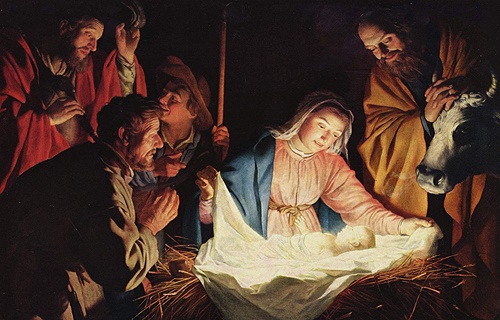
Oh, the paradox of Christmas. For Christmas, my friends, is the arrival of the Divine Response to every wound and cut and tear you carry with you. It is Almighty God dwelling amongst us. He made Himself vulnerable to encounter our vulnerability. God entrusted Himself to the arms of a mother, to the home of an earthly father, and to a community of imperfect, suffering individuals.

Adoration of the Shepherds by Gerard van Honthorst

Christmas is the issuance of God’s answer to our suffering, to our feeling of being cut off from good. It is a resounding song of hope: “You are not cut off. You are not abandoned. You are not lost. For I am with you. Here in the deepest cuts, I abide with you. I may have allowed pain and loss, but I fill the voids. I AM the source of all good and I AM here.”

Christmas, when “the Word became flesh and dwelt among us” (John 1:14) is the root of our conviction “that neither death, nor life, nor angels, nor principalities, nor present things, nor future things, nor powers, nor height, nor depth, nor any other creature will be able to separate us from the love of God in Christ Jesus our Lord” (Romans 8:38-39).

Because the Saints Said So, Catholicism, Faith, Holiness, Saints, Scripture

Because the Saints Said So: Be You (St. Francis de Sales)

I was introduced to St. Francis de Sales while I was in my sophomore year of college. In the context of a community of incredible, fun, faithful, hilarious, supportive women, I read his classic, Introduction to the Devout Life. If I name the top five books that have affected my life, that is likely to always hold steady among them for the rest of my years.

One of the hallmarks of de Sales’ spiritual advice is high, challenging standards. Another hallmark is gentleness. He did not divorce the two notions. I had trouble narrowing my focus down to just one quote from this most excellent spiritual writer so here are a few to consider:

Do not wish to be anything but what you are, and try to be that perfectly.

Do not lose courage in considering your own imperfections.

Have patience with all things, But, first of all with yourself.

Nothing is so strong as gentleness, nothing so gentle as real strength.

These snippets are written alongside mandates for the men and women who call themselves Christians to be exemplary in their moral choices, in the use of their time and talents, and in the practice of virtue. Reading St. Francis de Sales’ spiritual advice is like reading a dissertation on Jesus’ command to “be perfect as your heavenly Father is perfect” (Matthew 5:48).

Never does it become too much though, never more than a person can handle. For de Sales makes clear that to seek to be this living image of God also requires a kind realism. Realistically, know yourself. Know your strengths and your weaknesses. Your passions. Your hopes. Your temptations. And lovingly, patiently cultivate your unique self.

You know when I have failed the most in living a life that glorifies Christ? When I have tried to ignore who I really am in order to be what I thought I needed to be. Inevitably, in such misguided efforts, I become exhausted and overwhelmed. I give up. I resent the real me for showing up yet again. What a pitiful way to live.

St. Francis de Sales knew better. He took the Lord’s words to heart: “Love your neighbor as yourself” (Matthew 22:39). As yourself. Loving yourself is not a hippie or new age notion. No, it is rooted in the supreme reality of Christianity, that God loves you unconditionally and thus sacrificed Himself to save you. How logical then that I am deserving of love from myself and all others are deserving of love from me.

The standards, the virtues, and all that is encompassed by a God-glorifying life comes about in the day to day manifestation of that love. Love seeks the beloved’s greatest good. This is no less true when we are considering ourselves than when we are considering another person. So, “have patience with all things. But, first of all with yourself.”

Because the Saints Said So, Catholicism, Faith, Holiness, Jesus, Saints, Scripture

Because the Saints Said So: Manifesting the Truth (St. Thomas Aquinas)

Speaking the truth is not the same as living truthfully. They ought to go hand in hand, without a doubt, but they are not one single matter. Why is this matter on my mind today? Because of this weighty declaration by St. Thomas Aquinas, one of the greatest minds in the history of Christianity:

“As a matter of honor, one man owes it to another to manifest the truth.”

When I hear “manifest,” I think of something being revealed and made known in a way that the recipient has not experienced before. It is a tangible illustration. And when I hear “the truth,” my mind goes straight to Jesus. Surely though, the truth refers to every facet of God’s revelation though – from Natural Law to the words of Sacred Scripture to the daily applications of Christian morality.

We have a duty of honor to manifest the truth to others! By words, actions, proclamations, stories, lifestyles, choices, reactions, attitudes – the list can go on and on. Because there are so many ways to manifest the truth, perhaps we could consider that doing it well is an essential part of that duty.

It is natural, when you are certain of a truth and that truth has done something remarkable for you, to desire to share it with others. It is natural and it is good. Sometimes, in our eagerness or confidence though, we can be unfortunately misguided in our methods. Great intentions but terrible form. I’d wager we have all experienced this, both as the truth teller and as the recipient.

Do not hesitate to manifest the truth, my friends, but be sure to tailor your approach to the circumstances. Consider the audience. Consider your relationship with them. Consider their situation. What in their life could make them receptive to what you are sharing, or make them resistant? What do they know of you that would cause them to trust what you are illustrating? St. Francis Xavier wisely noted, “The better friends you are, the straighter you can talk, but when you are only on nodding terms, be slow to scold.” If what you are sharing contradicts what they have previously believed or how they have behaved, are you standing on fertile ground that is ready to welcome the seed of truth you are offering? Or are you coming at them with your proverbial finger pointed and a glint of pride in your eye?

One of the most important precursors to sharing the truth, whatever bit of truth it might be, is a humble recognition of your own need for that truth. “If we say we have no sin, we deceive ourselves, and the truth is not in us (1 John 1:8).” If I say I am better than another person because I possess the truth, I am wrong. If I say I am better than the person I was before knowing that truth, I am on the right track.

In knowing our own need, we know why others need us to manifest the truth. If we truly “owe” our brothers and sisters the truth, as St. Thomas states, there must be a reason! Why do each of us need the truth? Because we are created by God, in the image of God, for eternal life with God. What I am trying to say is, intentions matter. If I am speaking the truth to another, it is not out of pride or judgment. I speak it because I hope they can know the love that I have experienced, and the joy, the strength, and the adventure that comes of knowing Him who is Truth. I speak it because I not only long to live my eternity in Heaven, but I long to have you there with me. If my intentions in manifesting the truth fall short of this (which they so often do), I do not stop trying to manifest the truth but I do keep purifying those intentions.

From our humility in accepting the truth for ourselves, comes change. Our lives must back up what we might say to another about the truth. When this is true, “saying” can become unnecessary in certain cases. The living speaks for itself and attracts others to the truth. No one expresses it better than St. John, I guess, for I go to him again: “Little children, let us not love in word or talk but in deed and in truth (1 John 3:18).”

I write this as one who needs to hear it. As one who must pray from the soul, “Send out your light and your truth; let them lead me; let them bring me to your holy hill and to your dwelling (Psalm 43:3)!” And my prayer goes on, “Make me a beam of that light of your truth.”

Because the Saints Said So, Catholicism, Faith, Holiness, Saints, Scripture

Because the Saints Said So: On Sadness and the Spirit (St. Pio)

In the past few years, the saint whose words and stories have resonated with me the most is St. Pio of Pietrelcina. An Italian farmboy born in 1887; a world renowned miracle worker known for his humility, integrity, and simple wisdom by the time he died in 1968. There are plenty of biographical details worth examining from his life but that is not the purpose of this post.

Numerous statements by St. Pio have I read, considered, prayed over, and taken to heart. Most recently, the one that is staying with me is this: “Don’t allow sadness to dwell in your soul, for sadness prevents the Holy Spirit from acting freely.”

My first response was, “Well, that’s just too much to ask!” But I stared a little longer at the words. I wondered if it was a matter of refusing to be sad about anything. That seemed unnatural and impossible. Was it about not letting the sadness reach your soul then? That could be debated, I suppose, but I still believed I hadn’t hit the nail on the head. True sadness does reach the soul. That’s the nature of the beast. So what then was St. Pio challenging me to do?

Eventually my eyes lingered on one word: dwell. Don’t allow sadness to dwell.

Dwell: verb: 1. to live or stay as a permanent resident; reside; 2. to live or continue in a given condition or state

Don’t let sadness be a resident. Allow sadness to be a visitor. Treat it as such. Visitors require attention. Meet the needs of the visitor of sadness. Ignoring it is not appropriate. Visitors (hopefully) come for a reason. They are present but they are expected to depart. Visitors are not permanent residents.

St. Pio is not demanding the impossible. Nor is he saying anything that wasn’t already indicated long ago in Scripture by Jesus and his apostles.

So you also are now in anguish. But I will see you again, and your hearts will rejoice, and no one will take your joy away from you (John 16:22).

Blessed are they who mourn, for they will be comforted (Matthew 5:4). 

I consider that the sufferings of this present time are as nothing compared with the glory to be revealed for us (Romans 8:18). 

Blessed be the God and Father of our Lord Jesus Christ, who in his great mercy gave us a new birth to a living hope through the resurrection of Jesus Christ from the dead, to an inheritance that is imperishable, undefiled, and unfading, kept in heaven for you who by the power of God are safeguarded through faith, to a salvation that is ready to be revealed in the final time. In this you rejoice, although now for a little while you may have to suffer through various trials, so that the genuineness of your faith, more precious than gold that is perishable even though tested by fire, may prove to be for praise, glory, and honor at the revelation of Jesus Christ (1 Peter 1:3-7, emphasis added).

They and St. Pio challenge us to give sadness its proper due but nothing more.

What should you allow to “dwell in your soul?” Well, St. Pio touches on that, too. The rightful resident of your soul is the Holy Spirit, and therefore the gifts and fruits of the Holy Spirit.

Do you not know that you are the temple of God, and that the Spirit of God dwells in you (1 Corinthians 3:16)?

Gifts;
The spirit of the Lord shall rest upon him: a spirit of wisdom and of understanding, a spirit of counsel and of strength [fortitude], a spirit of knowledge and of fear of the Lord, and his delight shall be the fear of the Lord [piety] (Isaiah 11:2-3a, emphasis & notes added).

Fruits:
In contrast, the fruit of the Spirit is love, joy, peace, patience, kindness, generosity, faithfulness, gentleness, self-control. Against such there is no law (Galatians 5:22-23, emphasis added).

When visitors like sadness are allowed to act as residents, the life and work of the Holy Spirit is fettered and obstructed. Luggage blocking the hallways where the Spirit should move freely. In the case of sadness, it is the fruit of joy that is most inhibited. However if joy is a resident of your soul while sadness, caused by any number of things, is only given a visitor’s pass, you will not lose your joy.

Joy is not merely a higher degree of happiness. It is different than happiness. Joy is rooted in hope, particularly the hope of salvation. As its roots then link it to eternity, Joy is not eroded by the changing tides of circumstances the way that happiness can be. Certainly circumstances can affect our joy, strengthening or weakening our awareness of joy or our ability to choose joy in our reactions to things. Circumstances cannot steal authentic joy though. That is among its key differences from happiness.

It is wrong to say that a Christian should never be sad. It is right to say that a Christian does not allow sadness to be a resident of the soul.

Faith, Jesus, Scripture

On the Water

Then he made his disciples get into the boat and precede him to the other side toward Bethsaida, while he dismissed the crowd. And when he had taken leave of them, he went off to the mountain to pray.

When it was evening, the boat was far out on the sea and he was alone on the shore. Then he saw that they were tossed about while rowing, for the wind was against them. About the fourth watch of the night, he came toward them walking on the sea. He meant to pass by them.

But when they saw him walking on the sea, they thought it was a ghost and cried out. They had all seen him and were terrified. But at once he spoke with them, “Take courage, it is I, do not be afraid!” He got into the boat with them and the wind died down. They were completely astounded. 

They had not understood the incident of the loaves. On the contrary, their hearts were hardened.     Mark 6:45-52

I am much more familiar with Matthew’s account of Jesus walking on the water than I am with Mark’s. The number of words and actions that stood out to me upon my recent reading of this passage tells me that anytime I’ve studied this particular story of Jesus, I made use of only Matthew’s account.

Right out of the gate, I note that Jesus made his disciples go in the boat and leave him behind. It gives the impression that they didn’t want to leave, didn’t wish to be separated from him. They had just witnessed the miraculous feeding of the five thousand. They were likely amazed, but confused, and had questions for Jesus. I would guess they were looking forward to some time spent with Jesus without the crowd so the twelve of them could ask those questions and mull over what had happened. Instead, Jesus tells them to take the boat to the other side of the sea and leave him behind.

On their way they encounter high winds and waves. It is stressful, exhausting, and possibly frightening. And Jesus is not with them. They don’t know he’s watching them from the shore. They don’t know he is seeing their travail.

Then Jesus takes to the water. He begins walking across the sea. Easily could we think “He’s going to them.” Jesus must be walking to his disciples, his closest companions, friends, and followers. He sees their hardship and He is going to them. Thus my surprise when I read “He meant to pass by them.” What?! This is the line that baffled me when I read this passage recently. It’s been on my mind for at least a week. “He meant to pass by them.” He was simply going to walk by them and leave them to the storm? He wasn’t going to help? He wasn’t going to get into the boat with them and calm the wind? Really, Jesus? Why?

It took until today, thinking on this yet again, to change my tune. “He meant to pass by them.” As in, He meant to get close enough for them to see Him. Close enough for them to call to Him, to ask Him to help. Yes. That is what Jesus meant to do. Instead of keeping His distance, waiting out the storm, or even helping from afar – instead of this, He would draw near. He would help them in the midst of their trouble. He would make Himself personally available to them.

I’m not claiming this is the only possible interpretation of this moment in the Gospel. As far as what the disciples themselves realized about Jesus in that experience, I can’t speak to that either. I am simply speaking as a person of faith reading this passage yet again and considering the manner in which our Lord sometimes chooses to help His beloved ones. We might want Jesus to stay with us in the particular manner we prefer, but He says no, you must go forward in the way I’m instructing you. We may want Him to appear in our midst, in our struggles, and take over the helm of the ship. He instead draws near and waits for us to recognize Him and call to Him.

God’s help, His saving grace and guiding hand, often come in surprising ways. He’s apt to choose the less obvious, the less understandable manner of meeting us on our wind tossed boats. And in every instance He commands, “Do not be afraid!” Do not fear! Trust in me! Know that I am here, that I, the Lord of Heaven and Earth, am available to you. I am here. Be not afraid.