Catholicism, Faith, Family, Gratitude, Holiness, Intentionality, Jesus, Love, Motherhood, Saints

Apostles of Joy

Yesterday, I witnessed the appearance of pure joy on the rosy cheeked face of my daughter. Again and again, her expression lit up like she was standing in the path of a sunbeam. Her smile flashed as wide as she could make it. Her laughter burst forth contagiously until I was giggling in unison.
St. Teresa of Calcutta stated that “joy is a net of love by which we catch souls.”
“Man cannot live without joy,” according to St. Thomas Aquinas.
Pope Francis advised that all Christians ought to be “apostles of joy.”
What brought on my daughter’s supreme display of joy? Bubbles. That’s all. To her two year old mind, they were wondrous works of art, wrought by magic and created expressly for her. I sat in a chair on our little deck outside the living room blowing bubbles. Even when she was ready to move on to other activities, I kept going. I didn’t want it to end. I needed to witness her joy.
In the hours since, I’ve contemplated both her joy and my reaction to it. That sort of joy arises when something unexpected and incredible appears before us. It’s easy to see why it exists in children as young as my daughter: everything is still new and unexpected at that age. Young children are easily impressed and easily pleased.
 
I am already sad for the days when I begin to recognize in my children a departure from this manner of encountering the world. It will happen though. Fewer and fewer things will feel unexpected or incredible. Must it be that way though? Could I, at 35 years old, experience that uninhibited, simple joy more often? Could joyful become one of my trademark attributes?
 
It’s worth finding out the answer to those questions. Joy adds vigor and spirit to daily living. It inspires gratitude, hope, and contentment – as well as arises from the same. It spreads from person to person, improving the quality of life further and further down the chain of people with whom we are each linked. Rediscovering a way of joy is worth the effort.
 
How do we become characterized by joyfulness in a manner that harkens back to that abundant childhood joy?
  1. Realize every earthly beauty was made for you but you have not earned any of it. Do you realize the world didn’t have to be made beautiful? God could design creation however he pleased. Purely functional might have been the only standard. Beautiful, enjoyable, fun, wondrous, exciting, incredible – God gave creation these aspects for our edification and, most importantly, for us to know Him through creation. He did it for you. He made the colors, textures, scents, and sounds for you. He gave you comprehension of these realities so that you might share in His nature. This He did entirely out of love for you. Encountering your world with this perspective can cast it all in a light that leads to joy.
  2. Engage now and do so without self-consciousness. We are trained to multi-task; to be efficient and productive. We plan. We prep. We do, do, do. We miss so much. Engage in the present moment as thoroughly as you can manage. My husband has been working on teaching me this for years now. Be present and don’t apologize for doing so. A reaction of joy can feel embarrassing, and what a sad statement that is about our accepted mentality! Lose the shame over experiencing joyful wonder at the bits of beauty and goodness that are taken for granted by many people.
  3. Believe your joy is a gift to others. They need it. Your family, friends, coworkers; the person sitting in the church pew with you; the cashier at the grocery store; the elderly man hobbling past you on the sidewalk; the tired parent handling the kids at the park. All of them need your joy. Your children need you to derive joy from their silliness. Your spouse needs to laugh with you and perhaps be reminded of the beauty shadowed by the daily grind. Your friends need a voice that replaces cynicism with joy. It is no surprise we become numb to the goodness available to us in life. Our senses are battered by harshness at every turn and joy is a healing balm.

An apostle of joy is a person who allows joy to be a defining theme of their life and who will carry that joy into the presence of anyone within their influence. If you don’t know where to begin, start with gratitude. Gratitude begets joy. And when you need an extra boost, watch a the face of a child chasing bubbles. I promise you won’t be disappointed.

    Because the Saints Said So, Catholicism, Faith, Holiness, Intentionality, Jesus, Saints, Simplifying

    Because the Saints Said So: Short On Time (St. Therese)

    Time. We can’t hold it. We can’t create it. We are directed by it at every turn. Morning/Evening. Day/Night. Early/Late. Hours, minutes, seconds are the context of our lives. I operate in a constant state of ‘not enough time.’ At any given moment, I could list a handful of things for which I don’t have enough time. I suspect a few of you can relate, and for you, I have an announcement: It’s a lie.

    It’s a lie.

    You have enough time.

    How do I know this? Because God knows better than I do the time I need. How much time I have is not a changeable reality. God is the wise and perfect designer of time and of my personal share of time. So, if we can’t change how much time we have and God designed our time perfectly anyway, where are we going wrong? Why at the close of the day are we saturated with the perception of inadequate time?

    Because we waste it.

    We have only short moments of this life to work for God’s glory.
    The devil knows this and that is why he tries to make us waste time in useless things.
    O, let us not waste our time!
    (St. Therese of Lisieux)
     
    
    Typically (typical of most of us), my mind goes to entertainment when I think of time wasters. Streaming video services, smart TVs, smart phones, online games, social media, and apps galore have all brought time spent on entertainment to a new level. It is easier and more enjoyable than ever to waste time on entertainment. However, condemning entertainment across the board as the cause of our supposed lack of time is a dangerously narrow view.

    There is a place for entertainment in our lives. It is not, in itself, evil. God made us in His image: capable of both creating and appreciating sources of joy, laughter, deeply provoked thought, and beauty. Like so many aspects of our world, there are options of entertainment that can do good and nurture the mind and spirit, and there are others that will do harm and undermine our call to be the best versions of ourselves. These matters become time wasters when they, even the truly good ones, are given more of our time than they deserve. Measure each entertainment activity honestly: is it at the service of my best self? If not, give it none of your valuable time. If so, give it only a share of time that doesn’t infringe on the time deserved by greater things.

    Entertainment is so far from being our only time waster. For some people, it is hardly even an issue. The other matter I’d like to highlight is expectations. Oh, the time I waste on expectations! Now, before you think I’m advocating lowering all our standards for how well we do what we do, let me explain.

    It is the plague of constant comparison and competition. We see the ideal Pinterest how-to guides; the Facebook posts of family vacations and activities; the hosted parties in spic and span homes; the celebrity glow of perfection reported and printed and photo shopped. We don’t witness the trial and error before that blogger posted their picture perfect meal display. We don’t hear the fights or know the stresses in the marriages and families on those vacations or participating in planned activities. We don’t see the piles of mail and toys and laundry stuffed behind closed doors so the hostess can present a perfect home. We forget the bank accounts, the personal trainers and assistants, and the marketing strategy all contributing to the projected image of professional athletes and gorgeous celebrities.

    We are immersed in expectations. Often without even realizing it, we strap on the yoke of earthly perfection and waste our precious time. In our aspirations to be good, successful, and happy, we mistake worldly expectations for worthwhile standards. They are not and never will be synonymous.

    Stop sapping your time for other people’s approval, or even for your own short lived self-satisfaction. You do not have enough time for that. You do have enough time to be the best version of yourself for you and everyone within your range of influence. You have enough time to live in a manner that glorifies God. You have enough time.

    Can you repeat that to yourself? I have enough time. I have enough time because God created my time. I will not give it away to that which isn’t worthy of the gift, be it undeserving activities or self-defeating expectations. Lord, I am not short on time. Help me to not be short on wisdom in my time.

    Advent, Christmas, Faith, Family, Hope, Jesus, Scripture

    The Paradox of Suffering and Hope at Christmas

    Photo provided by Trisha Hummel

    Today is my cousin Trudi’s 44th birthday. It is her 23rd birthday in eternal life. I was still stumbling my way toward my teen years when Trudi was murdered. Trudi and her older sisters were thick as thieves with my older sisters while I was just one of the little cousins in our extensive family circle. I remember her as cool; fun and beautiful; bold and humorous.

    This weekend I spent hours addressing Christmas cards. As I scribbled the names, streets, and cities of my cousins, I couldn’t help wondering about Trudi. Would she live in the same area, like her sisters, or would she have established her life elsewhere? Would we have attended a wedding? Would our children have played together by now? Would we have that comfortable, enjoyable dynamic that develops between family members after the years have placed us on level ground?

    Hypotheticals. They do an excellent job of muddling the mind and stinging the heart. There’s nothing like loss to leave you wading through a pool of hypotheticals. And there’s nothing like Christmas time to amplify the wound of loss.

    This isn’t a direct quote, as I can’t remember where I heard it, but I once read that St. John Paul II said suffering is created by feeling cut off from good. We live and love and link ourselves to sources of good. When one of those links is severed, we are left trying to patch the tear.

    What has severed a link to good in your life?
    Death
    Divorce
    Job loss
    Infertility
    Disease
    Rejection
    Betrayal

    Every cut in our connections to what is good is felt keenly in this season of celebration. For some, the suffering renders Christmas undesirable. Potential joy is swallowed up in misery. Sounds of peace are drowned out by the roar of hypotheticals that can never be.

    Oh, the paradox of Christmas. For Christmas, my friends, is the arrival of the Divine Response to every wound and cut and tear you carry with you. It is Almighty God dwelling amongst us. He made Himself vulnerable to encounter our vulnerability. God entrusted Himself to the arms of a mother, to the home of an earthly father, and to a community of imperfect, suffering individuals.

    Adoration of the Shepherds by Gerard van Honthorst

    Christmas is the issuance of God’s answer to our suffering, to our feeling of being cut off from good. It is a resounding song of hope: “You are not cut off. You are not abandoned. You are not lost. For I am with you. Here in the deepest cuts, I abide with you. I may have allowed pain and loss, but I fill the voids. I AM the source of all good and I AM here.”

    Christmas, when “the Word became flesh and dwelt among us” (John 1:14) is the root of our conviction “that neither death, nor life, nor angels, nor principalities, nor present things, nor future things, nor powers, nor height, nor depth, nor any other creature will be able to separate us from the love of God in Christ Jesus our Lord” (Romans 8:38-39).

    Because the Saints Said So, Catholicism, Faith, Holiness, Jesus, Saints, Scripture

    Because the Saints Said So: Manifesting the Truth (St. Thomas Aquinas)

    Speaking the truth is not the same as living truthfully. They ought to go hand in hand, without a doubt, but they are not one single matter. Why is this matter on my mind today? Because of this weighty declaration by St. Thomas Aquinas, one of the greatest minds in the history of Christianity:

    “As a matter of honor, one man owes it to another to manifest the truth.”

    When I hear “manifest,” I think of something being revealed and made known in a way that the recipient has not experienced before. It is a tangible illustration. And when I hear “the truth,” my mind goes straight to Jesus. Surely though, the truth refers to every facet of God’s revelation though – from Natural Law to the words of Sacred Scripture to the daily applications of Christian morality.

    We have a duty of honor to manifest the truth to others! By words, actions, proclamations, stories, lifestyles, choices, reactions, attitudes – the list can go on and on. Because there are so many ways to manifest the truth, perhaps we could consider that doing it well is an essential part of that duty.

    It is natural, when you are certain of a truth and that truth has done something remarkable for you, to desire to share it with others. It is natural and it is good. Sometimes, in our eagerness or confidence though, we can be unfortunately misguided in our methods. Great intentions but terrible form. I’d wager we have all experienced this, both as the truth teller and as the recipient.

    Do not hesitate to manifest the truth, my friends, but be sure to tailor your approach to the circumstances. Consider the audience. Consider your relationship with them. Consider their situation. What in their life could make them receptive to what you are sharing, or make them resistant? What do they know of you that would cause them to trust what you are illustrating? St. Francis Xavier wisely noted, “The better friends you are, the straighter you can talk, but when you are only on nodding terms, be slow to scold.” If what you are sharing contradicts what they have previously believed or how they have behaved, are you standing on fertile ground that is ready to welcome the seed of truth you are offering? Or are you coming at them with your proverbial finger pointed and a glint of pride in your eye?

    One of the most important precursors to sharing the truth, whatever bit of truth it might be, is a humble recognition of your own need for that truth. “If we say we have no sin, we deceive ourselves, and the truth is not in us (1 John 1:8).” If I say I am better than another person because I possess the truth, I am wrong. If I say I am better than the person I was before knowing that truth, I am on the right track.

    In knowing our own need, we know why others need us to manifest the truth. If we truly “owe” our brothers and sisters the truth, as St. Thomas states, there must be a reason! Why do each of us need the truth? Because we are created by God, in the image of God, for eternal life with God. What I am trying to say is, intentions matter. If I am speaking the truth to another, it is not out of pride or judgment. I speak it because I hope they can know the love that I have experienced, and the joy, the strength, and the adventure that comes of knowing Him who is Truth. I speak it because I not only long to live my eternity in Heaven, but I long to have you there with me. If my intentions in manifesting the truth fall short of this (which they so often do), I do not stop trying to manifest the truth but I do keep purifying those intentions.

    From our humility in accepting the truth for ourselves, comes change. Our lives must back up what we might say to another about the truth. When this is true, “saying” can become unnecessary in certain cases. The living speaks for itself and attracts others to the truth. No one expresses it better than St. John, I guess, for I go to him again: “Little children, let us not love in word or talk but in deed and in truth (1 John 3:18).”

    I write this as one who needs to hear it. As one who must pray from the soul, “Send out your light and your truth; let them lead me; let them bring me to your holy hill and to your dwelling (Psalm 43:3)!” And my prayer goes on, “Make me a beam of that light of your truth.”

    Faith, Jesus, Scripture

    On the Water

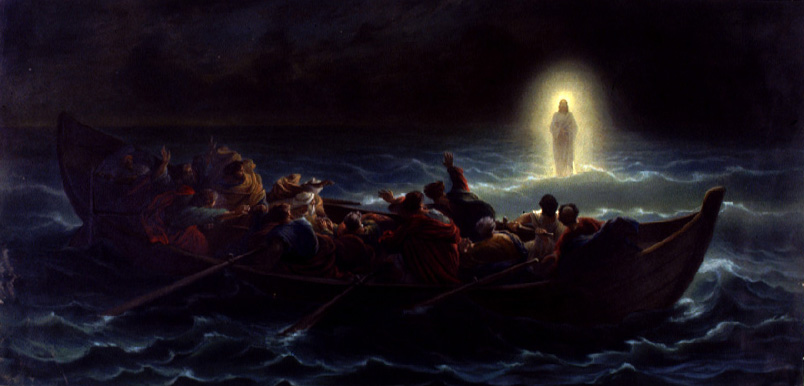
    Then he made his disciples get into the boat and precede him to the other side toward Bethsaida, while he dismissed the crowd. And when he had taken leave of them, he went off to the mountain to pray.

    When it was evening, the boat was far out on the sea and he was alone on the shore. Then he saw that they were tossed about while rowing, for the wind was against them. About the fourth watch of the night, he came toward them walking on the sea. He meant to pass by them.

    But when they saw him walking on the sea, they thought it was a ghost and cried out. They had all seen him and were terrified. But at once he spoke with them, “Take courage, it is I, do not be afraid!” He got into the boat with them and the wind died down. They were completely astounded. 

    They had not understood the incident of the loaves. On the contrary, their hearts were hardened.     Mark 6:45-52

    I am much more familiar with Matthew’s account of Jesus walking on the water than I am with Mark’s. The number of words and actions that stood out to me upon my recent reading of this passage tells me that anytime I’ve studied this particular story of Jesus, I made use of only Matthew’s account.

    Right out of the gate, I note that Jesus made his disciples go in the boat and leave him behind. It gives the impression that they didn’t want to leave, didn’t wish to be separated from him. They had just witnessed the miraculous feeding of the five thousand. They were likely amazed, but confused, and had questions for Jesus. I would guess they were looking forward to some time spent with Jesus without the crowd so the twelve of them could ask those questions and mull over what had happened. Instead, Jesus tells them to take the boat to the other side of the sea and leave him behind.

    On their way they encounter high winds and waves. It is stressful, exhausting, and possibly frightening. And Jesus is not with them. They don’t know he’s watching them from the shore. They don’t know he is seeing their travail.

    Then Jesus takes to the water. He begins walking across the sea. Easily could we think “He’s going to them.” Jesus must be walking to his disciples, his closest companions, friends, and followers. He sees their hardship and He is going to them. Thus my surprise when I read “He meant to pass by them.” What?! This is the line that baffled me when I read this passage recently. It’s been on my mind for at least a week. “He meant to pass by them.” He was simply going to walk by them and leave them to the storm? He wasn’t going to help? He wasn’t going to get into the boat with them and calm the wind? Really, Jesus? Why?

    It took until today, thinking on this yet again, to change my tune. “He meant to pass by them.” As in, He meant to get close enough for them to see Him. Close enough for them to call to Him, to ask Him to help. Yes. That is what Jesus meant to do. Instead of keeping His distance, waiting out the storm, or even helping from afar – instead of this, He would draw near. He would help them in the midst of their trouble. He would make Himself personally available to them.

    I’m not claiming this is the only possible interpretation of this moment in the Gospel. As far as what the disciples themselves realized about Jesus in that experience, I can’t speak to that either. I am simply speaking as a person of faith reading this passage yet again and considering the manner in which our Lord sometimes chooses to help His beloved ones. We might want Jesus to stay with us in the particular manner we prefer, but He says no, you must go forward in the way I’m instructing you. We may want Him to appear in our midst, in our struggles, and take over the helm of the ship. He instead draws near and waits for us to recognize Him and call to Him.

    God’s help, His saving grace and guiding hand, often come in surprising ways. He’s apt to choose the less obvious, the less understandable manner of meeting us on our wind tossed boats. And in every instance He commands, “Do not be afraid!” Do not fear! Trust in me! Know that I am here, that I, the Lord of Heaven and Earth, am available to you. I am here. Be not afraid.

    Faith, Holiness, Jesus

    Enduring Faith

    Today, my friend came home. For the last three years he has been serving a prison sentence, unjustly in many people’s opinion – including mine.  This man… well, I could spend this entire post summing up the goodness of this man and the effect he had on me during our time of closer friendship. But that isn’t the purpose of this post. The purpose is to honor the way, during the last three years, he lived the Scripture, “Rejoice in hope, endure in affliction, persevere in prayer” (Romans 12:12).

    I didn’t get an opportunity to visit Pete while he was in prison. I sent a handful of letters and cards and occasionally received a reply. The tone of those replies, the statements he made, added to the stories and descriptions I heard from his family and friends who did visit him, came as no surprise to me. They were true to Pete’s character. True to the young man I knew better years ago; true to the man I have always assumed he has continued to be since then. No, they did not surprise me, but that’s not to say they didn’t move me.

    Smack dab in the middle of his doctorate studies, ongoing cancer research at his job, and plenty of other endeavors and activities, Pete was punished for circumstances outside his control. He had reason to despair. He had reason to wallow and slip into depression. He had reason for anger. Yet, beyond a reasonable level of righteous anger, he indulged in none of these things. I’m not saying he didn’t have to struggle against them. I don’t know if there were days when they tried to sneak into his heart and fill him with discouraged resignation. I do know that he did not allow them to take over.

    Throughout the three years, Pete remained a man of hope. He remained a man of patience. He remained, above all, a man of faith. We are exhorted again and again in Scripture to endure trials and tribulations with the attitude of Christ. We are called upon to take up our crosses and carry them in the path of our Lord. In the Gospels, Jesus does not assure us that we will see justice prevail this side of Heaven. He does not promise to relieve from our lives the suffering that comes our way. Throughout the rest of the New Testament, the Apostles reinforce these realities of life in Christ.

    We are assured instead that there will be crosses and trials. We are told flat out that “in the world [we] will have trouble” (John 16:33). The promised reward is only received in full when this life has finished. The justice is meted out according to God’s terms and timing, not ours. The relief from the suffering is not guaranteed until Paradise.

    So many of us know these truths. We’ve heard them, read them, attempted to be accepting of them. In the moment though – the moment of darkness and pain – do we hold fast to them? There is no easiness in this aspect of the Christian life. It is why the stories of the martyrs and saints are such effective buoys of inspiration. We need to know it’s possible. We need to celebrate the lives of those who emanate the attitude of Christ as they carry their crosses. In them we gain encouragement to do likewise.

    This is what Pete gives to those who know him. Whether he ever realized it or not, each day that Pete chose faith, hope, and charity in his attitude, thoughts, and actions during the last three years, he allowed Christ to make use of him. He became an extension of the example set by Christ for us all.

    Pete isn’t a superhero. He’s not something other than what we are. Which means, we are all capable of acting in God’s grace to live with the attitude of Christ. In every circumstance – joy and suffering – from the most ordinary to the most extreme. By the Spirit of Christ, we are transformed. Let us live transformed lives. Let us honor those among us doing so right now.

    Advent, Christmas, Jesus

    Christmas is coming…

    I don’t know about you but it can be awfully hard to remember what I’m preparing for during this season. Okay, not that hard. I mean, I’m buying presents, baking cookies, listening to Advent themed sermons on Sundays. Obviously it’s Christmas that we’re preparing for in these present weeks. Better put, it can be difficult to appreciate and understand the result of that which we’ll celebrate on the 25th. Contemplation is a lost art. Stillness of mind and heart can seem impossible or even counterproductive. We always have to be doing enough, saying enough, moving enough. I’m as susceptible to this as anyone. But if I quiet down and hold still, what might I find?

    I might find that God is with me. I might find His presence to be full of consuming, transforming peace and joy and hope. All the things we wish for one another in our greeting cards, we’re walking through life surrounded by. They hang about us like the particles in the air of this room, invisible until we stop moving and look at where the light shines brightest.

    Mary knew how to do it, always “[keeping] all these things, reflecting on them in her heart” (Luke 2:19). Joseph knew how to do it, aware that the actions he took to be the guardian of the Savior were more important than any words he could speak. So our record of him in Scripture holds no words of his own, only listening, hearing the Word of God guide him, and acting upon it. Simeon knew how to do it, waiting and praying year after year for God to reveal the Messiah. His preparation made him know that Messiah the moment he saw the Holy Family enter the temple.

    “Don’t we love the word ‘with’? ‘Will you go with me?’ we ask. ‘To the store, to the hospital, through my life?’ God says he will. ‘I am with you always,’ Jesus said before he ascended into heaven, ‘to the very end of the age’ (Matthew 28:20). Search for restrictions on the promise; you’ll find none…. Prophets weren’t enough. Apostles wouldn’t do. Angels won’t suffice. God sent more than miracles and messages. He sent himself; he sent his Son. ‘The Word became flesh and dwelt among us’ (John 1:14).” (Max Lucado, Cure for the Common Life)

    With a little practice now – taking a bit of time each day to pray, reading through the Scripture story of the arrival of my Savior, thinking over this extraordinary truth as I perform ordinary tasks – maybe come December 26 and into the new year, I won’t forget that God is with me. Christmas brought Emmanuel, “God With Us,” but every morning brings another day that He is with me, another day for me to acknowledge and thank Him for being with me, another day to speak and move and act in a manner that declares I know He is with me and I choose not to forget.

    God is with us… may we always remain with God.