Catholicism, Faith, Holiness, Jesus, Love, Personal Reflection, Prayer

The Heart of Jesus – Pt 1

By human understanding and language, the heart is the seat of love. It is the place from which comes goodness and virtue. When we speak passionately or honestly, we are speaking from the heart. When we love someone to a particularly high degree, we give them our hearts and it is considered the most valuable gift one can offer another.

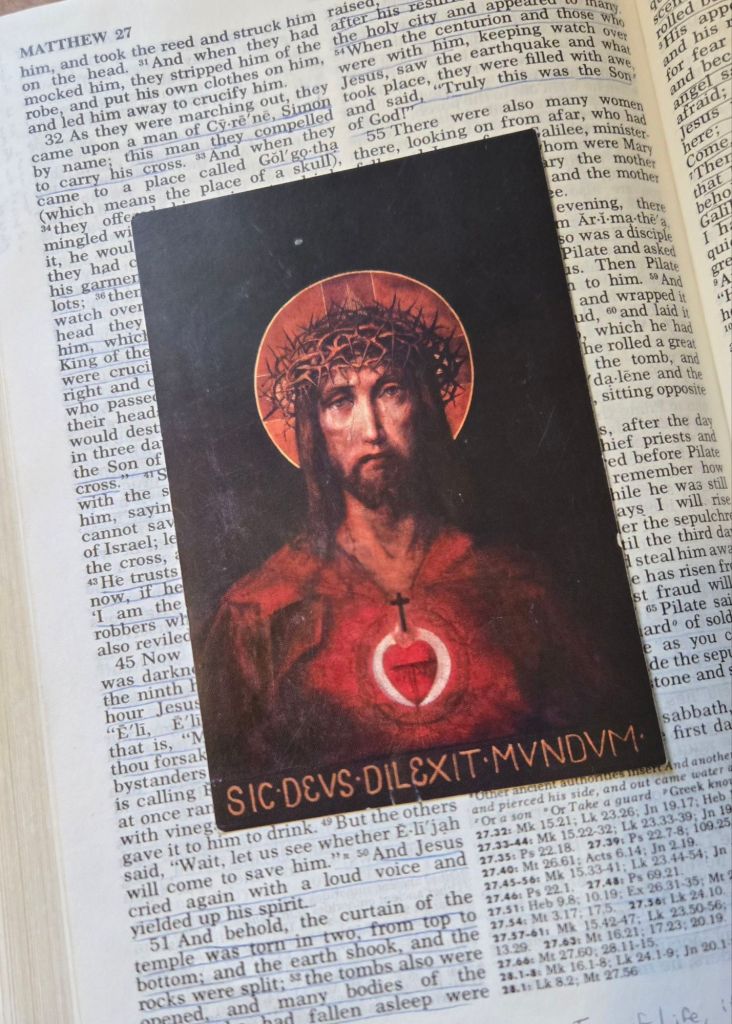
Jesus, fully God and fully human, loves us with divine love from his human heart. In the Sacred Heart – our ancient and holy title for the seat of our savior’s love – resides his perpetual care and desire for us, as well as his glorious character. All virtues and fruits of life, all in which we could seek to grow in our own hearts, exist in perfection and fullness in the Lord’s heart. Be it courage, wisdom, generosity, understanding, honesty, strength, or any other trait we might pursue, it flows from the bottomless well of the Sacred Heart of Jesus.

Great and wondrous, selfless and sacrificial, God’s remarkable love is offered by way of his heart. As a groom offers himself to a bride at the marriage altar, and the bride matches him in return, Jesus holds his heart out to us. He offers his wholehearted devotion, his mercy, his protection – all that makes up his love – by giving us his beautiful heart.

He invites us to match him in the offering. We cannot match Jesus in the perfection and fullness, yet that does not lessen his desire to receive our hearts, our devotion, and our love.

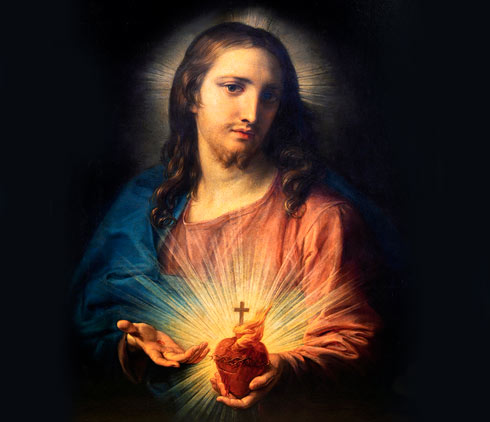
These realities course through my thoughts as I sit before an image of Jesus. It is a mere copy of a lovely old painting; one artist’s imagining of the gentle, solicitous expression of our savior offering his love to us in the symbolic seat of that love. His heart, radiant with light and wrapped in the crown of thorns worn when he died for us, is held out in invitation. Take it, he whispers to my soul. I am yours and you are mine, if you so choose.

The Sacred Heart of Jesus by Pompeo Batoni, 1767
Catholicism, Faith, Good Friday, Holiness, Hope, Jesus, Lent, Personal Reflection, Prayer, Scripture

The Good of That Friday

My sins are nailed on the cross with my Jesus.

My mistakes.

My failures.

My shortcomings.

My selfishness.

My self-loathing.

My rejections.

My punishments.

My shame.

They are nailed to the cross in the hands of Jesus and thus I can no longer hold them in mine.

With the repentant criminal beside him, I plead “Jesus, remember me when you come into your kingdom,” and he assures me that he does. He remembers me. He remembers the me known by the Father even before I was formed in my mother’s womb, stripped of the sins that mar that creation. With his arms spread on the bloody cross, he moves my sin and shame away from me, as far as east is from west.

This is the redemption of Christ. This is the good of that incredible, unmerited Friday.

Catholicism, Easter, Eucharist, Faith, Holiness, Holy Thursday, Jesus, Lent, Prayer, Scripture

To Whom Shall We Go – Holy Thursday Reflection

Jesus said to the twelve, “Will you also go away?

Simon Peter answered him, “Lord, to whom shall we go? You have the words of eternal life; and we have believed, and have come to know, that you are the Holy One of God.”

John 6:67-69

Simon Peter’s statement of commitment and faith comes after Jesus’s bewildering explanation of his being the Bread of Life. Surrounded by a crowd that followed him across a sea to continue hearing him teach and to witness his miracles, Jesus boldly declared that he is “the true bread from heaven,” “the living bread,” and “if anyone eats of this bread, he will live forever.”

As the verses pile up through John, chapter six, we hear these incredible words from Jesus and the unsurprising objections of his listeners. With each murmured doubt from the crowd, Jesus deepens his teaching. He reinforces it and makes no move to backpedal or soften the truth he is delivering to them – and to us.

Jesus is “the bread of life,” “true food” and “true drink” to be consumed by those who believe he is the way to eternal life. He is the fulfillment of every sacrifice and ceremonial meal of the Old Testament. He is the manna sent by the Father to feed God’s people, not for a day but for eternity.

When he finishes this discourse, the response that rose above the noise was, “This is a hard saying; who can listen to it?”

Isn’t that the question for me? For us?

It is the question that comes with the real presence of Christ in the Eucharist, and the necessity of that miraculous and baffling sacrament.

Just the same, the question accompanies every “hard saying” in the moral teachings of Christ and his church. It is heard behind the disciplines and virtues within the call to imitate Christ, which often fly in the face of what is deemed acceptable or good by the rest of society. From the unflinching declaration of Jesus that he is the way, the truth, and the life, the question comes in the appeal of the wide array of other ways, partial truths, and opposing lives I could live.

Who can listen to it? Who can accept it? Who can live it? The question arises from the voices around me and from deep within my own soul. I hear it echoing through times of suffering and confusion. When I don’t understand where to find God or what he is doing, it is heard above the noise.

“This is a hard saying; who can listen to it?”

Like the followers then, I, his follower now, can respond as many did when they “drew back and no longer went about with him.” Or I can speak in harmony with Peter – with imperfect yet wholehearted faith.

I can walk with Jesus with questions on my tongue, and still thoroughly convinced by all I do know and all I have seen and heard. I can trust that greater insight will come further down the road, just as it did for the disciples when the earlier words of Jesus replayed in their ears as he lifted the bread and wine at the Last Supper: “Take, eat; this is my body…. Drink of it, all of you; for this is my blood of the covenant, which is poured out for the forgiveness of sins” (Matthew 26:26b, 27b-28).

It is from this place of faith and trust that I gaze at the body of my Lord on the Cross and in the Eucharist. With that gaze comes a swell of love, awe, and peace. With that gaze, my soul sees its savior and answers, “Lord, to whom shall we go? You have the words of eternal life; and we have believed and come to know, that you are the Holy One of God.”

Advent, Christmas, Holiness, Intentionality, Jesus, Prayer, Saints, Scripture

My Soul Proclaims – Advent Reflection, December 22nd

Week 3, Friday – December 22nd

My soul proclaims the greatness of the Lord; my spirit rejoices in God my savior.”

Luke 1:47, NAB

We do not possess silent souls. Mary’s soul proclaimed the greatness of the Lord, and reading this verse brings me to the question of what my own soul proclaims.

The human soul was designed to proclaim what it revels in and thrives on from day to day. In some translations of the Bible we read the words “my soul magnifies the Lord” and what an equally true description that is. In words, responses, actions and attitudes, in perspectives on any human issue, and in how time is spent, every person is making a continuous proclamation of what fills their soul. We fill the earth – especially our families and immediate communities – with what our souls magnify. In turn, these proclamations have untold influence on countless other souls and what they will proclaim.

I can attest to how easy it is to roll along through my days, giving no heed to what my soul and spirit are magnifying at any given moment. Usually it is a mix of things, but always there is a choice. For if I do not pause and choose to proclaim what I know to be true, beautiful, and good, a thousand other influences are ready to fill up my soul and magnify what they will.

Life or death; love or hatred; faith or doubt; courage or fear; pride or humility.

Who I worship; who I serve; where my hope lies; the greatness of me or the greatness of the Lord.

My soul is always in proclamation mode, but some subjects offer far more lasting satisfaction than others. None, not one, surpasses the satisfaction of the greatness of God. In this truth I find the purpose of my soul’s ability to proclaim and magnify. I am meant for the glory of God, to give it, to experience it, and to draw others to it. St. Augustine spoke wisdom when he said “You have made us for yourself, O Lord, and our hearts are restless until they rest in You.”

When I am plagued by restlessness and dissatisfaction, I can pause and hear for myself what my soul is habitually proclaiming. If I find I have dropped the thread of truth, beauty, and the goodness of God, I can choose to pick it back up and drop the things that crowded that thread out of soul’s grasp.

At Christmas, may my soul, O Lord, proclaim You louder and more readily than it proclaims the busyness and burdens of the season. Let my soul proclaim the greatness of You, the God who comes to satisfy our restlessness for Him.

Advent, Catholicism, Christmas, Faith, Holiness, Jesus, Prayer, Saints, Scripture

Like Joseph Did – Advent Reflection, December 18th

Week 3, Monday – December 18th

When Joseph awoke, he did as the angel of the Lord had commanded him and took his wife into his home.

Matthew 1:24

Each time I read a gospel passage involving Joseph, I wish he’d speak up. This man lived with Jesus and Mary! He was the human father figure for the Son of God! Imagining his experiences fascinates me. For goodness’ sake, I want to hear from him!

Sorry, didn’t mean to get so worked up there.

Having no record of Joseph’s words does not mean he didn’t say anything. That’s a silly notion. So, why are there no statements or dialogue from him? Believing in the divine inspiration of sacred scripture, I come to one conclusion: what I read of Joseph is what God wanted me to get from Joseph.

Matthew writes that Joseph is a righteous man, and from this righteousness comes his planned course of action: to divorce Mary quietly after he found out about her pregnancy. For though they had already entered a marriage bond by Jewish betrothal, they did not yet live together or have relations as husband and wife. A righteous man among the Jewish people was one who followed God’s laws and commandments. Joseph would have been lawful to not only divorce Mary for her assumed infidelity but also to publicly shame her and even call for her to be stoned to death.

Joseph’s righteousness, however, is clearly coupled with compassion. He does not wish to associate himself with apparent sin and scandal but he also does not desire to publicly punish Mary. A quiet divorce was an act of mercy when Joseph’s possible choices are considered.

I am certain Joseph, being prone to righteousness and mercy, took such serious matters to prayer. I expect he sought out God for guidance. No record of his prayers are in the pages of scripture. What is recorded is God’s answer, and Joseph’s response to it.

God sent an angel while Joseph was asleep. Joseph went to bed that night with a decision made, then awoke with that decision trumped by God’s explanations and instructions. There, at that awakening, is where I am most eager to emulate Joseph.

He did not wake up and write off God’s message as irrational to follow. He didn’t hem and haw, mulling over doubts about what would happen if he did as God said to do.

Joseph awoke and did as God commanded. Once God made the way clear, Joseph stepped into it and no longer considered the other ways he could go, even though they likely felt safer and more reasonable.

From Joseph, I learn of faith producing the necessary fortitude to be who God calls me to be in the grand story of salvation. Joseph’s faith told him to listen to God and to trust in what he heard. It does not take a single word from Joseph for him to tell me likewise. That’s the might of authentic faith. That’s the fruit such faith bears.

Joseph’s piece in the story demonstrates that complex situations reach their best outcomes when submitted to God’s will. Like Joseph, I am not necessarily called to figure it all out and determine the best course of action by my reasoning alone. I am called to seek the guidance of God, and respond with trusting obedience to Him. It is encouraging that, in practicing this, that reasoning of mine can grow little by little to resemble the wisdom of God.

No matter the gap between my answers and the Lord’s, I pray that any time I am awakened to the instructions of God, I will rise and obey with a heart full of faith. Like Joseph did.

Advent, Christmas, Faith, Holiness, Jesus, Prayer, Scripture

The Author Takes the Lead – Advent Reflection, December 15th

Week 2, Friday – December 15th

I, the Lord, your God, teach you what is for your good and lead you on the way you should go.

Isaiah 48:17

A fun author experience that I’ve occasionally had is when someone tells me what should have happened in my story, or what my characters should have done. I’m not talking about hearing a reader’s opinion on a story, which is a genuine thrill every time, or about receiving constructive feedback from a fellow writer or editor. I’m talking about when someone essentially declares that they know better how to tell the story. The story that only exists because I imagined it. The story that is filled with characters who are my own creations.

Fun might not be the right word for this experience, but there is something laughable about it.

I wonder if God laughs sometimes when I assume I know better how to carry out His story.

We’re not fictional characters, but we are created by an author. We are created by the author; the author of the universe and of each individual life that has ever existed.

My experiences of God aside, simple logic suggests that the creator of my life knows better than anyone how that life ought to play out. He knows how I will get through the crisis points and how I’ll be blessed through the twists and turns. He knows best because He knows me, His creation, best.

If I follow His pen rather than take the pen in my own hand, God will write me a greater story than anything I could aspire to create. He is my true author, the one who determines what is for my good and what is the way I should go.

All the messages, marketing, opinions and ideologies, as well as peers, superiors, friends, and family, and even my own thoughts… there are so many voices willing to tell me how it all should go. Some with good intentions and some with evil in their minds, these voices speak. They shout. They whisper. They overlap and contradict, bringing confusion in their wake. There is only one effective test to determine which voices should have any influence: how do they hold up alongside the voice of my Lord, the author of my life?

It takes practice to listen to Him first and above the others. I’m rebuilding the habit myself. The more time spent tuning in to Him though, the more recognizable His voice becomes. Increasingly often, I find I can pick up on that voice no matter the volume of the rest.

Lord, I pray the remaining days of Advent will be a season of listening for Your voice. You spoke the fullness of truth in the Word made flesh, Jesus Christ, the Son of God. Speak truth into my story. I submit to You as the author of the greatest story of all, the one that brought salvation.

Advent, Catholicism, Christmas, Faith, Holiness, Jesus, Prayer, Scripture

A Marvelous Faith – Advent Reflection, December 4th

Week One, Monday – December 4th

But the centurion answered him, “Lord, I am not worthy to have you come under my roof; but only say the word, and my servant will be healed.”

Matthew 8:8, RSV

The fifth graders I teach at church on Wednesday nights are fluent in the language of distractions. The weekly lessons are often interrupted by random questions and comments from them, or by efforts to quiet their chatter by me. Once in a while, a question seems prompted more by the Holy Spirit than by the kids’ restlessness, and an unexpectedly rich discussion arises from it.

“What does humility mean?” That was the one in a recent class that derailed my lesson plan in all the right ways.

The centurion of Matthew, chapter eight stands in the forefront of my understanding of humility. I paraphrase his own words, in unison with the rest of the congregation, before receiving holy communion at Mass each week: “Lord, I am not worthy that you should enter under my roof, but only say the word and my soul shall be healed.”

Humility does not stop me from going to the Lord. Recognizing my unworthiness of God’s love is not an obstacle to receiving God’s love. Humility acknowledges my inherent worth, my abilities, and the value of my life in this world. Simultaneously, humility understands that all of that worth comes from being made in the image and likeness of God, and then being loved perfectly by Him. It says, “I am worthwhile, and all that is worthwhile in me ought to bring glory to Him.”

How better than that can I love Him back?

The centurion had faith strong enough to make Jesus marvel (Matthew 8:10). He was a Roman soldier, not a dedicated attendant of the preacher Jesus’s sermons; nor was he a man with opportunities to sit with Jesus, listening and speaking with Him as the disciples did. He was a ranking soldier managing the community, and likely hearing from various sources of the words and deeds of this Jesus of Nazareth. Perhaps he occasionally witnessed them with his own eyes and ears. Whatever his experience with Jesus, it was enough. He was a man who believed in what Jesus proclaimed and showed Himself to be. The centurion knew his unworthiness to host Jesus under his own roof, and also knew Jesus was exactly who he could and should turn to in his need.

That is humility. That is marvelous faith.

Lord, I am unworthy to be the temple you declare me to be. For you to dwell in me by baptism and nourish me with your own sacred body and blood is far more than I deserve. Yet you created me to be exactly that, your dwelling place. Even in humility, I can sing, “How lovely is thy dwelling place, O Lord of hosts!” (Psalm 84:1) and hope You marvel over any moment when my faith gives You glory.