Fiction, Short Story, The Summer Holiday, Writing, Writing Prompt

The Summer Holiday – Part Three

Part One


“Good evening,” Michael greets us. “You both look lovely. I am glad to see you.”

He addresses Aunt Rita too, but his gaze remains on me and I am surprised to see a touch of nervousness in his friendly expression.

“Good evening, Mr. Gable. I hope you are well tonight,” Aunt Rita responds.

“I am.”

I blush under his attention. He is even more handsome in this glittering, giddy atmosphere than in the midday sunlight. His black tuxedo is well tailored, with a pop of color in his emerald green pocket square.

The band begins another high spirited tune. Dancing couples cover the open space on the large, raised patio where the band is arranged, facing the ocean. The harmonizing notes fill the silence that falls between us.

Aunt Rita clears her throat. “I’m going to find some acquaintances.” She finishes her wine and places the empty glass on a passing footman’s tray. “Enjoy yourself, Mary.”

While I am wondering what I might say to encourage her in her mission for the night, she is already striding away with her chin high.

Michael looks toward the band and back at me. “Would you care to dance?”

Again, I am struck by his nervousness. It is slight, and if I did not have his self-assured demeanor of this afternoon with which to compare, I might not notice. Somehow, the alteration in him bolsters my confidence. This man, this stranger who feigned friendship in order to speak to me today, has a unique effect on me.

“Perhaps we could walk first and see the grounds,” I suggest. “I can’t say I’ve ever been to a party quite like this one. Have you?”

“Only here.”

He offers his arm and I slip my hand into the bend of his elbow. We begin to walk the circumference of the lawn and the crowd it contains.

“Do the Colemans host many of these?”

“Twice a year. This is their annual end-of-summer garden party.”

I laugh in disbelief. “Garden party?” Images of the garden parties I’ve attended flash through my mind: small gatherings of intimate friends; tea and finger sandwiches; quiet conversation.

“They like to take something average and raise the bar,” he remarks with a laugh. “Their other annual event is the Christmas party. That one is indoors, of course, and even more grand.”

The reality that I know nothing about Michael is dominant in my thoughts. “How do you know the family?”

“I am a second cousin. Mrs. Coleman’s maiden name was Gable.” He greets someone as we round a back corner of the courtyard, then returns his focus to me. “And you, Mary? If this is your first Coleman celebration, how did you happen to be here tonight?”

I admit, “We weren’t invited.”

“Do tell.” His eyes widen with curiosity.

“I don’t think I can.”

“You are more a mystery than I expected.”

“I’m not, truly, but it turns out my aunt might be.” I leave it at that, unwilling to confide Aunt Rita’s secrets.

Michael stops beside a stone fountain at the end of the courtyard. It is a circular structure with a tall statue of a heron perched on a pedestal at the center. The bird’s wings are spread as if about to take flight. Water flows from the backs of its wings and around its feet down into the tiled bowl below. We admire it in silence. The band segues into a softer, slower melody.

“You’re a bit of a mystery yourself, Michael.”

“Tell me about yourself, Mary.”

“I was about to make the same request.”

“You first. Tell me anything you’d like.”

He lets my hand slip off his arm and takes a seat on the edge of the fountain.

“My full name is Mary Eve Harper and I have lived in Boston all my life. I have an older brother and sister, both married. I teach piano to schoolchildren, which I rather enjoy. I paint, though I’m terrible at it. I have a collie named Jasmine and a nephew named Paul, and I love both of them dearly.”

I ignore the wave of embarrassment I feel over the bits of autobiography that tumbled from my mouth without forethought. “It’s your turn.”

“Fair enough.” He thinks for a moment. “I live in Manchester. I’m a civil engineer for the city, as is Tommy, whom you met this afternoon. I have four sisters, two older and two younger. I have a spaniel named Devlin. He’s my bird hunting partner even though he’s fairly useless. I’ve vacationed here in Hampton Beach with my family every summer of my entire life except when I was eight years old and sick with the measles. I almost didn’t come this summer, but I am exceedingly glad I did now.”

My cheeks blush madly and I’m thankful for the low light of the lanterns in the courtyard behind us.

“I do have to add one more thing.”

I wait.

Michael fiddles with the buttons of his jacket, diverting his eyes from mine. “I’ve been watching you all week.”

My mouth drops open and I take a step back. “Excuse me?”

“No! No, I said that all wrong.” He half groans, half laughs. “I’m sorry. I mean, I’ve seen you around the town throughout the week. I mean, I’ve noticed you several times this week.”

I bite my lip, unsure if this is an improvement.

Michael leaves his seat on the fountain and stands in front of me. His voice softens. “I first saw you on Sunday, walking with your aunt on the boardwalk and wearing a blue hat. I was drinking coffee at an outdoor table at a café. You passed right by me,” he refuses to drop his eyes from mine, “and I wanted to follow you then and there. You were conversing with your aunt, but your eyes watched everything around you. You looked like you wished for nothing less than adventure.”

I remain stunned and speechless, but also thrilled in a manner that makes me anxious.

“Then you were in the crowd at the concert in the park on Tuesday evening, and I saw you again the next day when you were eating lunch with your aunt and someone else, one of her friends, I guess, at the same café where I had coffee on Sunday. I just finished brunch with my parents and aunt and uncle when you arrived there. That’s when I promised myself I’d speak to you somehow the next time I saw you.

“I waited for my next opportunity, watched for you everywhere we went. I had Tommy on the lookout for you too,” he says with a chuckle. “You can imagine how relieved I was this afternoon when I realized it was you and your aunt walking so closely behind us on the boardwalk. I’d begun to wonder if you’d left town already.”

He raises an eyebrow. “You didn’t notice me even once before this afternoon, did you?”

“I’d be lying if I said I did.”

Nerves threaten to disband the gumption I’ve somehow possessed since meeting Michael today. Behind the fountain is a gravel footpath extending away from the house and toward a manicured maze of tall hedges. I walk to the path without a word and hear Michael follow. Our feet crunch on the stones covering the narrow lane. Rosebushes laden with late summer blossoms in an array of hues – red, pink, white, orange, yellow – line the length of the path. I stare at one perfect, pink bloom and am overcome by the beautiful unexpectedness of this night.

Before we reach the entrance to the hedge maze, I stop and Michael comes around in front of me. I want to tell him every thought in my head. I want to tell him I’m flattered, but that is an entirely inadequate word for what I feel. I want to say I wish we’d met on the first day I arrived instead of a week into my stay. I want to ask if he ever visits Boston for any reason at all, and if I might be a reason to visit if he does not. My search for words lasts longer than I’d like.

“Have I scared you off?” he asks, hands in his pockets and eyes on his feet.

I inhale the intoxicating fragrance of the flowers, then I lay my hand on his smooth cheek. The feel of his skin against my palm startles me, as if I didn’t realize I was touching him. He frowns when I drop my hand back to my side. I do not want to make him frown.

“Does your invitation to dance still stand?”

The party, the patio, and the band are all behind me. He looks over my shoulder and asks, “You want to go back?”

I shake my head.

He surveys our spot here on the white gravel path, with its rosebush walls and high-rise, starry ceiling. His smile reappears and, with a deep bow, he extends a hand. “Would you do me the honor, Miss Harper?”

Mirroring the smile while suppressing a giggle, I curtsy. “It would be my pleasure, sir.”

We sway and turn with the distant music. His hands, one wrapped around my fingers and one on my waist, are warm, like the inside of my chest where my heart beats at a doubled pace.

“If you tell me you are going home tomorrow, my summer will be utterly ruined,” he declares.

I laugh aloud, setting a sparrow flying from its hiding spot in a hedge. “We are here another week.”

He twirls me out and back in again. “May I take you to lunch tomorrow?”

I nod.

“Tomorrow, I’ll ask to see you on Monday.”

I nod again. Anticipation tingles in my fingertips.

We slow our dancing though the music’s rhythm does not change. “On Monday, I’ll ask for Tuesday, and then for each day that remains.”

“We’ll have a splendid week.” I am breathlessly aware of how near his face is to mine. I almost ask about after, about letters or telegrams or visits, then I tell myself to enjoy tonight. Tomorrow, I will enjoy tomorrow. I’ve never felt that the days ahead must be known before they arrive, and I don’t wish to start now.

As if reading my thoughts, Michael winks the way he did in the first minute of our first meeting. “Maybe I’ll take piano lessons in the fall, in Boston.”

The song comes to an end and we stand still. Statues sculpted in a dance. I try to remember what it was like to be unfamiliar with his smile. We are both holding our breath until we laugh in unison at ourselves. He releases my hand and my waist.

“Would you like to return to the party? You haven’t even tasted the food, have you?”

At the mention of food, I realize I am famished. Back at the hotel, Aunt Rita only ordered a light supper for us while we prepared for the party. Knowing all I know now, I realize she was likely too anxious to eat.

“Food does sound good, thank you.”

Before we can step from the shadows of the tall hedges though, we hear footsteps. Two people deep in conversation, and clearly assuming they are alone, approach on the gravel path. I freeze.

“It’s okay, Mary. We won’t be in any trouble for walking back here.”

I shake my head. I know immediately the identity of one of those voices, and I feel certain in my guess at the other. Grabbing Michael’s wrist, I pull him through the entrance of the maze. There are only the stars to see by now, tucked away behind the eight-foot-tall, two-foot-thick hedge.

Michael peers at my face in bewilderment. “What’s wrong?”

How can I explain? I cover my face in my hands, realizing how ridiculous I must seem. “I’m sorry,” I whisper. “It’s my aunt and Miles Coleman.”

To be continued.

Read Part Four here.

Fiction, Short Story, The Summer Holiday, Writing, Writing Prompt

The Summer Holiday – Part Two

Read Part One here.

We hear the music before we see the estate. Trumpets from the band herald the night’s arrival. A sumptuous night it is, too. Sky thick with stars, the day’s heat still hanging about but tempered by the salted breeze off the ocean. It is end-of-summer splendor.

Our hired driver putters up the driveway, behind and before at least a dozen other cars delivering guests to the soiree. The scene unfolding with each forward movement sheds new light on the preparations Aunt Rita insisted upon in the last several hours: new gowns in the most current style; hair curled and pinned to perfection; polished shoes and glittering, albeit modest, jewels.

I have spent the time trying and failing to ask my aunt not only why the party necessitated such measures, but why we are attending this party at all. Though the name feels intangibly familiar, I am not aware of any personal connection to the Colemans. I am certain Aunt Rita has never mentioned them before. Yet here we are, pulling ever closer to the front steps of their impressive mansion, readying our skirts and shawls to emerge from the car into the glittering crowd milling about the lawn.

Finally, entirely too close to our exiting the vehicle, my aunt rushes to explain.

“The Colemans,” she begins with a clearing of her throat, “reside in California. Their home, Grove Palace, is a vineyard. Their wines are among the most superb wines currently being bottled. This is their vacation home.”

I gaze out of the automobile’s rectangular window. Only two vehicles remain ahead of us. I can see the valets ushering the guests from their cars. The mansion is larger than any I’ve seen in the region. Three stories, a pillared façade, and as wide as the full city block that contains my family’s home in Boston. Candlelit lanterns flicker in every window and line the paved path to the lawn. Guests adorn the courtyard and gardens like sprinkles on a cake.

“Do you know them?” I ask.

When Aunt Rita doesn’t answer, I look her way. She bites her lip. She is lovely tonight – a description I have never applied to my aunt. Her usually stern features are softened by the dusting of powder and rouge, as well as the fetching arrangement of her hair. Looking past me and out the window as we roll forward, she sighs.

“I knew them.”

“When?”

“A lifetime ago.”

We move again and before the wheels are still, a man in a tuxedo opens my door and offers his hand.

We keep to the edge of the activity. I feel like a moth in a butterfly garden. A footman presents a tray of beverages. Aunt Rita chooses a red wine and I pick a crystal glass filled with pink punch. The first sip tells me it is not merely punch. It burns deliciously in my throat.

My eyes roam. Face after face, glowing in the lantern light, beautiful but unfamiliar. I watch for Michael and wonder if I’ll recognize him. His smile is the most lasting impression left from our boardwalk encounter.

Aunt Rita interrupts my search, “Miles and I were to be married.”

“Miles?” My deceased uncle, my mother’s brother, was named Otto.

“Miles Coleman.”

I stutter over this bit of information. “What, what do you mean?”

“We weren’t publicly engaged, but privately.” Aunt Rita purses her lips. Her eyes look wet. “Privately, we were promised to each other.”

I face her, the strangers’ laughter and conversations fading to the background. She has never spoken to me of her younger years. She is still staring into the crowd, or perhaps beyond it. For a moment, my eyes see her as a woman I do not know, another stranger at this party. She is not old, though I think of her as such. Fifty-two, healthy, her body trim and her hair still dark and full. It is her frowns and general air of disenchantment that ages her. And her walking cane. Her use of it is only a habit after requiring it for a year after an injury to her foot. She does not need it, and for the first time, she left it at the hotel tonight.

“I summered here for two years when I was very young, seventeen and eighteen, with my dearest friend and her family. They owned a cottage in Hampton Beach. I met Miles my first week here that first summer, and spent every possible minute with him. I loved him with my whole, naïve heart. For the year in between our two summers together, we wrote letters. Dozens of letters. Before the end of the second summer, he proposed to me. He was twenty at the time. We decided we would wait to announce it, we would wait to marry, until he finished university. He had two years of schooling left before he was to join his family’s business. That was the plan. That was the promise we exchanged.”

The remembrance, the revelation, thickens her voice. One shaking hand she presses to her chest while the other lifts her wine glass tremulously to her lips.

“What happened?”

“Three months after his proposal, he told his parents our plans. They objected. With each month that he insisted on marrying me, their objections grew stronger. Eventually, they demanded he make a marriage that was advantageous to the family. My middleclass roots and my father’s unremarkable financial standing didn’t fit the bill. They pressured. He slowly weakened. We were thousands of miles apart. There was little I could do. Nine months after his proposal, he undid our arrangement. Three months after that, he wrote a final goodbye and informed me of his upcoming marriage to the daughter of a family friend. I have not seen Miles Coleman in thirty-two years, Mary, but I will see him tonight.”

I try to respond. I try to sort out the right thing to say but my tongue is dry and my thoughts are foggy. The pink punch and the revealed secret are a heady combination. “Why now? You take your holiday here every summer. Why see him now?”

“Do you know why I take my holiday here every year?” She doesn’t wait for a reply. “To remember that girl. To remember that version of myself from those memories really existed, and to feel I might still be her. I come here to remember I did love like that once. I need to remember.”

Aunt Rita sips her wine, wine that, I assume, is a Coleman Family vintage. “I never tried to see him though, not once in the sixteen years I’ve come here. So, ‘why now’ is a terribly good question, Mary. Of course, the notion crosses my mind each and every year. To what end, though? That is the question that stops me each year.”

“Except for this year,” I say.

“Yes, except for this year.” She sips again. The glass, as she tips it to her mouth, seems to catch the moonlight itself and sets her visage aglow. Her eyes are dry now, and open wide. “When your acquaintance, who is clearly not your acquaintance,” she smiles a little, “asked if we were attending tonight’s soiree, I decided then and there it is time to meet Miles again. I cannot explain it better than that, I’m afraid.”

“You aren’t asking yourself, ‘to what end’ this time?”

“Oh, I certainly am. I stopped caring about the answer though. Even if it is only to see his face again, or,” she swallows hard, pushes out her next words, “or maybe meet his wife, I need to be here.”

As Aunt Rita falls silent, I see him. I recognize his smile in an instant, then every feature of his handsome face.

“You knew Michael was a stranger?” I ask.

My aunt casts a sideways glance at me. “I was not fooled.”

Michael is only steps away.

“Guard your heart, Mary, but not too tightly.”

To be continued.

Read Part Three here!

Fiction, Short Story, The Summer Holiday, Writing, Writing Prompt

The Summer Holiday, Part One

We are here for the day. Had rather be with you.
Mary H.

I scrawl the message in haste and add the stamp to the card. I’ll post it with the hotel clerk when I return there tonight. There is much more to say, but not on a postcard. Ann will understand, assuming she can manage to read my handwriting.

The scene along the seaside boardwalk differs little from the one captured on the postcard: busy, crowded, overdressed. I do not understand why people put on their best to visit the beach. Sand belongs between toes and dusted around damp ankles. Folks in their suits and dresses and high laced shoes can’t possibly enjoy the beach the way it deserves. My aunt, much to my dismay (though not my surprise), is one of those folks.

A week ago, I came up from Boston to accompany Aunt Rita to Hampton Beach. It is her annual summer holiday. The one about which we receive a four-page letter at the close of the summer, detailing every morning, noon, and night of her two weeks there. My mother insists on reading the letter in its entirety to the family. I have the same thought every year: Lord, if I ever can manage to take an annual seaside holiday, please don’t let it be as a dreary as Aunt Rita’s.

Now, here I stand, staring at the crowds and motor cars on the boardwalk, waiting for Aunt Rita to finish perusing yet another shop in which she will buy nothing and critique everything. The breeze is light today; too light. The humidity and heat of the unobstructed sunshine make me wish for my swimming costume and a dip in the water. My straight, auburn hair slips repeatedly from its pins. Pieces stick to my damp neck and cheeks. I wipe my forehead with a handkerchief and shade my eyes against the sun. It can be lovely here, under the right conditions. These are not quite the right conditions.

When Aunt Rita exits the shop, I supply a bright smile. I know she doesn’t want me here, so the least I can do is be cheerful. She has openly loved her independence since her husband’s death sixteen years ago. (Amazing how the possession of money renders such independence an enviable blessing, whereas my own state in life evokes only pity.) When her children insisted that this year she allow someone to accompany her to the seaside, Aunt Rita reluctantly agreed. At twenty-six and unmarried, I was the naturally chosen companion.

This is why the terribly short note on the postcard to my lifelong, dearest friend Ann will speak volumes. She knows. I don’t need to explain.

“They need to dust their shelves every day,” Aunt Rita says when she rejoins me and we step back onto the boardwalk. “Everything in there was gray with dust.”

“Mmmhmm.”

“Don’t mumble.”

My eyes flit between the blue water to my left and the two men in front of us on the walkway. They stroll at a pace too leisurely for Aunt Rita. She supplies a series of supposedly inconspicuous huffs and sighs as we slow our own steps behind the men. I tune my ears to the foamy waves instead.

Within a few yards, her less than subtle hints must be heard by the men, for they step aside and tip their hats as we pass. Yet, once we take the lead and regain Aunt Rita’s standard march, the men do likewise. I turn my head enough to be sure it is them so close behind us. The man behind Aunt Rita winks before I face forward again, and I cringe, imagining the lecture on rudeness that Aunt Rita will likely deliver if she realizes these young men are amusing themselves in such a manner. I walk a tad faster.

She taps her walking cane against the boards. “Mary! Whatever is your hurry?”

“Yes, Mary,” says the winking man. “How can you enjoy the views at such a speed?”

There is a sparkle of fun in his brown eyes. His smile is wide and unashamed.

“Do we know you, gentlemen?” Aunt Rita demands.

A blush spreads over my already hot cheeks.

“We’re friends of Mary.” Another wink comes my way.

A thrill with which I’m unacquainted possesses me and I play along. “Of course,” I say with barely managed confidence. “This is Mister…” I let my voice fade and he jumps in.

“Gable. Michael Gable.” He bows toward Aunt Rita. “This here is Thomas Lafferty, my colleague.”

“Pleased to meet you, ma’am. Lovely to see you again, Mary.” Thomas plays along too, though with less ease than Michael.

I nod. “Yes, it is lovely. It has been a long time since we last met. This is my aunt Rita.” There is no accounting for how widely I am smiling. I imagine describing it all for Ann in a proper letter.

The introductions complete, I am left wondering where we can possibly go from here. Michael continues the ruse without hesitation.

“Was it in New York that we last saw you?”

“No, no,” I say, aware that my aunt knows I haven’t been to New York in many years. “It was in Boston.”

“Christmastime, last year?”

“I believe you’re right.”

Michael frowns, though it is an expression in danger of reverting to a smile at any moment. “How is your mother?”

“She is well. It is kind of you to ask.” I mirror his seriousness.

Aunt Rita watches with her wrinkled mouth agape.

“How fortunate that we would see you here!” Michael says. “We must catch up properly. There is a soiree at the Coleman estate tonight. Will you ladies be attending?”

To this, I can make no reply, for Aunt Rita is the guardian of the daily schedule. When I chance a look at her though, it is clear Michael has peaked her interest. We all wait for her to speak, a collective suspense in the humid air.

“Coleman, you said?” Aunt Rita asks.

“Indeed.”

“The Grove Palace Colemans?”

“The same,” Michael confirms.

Aunt Rita smooths her skirt. “Yes, Mary and I plan to attend.”

“We do?” I ask.

“Yes, we do.”

“We do.” I repeat.

“That’s splendid.” Michael claps his hands together. “We will arrive by nine o’clock. I shall keep an eye out for you.”

I only nod, equal parts delighted and stunned by the exchange.

Michael lifts and kisses Aunt Rita’s hand. He takes mine next. His fingertips press into my palm while his thumb massages in a circle below my knuckles. He plants a soft kiss on the same spot. When he stands straight again, he tucks a loose piece of hair behind my ear. Aunt Rita clears hear throat.

“Until tonight, Mary.”

The men enter a shop after another tip of their hats.

Aunt Rita fires forward on the boardwalk, her cane tapping out her cadence. “Oh, we must hurry, Mary. There is much to be done.” I hear her whisper into the August heat, “A soiree at the Colemans. Surely, he’ll be there. Finally.”

To be continued.

Read Part Two here.

A to Z, Fiction, Flash Fiction, Love, Marriage, Writing, Writing Prompt

A to Z Flash Fiction: Catharsis

C: Catharsis

I walk two blocks west from my hotel and spot the wooden sign for The Griffin. When I asked the front desk attendant for a recommendation of both the best Reuben sandwich and the best whiskey old fashioned, this was his immediate answer.

As I push open the door, I loosen my tie and undo the top button of my white oxford shirt. I scan the room.

It’s large. Dark, polished wood, red accents, and brass hardware under dim, golden light create a weighty ambiance. There are about a dozen patrons inside, each silent or conversing in their lowest voices. The mahogany bar runs the full width of the front of the room.

I pick a stool near no one and order my first round from an indifferent bartender. He keeps his eyes on a muted flat screen television on the adjacent wall. It’s a re-broadcast of this afternoon’s Dodgers-Giants game.

While I sip my drink and peruse the kitchen’s menu, a man sits on the stool to my left.

The bartender immediately hands him a Budweiser without a word from either of them. He’s about my age, I discern from a sideways glance, though his hands look older. Their calluses and knobby knuckles remind me of my father’s hands. My father was a union man in an iron foundry for forty-two years.

I wonder briefly what this man does for a living, but the curiosity passes. There’s only one thing that occupies my mind tonight. One person.

My food order taken, the bartender brings me a second cocktail. I turn the glass in my hand. The slick condensation transfers from the glass to my fingers.

“Ricky?”

My neighbor on the next stool is peering at me with bloodshot eyes.

“Ricky! What’s it been?” he slurs. “A few years, I’d say. How you been, man?”

“I’m not Ricky, sir.”

His raspy laugh turns into a cough.

“What are you going on about, Ricky? I’d know you anywhere.”

“My name is David. I’m not Ricky.”

“Aw, don’t be like that, man. It’s good to see you.”

He swats my shoulder and almost slips off his stool.

I decide to ignore him. My brain returns to the same questions plaguing me since I flew to this city on Monday. It’s Thursday now.

How’s it going to be when I get home? More of this? What do I want it to be like when I get home? That last question is the one I know I need to answer.

“You heard what happened, I’ll bet.”

The man is teetering on that thin line between thoroughly intoxicated and sloppy drunk.

I stare into my glass after taking another swallow.

“Yeah, of course you heard what happened to my Jenny.”

He doesn’t seem to care that I’m not responding. I look toward the bartender for aid but his eyes are on the already played ballgame.

“Can I confess the truth?”

The man leans in as if he’s whispering, though he is not.

“Sure, sure, I can. You’re an old friend. You won’t tell.”

I shake my head, wishing I’d stayed in and ordered overpriced room service.

“I think I killed her.”

My fingers stop tracing the rim of my glass. I turn my head a little and meet his eyes. They’re wide and bleary.

He waits and I find my voice.

“Listen, sir. I’m not Ricky. Maybe you need to have a water, or a soda, and sober up a little.”

It’s as if I didn’t even speak.

“Geez, it feels good to admit that. Really good. I mean, don’t call the cops or nothing. I didn’t kill her.”

I raise my eyebrows.

“But still, I think I killed her.”

He goes silent for more than a minute and I hope it’s over.

It’s not.

The man downs the last of his beer.

“She only took drives like that when I made her mad. Fast. Old roads. Curves and hills.”

His voice fades out. There are fat tears on his cheeks. I doubt he even knows they’re there.

“‘You’ll kill yourself, driving like that, girl!’ That’s what I used to tell her. ‘Good,’ she’d say. ‘I have a way to do it then when you make me want to.’”

I shudder at the darkness of this exchange he had, more than once, with Jenny, whom I assume was his wife or near to it. Even as I think on it, I am flashing back to the bitter words that filled the air of our living room on Sunday night, and the cold indifference Josie and I maintained the next morning until I left for the airport. No calls, no texts. None, this whole week, and tomorrow I fly home.

“I made her so mad that night. Madder than I’d ever seen.”

He pounds on the bar and the bartender looks our way.

“Another!” he calls.

The bartender shakes his head.

“No can do, McNeil. I already called your cab. I warned you that bottle was your last for tonight.”

McNeil scowls. Then his expression clears and his focus is back on me.

“Do you think she meant to do it, Ricky?”

My mouth is dry. My drink is empty.

“Do you think she meant to hit that tree? Maybe, man, maybe. Either way, it’s on me. I knew what I was doing to her. I knew. I killed her.”

“Cab’s here,” the bartender interrupts.

“I could’ve stopped her, Ricky. I could’ve made it good.”

He stands and wobbles in his steel-toed boots. I see the grief, the self-loathing, in the lines of his face and the drop of his broad shoulders. He’s a large, muscular man, but he walks like a weaker, older version of himself.

After I watch him go, I rest my elbows on the bar and my head in my hands. Josie’s face fills my vision. The bartender slides my plate in front of me, but I stand up and mumble that I’ll be back in a minute. I reach for the phone in my pocket.

“I have to call my wife.”

A to Z, Fiction, Flash Fiction, Love, Writing Prompt

A to Z Flash Fiction: Bisou (Kiss)

B: Bisou (Fr: Kiss)
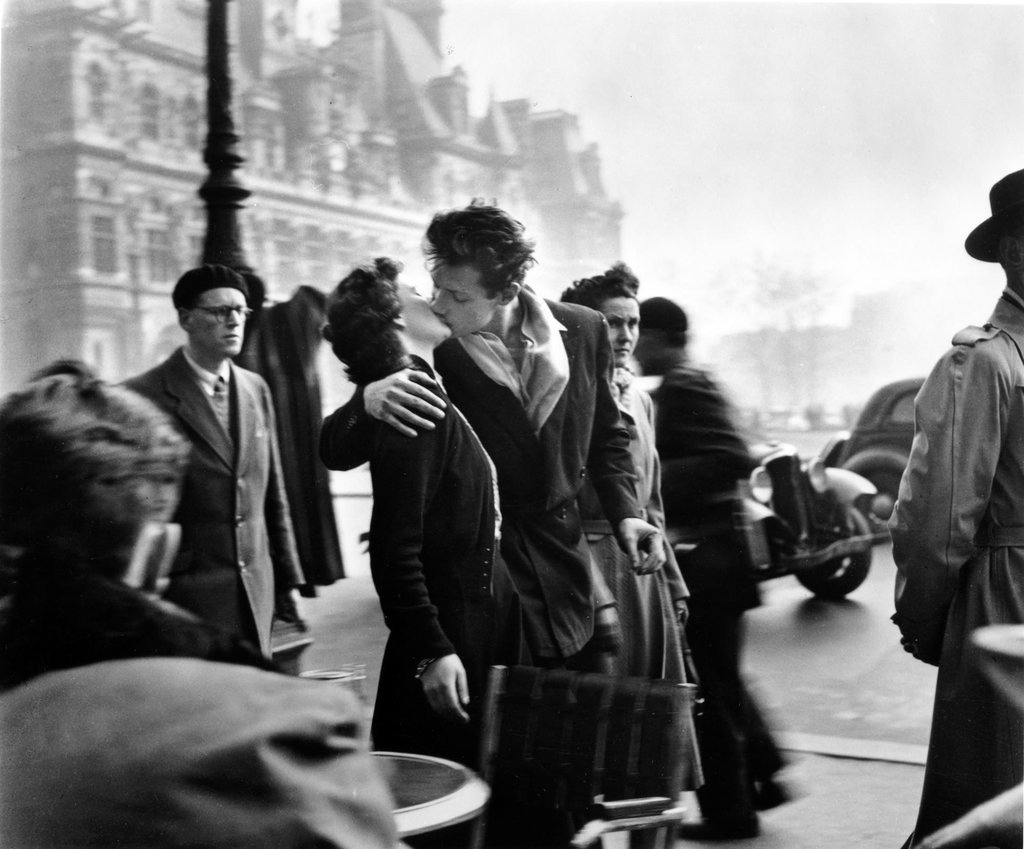
Photo Prompt: The Kiss by the Hotel de Ville, by Robert Doisneau

I sit at my usual table by the sidewalk, facing the Hotel De Ville. I drink my usual coffee, and take slowly paced bites of my usual croissant. People pass in their usual way, silent beside the street filled with noisy motor cars. All is as usual.

Then, it is not.

A couple appears. They are young, considerably younger than I. Pretty, but still blending with the stream of pedestrians. In front of the table beside mine, he stops. His arm is around her waist, so she stops too. He moves his arm to her shoulders, drawing her into his side as he dips his head toward her. Her graceful neck stretches, turns to match him. His lips meet hers, urgent and sincere. It is beautiful.

“The Kiss by the Hotel de Ville” by Robert Doisneau, 1950

It all happens in a matter of five seconds, maybe fewer. The kiss lasts as long, then his arm slides back to her waist and they walk on. Phantom smiles on their lips; a blush upon her cheekbones; and with no notice of the other persons in the flow that they rejoin on the sidewalk, they are gone.

My hand trembles around the porcelain coffee cup. The only thought in my mind slips through my lips in a whisper, “How long is it since I’ve been kissed like that? Have I ever?”

A memory flashes like a film reel. Yes, I have.

It is night, more than ten years ago. We walk beside the Seine. There is space between us, and then there is not. He takes my hand, pulls me in, and kisses me for the first time – the only time – for he is my friend and nothing more. His kiss is earnest. I feel his fingers tighten with mine.

I hear his voice in my head and I close my eyes to listen.

“I needed to do that,” he says.

But I am too stunned to speak.

“Should I apologize?”

“No,” I manage.

My fingertips rest on my lips, although I do not remember lifting my hand there. Every emotion, every sensation, returns to me, in the aftermath of those strangers’ kiss. How had I forgotten?

No, I did not forget, but I had not remembered either.

I lift my coffee for a drink, my hands no longer shaking. A smile teases at my lips. I reckon it is a match for the smile the woman on the sidewalk wore after being kissed like that, after being kissed like I have been before.

*****
Let’s get back to basics, my friends. Specifically, the alphabet. I’ll be writing a series of flash fiction pieces off of one word prompts, from A to Z. Enjoy! And if a word comes to mind for any upcoming letter, please make your suggestion and I’ll consider it for a prompt.

A to Z, Fiction, Flash Fiction, Intentionality, Writing, Writing Prompt

A to Z Flash Fiction: Aspire

A: Aspire

“What do you aspire to be?”

The odd question echoed over the noise in Sasha’s head.

Raina waited as patiently as a therapist.

Sasha waited too. She tucked her errant curls behind her ears. She crossed her legs under the table. She waited for an answer to come. The question made her want to laugh. Aspire? I’m not sure I remember the meaning of the verb. 

Raina finished waiting. “You know I love you, right?”

She nodded. “That’s usually what you say before you tell me I’m a fool.”

“You’re a fool.”

She did laugh a little then, and it felt like the first time she’d breathed today.

“You made me promise to tell you when you’re being a fool, ever since you almost switched universities to follow that chump Carter.”

“Carter was not a chump.”

“Carter couldn’t spell chump.”

Sasha stared at her chicken entree, fighting a smile.

“His brain tree was more of a shrub.”

There was no helping the laughter now. She caught her breath. “Mother of pearl, he was hot though.”

Raina smirked over her glass of iced tea. Drops of condensation fell to the table as she took a drink.

They sat on the patio of their favorite pub. Sasha had called the emergency convocation over her dilemma. When in doubt, consult Raina. It’d been her policy since sophomore year – the year of the infamous Carter. Raina never failed her in the seven years since.

“So, my fool of a friend, whats your answer?”

Sasha paused, her fork hovering at her lips. “Answer to what?”

“What do you aspire to be?”

“That’s  a job interview question.”

Raina shook her head. The ends of her sleek amber hair swung in unison around the base of her neck. Her eyes moved from Sasha to the view across the street. A mist floated over the bay tonight, not thick enough to be called a fog. The oscillating lamp of the lighthouse cut through the mist to the open water. An empty fishing trawler, tied to the dock, bobbed on each swell and fall of the water in a hypnotic rhythm.

Her eyes still on the water, Raina said, “You asked me that question once. It was during finals week, first semester junior year.”

“I did?” She couldn’t summon the memory.

“It was during your annoying step-by-step planning phase.”

She did remember that part. “I was not annoying,” she objected even as she laughed knowingly.

Raina raised her eyebrows. “You planned everything. Everything. ‘Nothing will happen if you don’t make it happen!’ That was your motto. It drove me crazy. One of the times I complained, you asked me what I aspired to be.”

“I was clueless.” Sasha shrugged.

“You were,” Raina agreed without apology. “But you changed the course of my life.”

“Don’t be ridiculous.”

“I’m not!”

Sasha took another bite. She watched her best friend, wondering what Raina was trying to convince her of with this claim. Raina was the poster girl for following your passions, naysayers be damned.

“I blew off your question but I couldn’t get it out of my head over Christmas break. When I came back in January, I decided I’d had enough of the coasting I’d been managing since starting school. If you remember, that’s when I switched over to the biomedical engineering program. So, yeah, changed the course of my life.”

“I had no idea,” Sasha said, mulling this over.

“Maybe you need to tap into that annoying, ambitious version of you from years ago. When’s the last time you aspired to be what you actually want to be? That’s all I’m asking. You don’t even have to answer me, but promise you’ll think about it as you make this decision.”

“I promise.”

“Good.” Raina took another drink. Her voice still reflective, her eyes back on the mist over the bay, she said, “Carter really was hot. What do you think ever happened to him?”

Sasha lost her breath laughing.

*****
Let’s get back to basics, my friends. Specifically, the alphabet. I’ll be writing a series of flash fiction pieces off of one word prompts, from A to Z. Enjoy! And if a word comes to mind for any upcoming letter, please make your suggestion and I’ll consider it for a prompt.

Fiction, Flash Fiction, Love, Marriage, Writing Prompt

Take Out

She’d overcooked the pasta. It was pitched in the trash. The empty kettle landed in the sink with an echoing clatter. She lifted herself with some difficulty onto the countertop, and sat. The burner on the stove still glowed red as fire. Of course she’d forgotten to turn it off. Of course.

“Andrea?”  Leo’s voice floated toward her from the hallway.

Typically, she turned on the light over the front steps before he came home so he could unlock the door without fumbling in the dark. Of course she’d forgotten that too.

“I’m here.”

Leo draped his suit jacket over a dining chair and came to stand before her. He rested his hands on her knees. She lightly bounced her heels off the cupboard below her. He smiled, leaned in for a kiss.

“I ruined dinner.”

She watched his nose wrinkle, then he covered the last two inches between them, claiming his kiss.

“I don’t care,” he whispered.

“I can’t focus today. The whole day,” she said emphatically.

“We’ll order take out.”

He went for a second kiss but she leaned past his face to lay her cheek on his shoulder. She inhaled his scent. Leo wrapped his arms around her waist, lifting her from the countertop. She draped her arms around his neck and pressed her knees against his hips. His muscles tightened to hold her steady while he walked to the sofa. When he laid her down there, she saw a wet circle on his shoulder. She hadn’t realized she was crying.

“I left the stove on.”

He returned to the kitchen, then back to the sofa a moment later. “You rest. I’ll order our food.”

Andrea closed her eyes. The resulting darkness was speckled with prismatic lights; beautiful lights she wished she could stop seeing. “I don’t know if I can do this,” she whispered. Opening one eye, she focused on the framed snapshot of her and Leo hiking Mount Moriah. “I have to do this.”

Leo was on the phone, muffled through the walls between here and their bedroom. He’d be changing into jeans and a t-shirt. She remembered the warmth of his chest against hers as he’d carried her from the kitchen; the steadfast beating of his heart. Ba-boom. Ba-boom. Ba-boom. She envied it. Her heart raced and stuttered more every week.

“It’s the medication,” the doctor always answered with a wave of his hand. The irregular heartbeat; the shaking hands; the pain in her legs; the lights in her vision; the inability to focus her mind; everything had one of two answers: “It’s the medication. It’s the tumor.”

“Are you resting?” Leo called from the bedroom.

“Mmmhmm,” she responded, far too quiet for him to hear.

She felt sleep approaching. Each night she welcomed it with a vague thought that it might be perfectly okay if she did not wake up. Come morning, when her eyes opened and she saw Leo on the pillow beside her, she felt overwhelming relief that it had not been her last day. Would that morning sentiment eventually dissipate? This was the question she pondered as she drifted out.

When Andrea woke, moonlight filled the gap in the curtains. It was a spotlight on Leo, slumbering in the leather easy chair beside the sofa. His neck would be sore from the angle of his surrender to sleep. His plate and fork were on the coffee table, empty but for a few bits of rice. A clean fork and knife
were on the table in front of Andrea. Their arrangement suggested a plate had resided between them, until it’d become obvious she wouldn’t be roused from her sleep. She knew she’d find it carefully wrapped and stowed in the refrigerator.

Propped against her fork stood a small rectangle of paper with red lettering: the slip from inside Leo’s fortune cookie. Andrea picked it up. She stood, slowly, and moved to the shaft of moonlight to see the words he’d wanted her to read.

“A true companion journeys to the same destination, and will carry you when your feet will not.”

Andrea clutched the paper in her fist. With a kiss to his forehead, she woke Leo. He stood, lifted her in his arms, and carried her to their bed. She rested her ear on his chest, seeking that reliable rhythm from inside of him. She rubbed her thumb against the soft stubble on his jaw, and prayed she’d wake up again tomorrow.