Catholicism, Faith, Family, Gratitude, Holiness, Intentionality, Jesus, Love, Motherhood, Saints

Apostles of Joy

Yesterday, I witnessed the appearance of pure joy on the rosy cheeked face of my daughter. Again and again, her expression lit up like she was standing in the path of a sunbeam. Her smile flashed as wide as she could make it. Her laughter burst forth contagiously until I was giggling in unison.
St. Teresa of Calcutta stated that “joy is a net of love by which we catch souls.”
“Man cannot live without joy,” according to St. Thomas Aquinas.
Pope Francis advised that all Christians ought to be “apostles of joy.”
What brought on my daughter’s supreme display of joy? Bubbles. That’s all. To her two year old mind, they were wondrous works of art, wrought by magic and created expressly for her. I sat in a chair on our little deck outside the living room blowing bubbles. Even when she was ready to move on to other activities, I kept going. I didn’t want it to end. I needed to witness her joy.
In the hours since, I’ve contemplated both her joy and my reaction to it. That sort of joy arises when something unexpected and incredible appears before us. It’s easy to see why it exists in children as young as my daughter: everything is still new and unexpected at that age. Young children are easily impressed and easily pleased.
 
I am already sad for the days when I begin to recognize in my children a departure from this manner of encountering the world. It will happen though. Fewer and fewer things will feel unexpected or incredible. Must it be that way though? Could I, at 35 years old, experience that uninhibited, simple joy more often? Could joyful become one of my trademark attributes?
 
It’s worth finding out the answer to those questions. Joy adds vigor and spirit to daily living. It inspires gratitude, hope, and contentment – as well as arises from the same. It spreads from person to person, improving the quality of life further and further down the chain of people with whom we are each linked. Rediscovering a way of joy is worth the effort.
 
How do we become characterized by joyfulness in a manner that harkens back to that abundant childhood joy?
  1. Realize every earthly beauty was made for you but you have not earned any of it. Do you realize the world didn’t have to be made beautiful? God could design creation however he pleased. Purely functional might have been the only standard. Beautiful, enjoyable, fun, wondrous, exciting, incredible – God gave creation these aspects for our edification and, most importantly, for us to know Him through creation. He did it for you. He made the colors, textures, scents, and sounds for you. He gave you comprehension of these realities so that you might share in His nature. This He did entirely out of love for you. Encountering your world with this perspective can cast it all in a light that leads to joy.
  2. Engage now and do so without self-consciousness. We are trained to multi-task; to be efficient and productive. We plan. We prep. We do, do, do. We miss so much. Engage in the present moment as thoroughly as you can manage. My husband has been working on teaching me this for years now. Be present and don’t apologize for doing so. A reaction of joy can feel embarrassing, and what a sad statement that is about our accepted mentality! Lose the shame over experiencing joyful wonder at the bits of beauty and goodness that are taken for granted by many people.
  3. Believe your joy is a gift to others. They need it. Your family, friends, coworkers; the person sitting in the church pew with you; the cashier at the grocery store; the elderly man hobbling past you on the sidewalk; the tired parent handling the kids at the park. All of them need your joy. Your children need you to derive joy from their silliness. Your spouse needs to laugh with you and perhaps be reminded of the beauty shadowed by the daily grind. Your friends need a voice that replaces cynicism with joy. It is no surprise we become numb to the goodness available to us in life. Our senses are battered by harshness at every turn and joy is a healing balm.

An apostle of joy is a person who allows joy to be a defining theme of their life and who will carry that joy into the presence of anyone within their influence. If you don’t know where to begin, start with gratitude. Gratitude begets joy. And when you need an extra boost, watch a the face of a child chasing bubbles. I promise you won’t be disappointed.

    Because the Saints Said So, Catholicism, Faith, Holiness, Intentionality, Jesus, Saints, Simplifying

    Because the Saints Said So: Short On Time (St. Therese)

    Time. We can’t hold it. We can’t create it. We are directed by it at every turn. Morning/Evening. Day/Night. Early/Late. Hours, minutes, seconds are the context of our lives. I operate in a constant state of ‘not enough time.’ At any given moment, I could list a handful of things for which I don’t have enough time. I suspect a few of you can relate, and for you, I have an announcement: It’s a lie.

    It’s a lie.

    You have enough time.

    How do I know this? Because God knows better than I do the time I need. How much time I have is not a changeable reality. God is the wise and perfect designer of time and of my personal share of time. So, if we can’t change how much time we have and God designed our time perfectly anyway, where are we going wrong? Why at the close of the day are we saturated with the perception of inadequate time?

    Because we waste it.

    We have only short moments of this life to work for God’s glory.
    The devil knows this and that is why he tries to make us waste time in useless things.
    O, let us not waste our time!
    (St. Therese of Lisieux)
     
    
    Typically (typical of most of us), my mind goes to entertainment when I think of time wasters. Streaming video services, smart TVs, smart phones, online games, social media, and apps galore have all brought time spent on entertainment to a new level. It is easier and more enjoyable than ever to waste time on entertainment. However, condemning entertainment across the board as the cause of our supposed lack of time is a dangerously narrow view.

    There is a place for entertainment in our lives. It is not, in itself, evil. God made us in His image: capable of both creating and appreciating sources of joy, laughter, deeply provoked thought, and beauty. Like so many aspects of our world, there are options of entertainment that can do good and nurture the mind and spirit, and there are others that will do harm and undermine our call to be the best versions of ourselves. These matters become time wasters when they, even the truly good ones, are given more of our time than they deserve. Measure each entertainment activity honestly: is it at the service of my best self? If not, give it none of your valuable time. If so, give it only a share of time that doesn’t infringe on the time deserved by greater things.

    Entertainment is so far from being our only time waster. For some people, it is hardly even an issue. The other matter I’d like to highlight is expectations. Oh, the time I waste on expectations! Now, before you think I’m advocating lowering all our standards for how well we do what we do, let me explain.

    It is the plague of constant comparison and competition. We see the ideal Pinterest how-to guides; the Facebook posts of family vacations and activities; the hosted parties in spic and span homes; the celebrity glow of perfection reported and printed and photo shopped. We don’t witness the trial and error before that blogger posted their picture perfect meal display. We don’t hear the fights or know the stresses in the marriages and families on those vacations or participating in planned activities. We don’t see the piles of mail and toys and laundry stuffed behind closed doors so the hostess can present a perfect home. We forget the bank accounts, the personal trainers and assistants, and the marketing strategy all contributing to the projected image of professional athletes and gorgeous celebrities.

    We are immersed in expectations. Often without even realizing it, we strap on the yoke of earthly perfection and waste our precious time. In our aspirations to be good, successful, and happy, we mistake worldly expectations for worthwhile standards. They are not and never will be synonymous.

    Stop sapping your time for other people’s approval, or even for your own short lived self-satisfaction. You do not have enough time for that. You do have enough time to be the best version of yourself for you and everyone within your range of influence. You have enough time to live in a manner that glorifies God. You have enough time.

    Can you repeat that to yourself? I have enough time. I have enough time because God created my time. I will not give it away to that which isn’t worthy of the gift, be it undeserving activities or self-defeating expectations. Lord, I am not short on time. Help me to not be short on wisdom in my time.

    Advent, Christmas, Faith, Family, Hope, Jesus, Scripture

    The Paradox of Suffering and Hope at Christmas

    Photo provided by Trisha Hummel

    Today is my cousin Trudi’s 44th birthday. It is her 23rd birthday in eternal life. I was still stumbling my way toward my teen years when Trudi was murdered. Trudi and her older sisters were thick as thieves with my older sisters while I was just one of the little cousins in our extensive family circle. I remember her as cool; fun and beautiful; bold and humorous.

    This weekend I spent hours addressing Christmas cards. As I scribbled the names, streets, and cities of my cousins, I couldn’t help wondering about Trudi. Would she live in the same area, like her sisters, or would she have established her life elsewhere? Would we have attended a wedding? Would our children have played together by now? Would we have that comfortable, enjoyable dynamic that develops between family members after the years have placed us on level ground?

    Hypotheticals. They do an excellent job of muddling the mind and stinging the heart. There’s nothing like loss to leave you wading through a pool of hypotheticals. And there’s nothing like Christmas time to amplify the wound of loss.

    This isn’t a direct quote, as I can’t remember where I heard it, but I once read that St. John Paul II said suffering is created by feeling cut off from good. We live and love and link ourselves to sources of good. When one of those links is severed, we are left trying to patch the tear.

    What has severed a link to good in your life?
    Death
    Divorce
    Job loss
    Infertility
    Disease
    Rejection
    Betrayal

    Every cut in our connections to what is good is felt keenly in this season of celebration. For some, the suffering renders Christmas undesirable. Potential joy is swallowed up in misery. Sounds of peace are drowned out by the roar of hypotheticals that can never be.

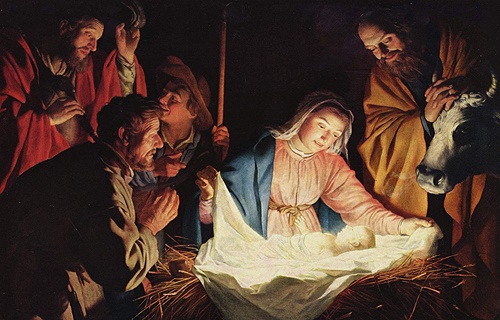
    Oh, the paradox of Christmas. For Christmas, my friends, is the arrival of the Divine Response to every wound and cut and tear you carry with you. It is Almighty God dwelling amongst us. He made Himself vulnerable to encounter our vulnerability. God entrusted Himself to the arms of a mother, to the home of an earthly father, and to a community of imperfect, suffering individuals.

    Adoration of the Shepherds by Gerard van Honthorst

    Christmas is the issuance of God’s answer to our suffering, to our feeling of being cut off from good. It is a resounding song of hope: “You are not cut off. You are not abandoned. You are not lost. For I am with you. Here in the deepest cuts, I abide with you. I may have allowed pain and loss, but I fill the voids. I AM the source of all good and I AM here.”

    Christmas, when “the Word became flesh and dwelt among us” (John 1:14) is the root of our conviction “that neither death, nor life, nor angels, nor principalities, nor present things, nor future things, nor powers, nor height, nor depth, nor any other creature will be able to separate us from the love of God in Christ Jesus our Lord” (Romans 8:38-39).

    Faith, Love, Personal Reflection

    It’s Okay to Love Your Country

    For months now, thoughts about my homeland have been crossing my mind. The events that take over the daily headlines have me contemplating America in what she used to be and what she has become. With these thoughts, mixed feelings are felt and levels of hope and despair fluctuate.

    On Sunday, I watched a lot of football. Three times I stood in my living room as dozens of individuals stretched out a flag covering the entire square footage of the playing field. Three times I listened through a moment of silence for the 15th anniversary of the September 11th terrorist attacks followed by a performance of our national anthem. Three times I got choked up.

    Only two times I felt embarrassed. When the feelings of silliness began to rise during the third occasion, they were sent packing with one simple thought: it’s okay to love my country.

    I’ve noticed a tendency toward extremes in people’s statements on America lately. So much of it goes all the way back to our collective reaction to September 11th. That attack felt intensely personal even to those of us who did not know individuals lost that day. I remember the sensation of protectiveness, of “how dare you hurt what is mine!” A new era of patriotism was ushered in, justifiably and beneficially so at the time. The experience awakened in many of our hearts a hibernating bear of attachment to our country.

    As is perhaps bound to happen though, the fierce plunge into patriotism was taken to an extreme by some. A refusal to hear a word against America and its culture; a disdain for most other nations and nationalities; a fear of anything that appeared outside the realm of what we now held so dear about our homeland. Then the last 10 years or so saw a whiplash reaction; a violent swing to the other end of the spectrum where a high regard for our nation is ridiculed as blind and foolish.

    The extremes frustrate me. I see patriotism as a genuine love of home and country. Genuine love is unconditional but it is not naive. Maybe the extremes are rooted in a misunderstanding of unconditional love. To love someone unconditionally is to love them through anything and everything. Highs and lows, achievements and mistakes, rights and wrongs; love them through it all. Unconditional love is not dependent on the other person earning the love. It is dependent on the giver of love choosing to offer it no matter what. However – and this is an important ‘however’ – unconditional love is not a refusal to recognize flaws. It is not turning a blind eye to what needs to change in the beloved. It is loving them despite the existence of those flaws and seeking productive ways to help them make changes in their best interest.

    The extremes aren’t authentic love. One is claiming that because you love your country, anyone who has anything to say against her be damned. The other is a refusal to love her so blindly but then just as blindly treating her as wholly unlovable. Neither are true patriotism.

    It’s okay to be moved by the sight of soldiers, firemen, policemen, and athletes all holding a football field sized flag. It’s also okay to look at the political system with a critical eye. It’s okay to oppose a federal law that contradicts what you know to be morally good. It’s also okay to teach your children to be proud to be American.

    It’s okay to love your country.


    Because the Saints Said So, Catholicism, Faith, Holiness, Saints, Scripture

    Because the Saints Said So: Be You (St. Francis de Sales)

    I was introduced to St. Francis de Sales while I was in my sophomore year of college. In the context of a community of incredible, fun, faithful, hilarious, supportive women, I read his classic, Introduction to the Devout Life. If I name the top five books that have affected my life, that is likely to always hold steady among them for the rest of my years.

    One of the hallmarks of de Sales’ spiritual advice is high, challenging standards. Another hallmark is gentleness. He did not divorce the two notions. I had trouble narrowing my focus down to just one quote from this most excellent spiritual writer so here are a few to consider:

    Do not wish to be anything but what you are, and try to be that perfectly.

    Do not lose courage in considering your own imperfections.

    Have patience with all things, But, first of all with yourself.

    Nothing is so strong as gentleness, nothing so gentle as real strength.

    These snippets are written alongside mandates for the men and women who call themselves Christians to be exemplary in their moral choices, in the use of their time and talents, and in the practice of virtue. Reading St. Francis de Sales’ spiritual advice is like reading a dissertation on Jesus’ command to “be perfect as your heavenly Father is perfect” (Matthew 5:48).

    Never does it become too much though, never more than a person can handle. For de Sales makes clear that to seek to be this living image of God also requires a kind realism. Realistically, know yourself. Know your strengths and your weaknesses. Your passions. Your hopes. Your temptations. And lovingly, patiently cultivate your unique self.

    You know when I have failed the most in living a life that glorifies Christ? When I have tried to ignore who I really am in order to be what I thought I needed to be. Inevitably, in such misguided efforts, I become exhausted and overwhelmed. I give up. I resent the real me for showing up yet again. What a pitiful way to live.

    St. Francis de Sales knew better. He took the Lord’s words to heart: “Love your neighbor as yourself” (Matthew 22:39). As yourself. Loving yourself is not a hippie or new age notion. No, it is rooted in the supreme reality of Christianity, that God loves you unconditionally and thus sacrificed Himself to save you. How logical then that I am deserving of love from myself and all others are deserving of love from me.

    The standards, the virtues, and all that is encompassed by a God-glorifying life comes about in the day to day manifestation of that love. Love seeks the beloved’s greatest good. This is no less true when we are considering ourselves than when we are considering another person. So, “have patience with all things. But, first of all with yourself.”

    Because the Saints Said So, Faith, Saints

    Because the Saints Said So: He Is a Beautiful God, Is He Not? (St. Paul of the Cross)

    When you are walking alone, listen to the sermon preached to you by the flowers, the trees, the shrubs, the sky, the sun and the whole world. Notice how they preach to you a sermon full of love, of praise of God, and how they invite you to proclaim the greatness of the one who has given them being.
    St. Paul of the Cross

    The other night I had an argument with my husband. By the end of it, I lashed out in anger and frustration over something – something that had nothing to do with what had started the argument. Basically, I’d given him my worst version of myself in the heat of that moment. Afterward, I didn’t want to face it. I didn’t want to look myself in the eye or try to repair the damage with an apology. When I finished putting the kids to bed, I told my beloved I was going out, that I needed to get away for a little while.

    I didn’t know where I was headed or what I thought I’d accomplish in this. All I was doing was running away from some ugliness. Human ugliness. I’m not sure why I did it, but as I grabbed my purse and keys, I also grabbed my camera.

    As I drove away from our home, my attention was grabbed by the sky. After-the-storm, weighty clouds were hanging low against the streaks of pink, orange, and blue of the sunset. As that expanse of beauty hit my eyes, tears came. Only a few; a physical reaction to the tension between what was on display in the sky above me and what was on display in my heart that evening.  I sped down the county roads to an area full of farm fields where I knew there would be horses grazing in the twilight. I climbed out of my car and snapped picture after picture, swallowing the lump in my throat with each click of the camera. I knew I couldn’t really capture it all but I had the compelling need to try.

    This is what happens when something ugly collides with something beautiful. This is what happens when the fallen soul meets God. For God is beautiful and we were designed to need, to ache for, that beauty.

    Every single piece of beauty in this otherwise ugly world comes from Him. “Every good and perfect gift,” as St. James puts it (James 1:17). Because the beauty has God as its source, it is always more powerful than the ugliness.

    Is there anything more beautiful than the moments when we let it in? When we look upon the 27th sunset of the month and suddenly halt in awe at the sight; when the field full of dandelions transforms before our eyes from an acre of weeds to an acre of golden flowers; when the sound of the rain ceases to be a reminder of the mud that will follow and becomes a symphony of divine sustenance played for our planet. Those are the moments that get me through. Those are the moments when I know, I know, there is beauty in me. For I am made in the image of this beautiful God, and so are you, my friend.

    Catholicism, Faith, Holiness, Love

    We Are Afraid of Ourselves

    Why are we terrified to admit to who we are? I do not mean your flaws or sins. I mean WHO YOU ARE. Why do we as human beings recoil at any claim of our inherent worth? We hear someone declare that human life is sacred, or that we are made in the image of God, or that the human person possesses an inalienable dignity that only a human can possess, and we balk. Downplay it. Avoid the topic. Point out all that is darkness so that we do not have to face the light that exists in us. Why are we afraid of who we are?

    Events of recent weeks, headlines and online chatter, have me contemplating a long loved quote of the great St. Augustine:

    “Men go abroad to wonder at the heights of mountains, at the huge waves of the sea, at the long courses of the rivers, at the vast compass of the ocean, at the circular motions of the stars, and they pass by themselves without wondering.”

    I have a few ideas of why we are afraid to look with rightful wonder upon ourselves and our neighbor:
    1. Acceptance of who we truly are would require us to raise our standards by about a mile. My chosen behaviors, the actions of others, the circumstances we settle for, the lies we tell ourselves to be more comfortable in this world: they would all be knocked down by the standard to which the human person, in all his greatness, deserves to be held.

    2. We could not look upon the evil humans can and do commit with either indifference or tolerance.

    3. Acknowledging the truth about ourselves leads to acknowledging the truth about every single other human person. The couple in the house next door; the terrorist; the kid who comes to your door; the murderer in prison; the handicapped man bagging your groceries; the elderly woman no longer productive in society; the jerk behind you at the ball game; the unborn child; your spouse; your best friend; your worst enemy. The truth of who we are as human beings demands a radical change in our treatment of each other, no exceptions.

    4. Belief in this truth opens the door to all the answers to life’s great questions. This seems like a welcome treasure to gain, but I believe that actually having those answers is a frightening prospect for must of us because having them would require us to do something about them.

    This quote from Marianne Williamson is one I’ve come back to again and again for personal inspiration. You have probably encountered it before. Read it slowly and maybe twice.

    “Our deepest fear is not that we are inadequate. Our deepest fear is that we are powerful beyond measure. It is our light, not our darkness that most frightens us. We ask ourselves, ‘Who am I to be brilliant, gorgeous, talented, fabulous?’ Actually, who are you not to be? You are a child of God. Your playing small does not serve the world. There is nothing enlightened about shrinking so that other people won’t feel insecure around you. We are all meant to shine, as children do. We were born to make manifest the glory of God that is within us. It’s not just in some of us; it’s in everyone. And as we let our own light shine, we unconsciously give other people permission to do the same. As we are liberated from our own fear, our presence automatically liberates others.”

    Even well-meaning Christians hesitate over the truth of the inherent worth of every human person. They settle into the idea (the more comfortable idea) that any worth and dignity they possess is only because they have Christ living in them. They decide to believe the theologically unsound notion that if Christ did not live in them, they would be worthless. This is not true. Even if Christ does not live in you, you are infinitely valuable. Let me repeat that. Even if Christ does not live in you, you are infinitely valuable. That is why Jesus came! If it were not true, you would not mean enough to God for Him to send Jesus to die for you!

    You are not worth everything because Jesus died for you. Jesus died for you because you are worth everything! If Christians want a leg to stand on in evangelization, we cannot treat anyone as less than what they are.

    This belief in the dignity of every unique person does not give rise to the lie that is modern tolerance. “I’m ok, you’re ok” is not the message here. Nor does it mean that everything else is meaningless. Who you are as a human being infuses meaning into all of your time, all of your encounters, and all of your endeavors. And like I mentioned already, it raises the standard for what is ‘ok’ tremendously higher than where we tend to place it on a daily basis.

    The true nature of your personhood and that of the person you encounter next today means that you and the other are worthy of love and nothing less. Authentic love is desiring the good of the person (yourself and others) and then doing something about it. If we hold each of our behaviors, attitudes, and words under the spotlight of that definition, how much authentic love would we find?

    I beg you as I beg myself, stop being afraid of your own worth.