Christmas, Faith, Holiness, Hope, Jesus

Joy Has Come

“You will show me the path to life, abounding joy in your presence, the delights at your right hand forever.” (Psalm 16:11)
Christmas has come. The simplicity and quiet of the celebrations this year (compared to how it is normally when the entire family gathers at my parents’ house) is lending itself to being more Christ-centered and reflective. I’m enjoying that a lot. It can be a difficult enough task, so any help is welcome. Fr. Mark’s homily on Christmas Eve was a compelling call to strip away all the wants of this life and want, above all, a “happy ending” to this life, or more truly a “happy eternal beginning.” Then yesterday, my friend, Erin, shared a little with me from Fr. Mike Chenier’s Christmas morning homily.
Fr. Mike is my friend, Mike, whom I mentioned previously in the post asking for prayers for his sister, Amy. That post can be found here. Excepting a miracle according to God’s great will, Amy is expected to live another one to three months. She is confused a lot of the time and has difficulty communicating now. The whole thing continues to break my heart. I have wept for Fr. Mike, who has been dear to me for so long, and for Amy, who ranks among the sweetest and most good-humored people I’ve been privileged to know. All of it breaks my heart in a way that tears away any pretense I might hold onto of knowing what this life will or won’t bring for me or my loved ones. The sense of vulnerability, our inability to sustain our own lives, and the prevailing authority of God as the Author of our lives is strong. I haven’t been able to shake it from my mind in the last few weeks.
What Erin shared from Fr. Mike’s homily has provided some necessary rounding out of these contemplations. I do wish I could have heard his sermon but the bits of summary have given me ample mental soil to work with this Christmas. He preached on joy, on the joy of Mary and Joseph and his and Amy’s joy, too. Joy instead of bitterness; that’s what was chosen by the Holy Family in the face of unavoidable suffering, certain hardship, and disconcerting mystery. Total entrustment of their lives to God’s Providence allows for this joy. The loss of all the plans and expectations for their personal lives; facing the unknown of what God was asking of them, taking from them, and giving to them, all of it could have led to fear and bitterness, even self-pity. Sorrow over the losses could take hold with no release; surely we all know people for whom this has been the case. This was not so for them. The sorrow and grief may be real but they are not the highest powers. Instead there is joy. True joy that comes from peace; true peace that comes from hope; true hope that comes from faith in the God who promises to never leave us, to always carry us back to Him, to be our “fullness of joy” for all eternity. Fr. Mike shared that in this most harrowing of times for his family, there is joy. Amy has joy; he has joy. I don’t know if I can think of another example that more effectively teaches me of the difference in depth and worth between joy and happiness. What a glorious sign of holiness when a soul still genuinely rejoices in the Lord when all sources of happiness are stripped away. I am humbled by the sight of this holiness in my friends.
Advent, Faith, Jesus

Advent Amazement

This Advent I’ve been reading a collection of meditations on quotes from C. S. Lewis. Lewis had a very worthy grasp of the the grandness of the miracle of the Incarnation, of the greatness of God becoming man in Jesus Christ. His awe of God’s actions on that first Christmas night is unmistakable. It casts light on my lack of awe and has me thinking about the vast difference between the greatness I attribute to God and His actual greatness. I think of Moses, who had to veil his face after seeing the glory of God because he shone with blinding radiance; of King David, who sought to contemplate God, His works and commands all day and all night; of the Prophet Isaiah, who saw a vision of the Lord on His throne, surrounded by worshipping Seraphim; of St. John, who wrote an entire mystical account of the heavenly visions he received; of St. Francis of Assisi, who went into a coma-like state for a few days after hearing a single note of the music of heaven… these men had a much deeper awareness of God’s divinity than I do. I’d even warrant that most of this era’s Christians don’t come close to such an awareness as used to characterize the great figures of the Church. It is why the mystics fascinate me more and more with each passing year. In this time we prefer to have everything figured out. We like to fully grasp the thing that is before us, to give it boundaries and know exactly how it works and what it means. I see it in the way the faith is taught, as well as the willingness of people to make acts of faith in truths that they haven’t fully grasped yet. I see it as well in our worship. The individualistic nature of our culture has crept into our worship. Though there is great worth in the individual’s worship of God, in the singular communication with and listening to God, there has been a loss of comprehension in how liturgy unites us with all the saints and angels of heaven, as well as all the Church on earth, in the worship of our King.

Basically, I find myself questioning these attitudes and tendencies that characterize the present. I don’t doubt the goodness of knowing what we can know, of grasping what we can grasp; God wouldn’t have revealed so much and commanded the Church to continuously teach it all if He didn’t desire that we know all of it. It’s all that we don’t fully know or fully understand that I’m concentrating on here. What is so wrong about being baffled with amazement? About sensing the infinite depth of the mysteries of God and concluding that I truly know so, so little. I cannot hit the bottom of the well with my bucket. At the end of his years, St. Thomas Aquinas, one of the greatest minds to ever encounter and expound upon the Christian faith, said this: “All that I have written appears to me as much straw after the things that have been revealed to me.” The more insight he gained into the truth of who God is, what He has done, who we are in light of Him, the more he realized how much there was still to know and understand.

How I react to the Incarnation is an excellent test of my heart’s capacity for amazement at the mysteries of God. The Incarnation is absurd, scandalous, bewildering, incredible! It is awesome in the truest sense of that overly used word. I’ve heard before that to get an idea of how much God humbled Himself to become man, we should imagine ourselves becoming an amoeba or a worm. But even that is a terribly weak analogy for I and a worm are both creatures; not equal creatures, but creatures nonetheless. What God did by becoming man, indeed an infant born expressly for the purpose of dying for mankind, is beyond any comparison we can make. This is not meant to belittle or devalue us as human beings. Rather if I develop a proper sense of awe at the Incarnation, my sense of human dignity will likewise develop. For in the face of this immeasurable difference between God and man, God still became man!

I have a feeling that this awe and bafflement at God, at the mysteries of God, are key to having faith like a child. Too much of our accessible knowledge of God has been gained at the expense of our certainty that we have only glimpsed into all that there is to know and experience of Him. Both must be nurtured in my heart and mind: the accessiblity of God (which is due only to His initiative over the course of salvation history, especially in the Incarnation) and the inexhaustible depth of His mysteries. Neither should be sacrificed. It’s difficult though not to give up one and cling only to the other.

“The Christian story is precisely the story of one grand miracle, the Christian assertion being that what is beyond all space and time, what is uncreated, eternal, came into nature, into human nature, descended into His own universe, and rose again, bringing nature up with Him. It is precisely one great miracle.” (C. S. Lewis) Do I even have a concept of what miracles are? I do, but I don’t recognize them enough. I don’t fall down on my knees in worship of the infinite God when He takes heed of the individual and intervenes in space and time for the sake of His sons and daughters. The divine intervention that is the Incarnation… well, I ought to be struggling for words to describe it, so great is this miracle! And the more I contemplate it, the more that is the case.

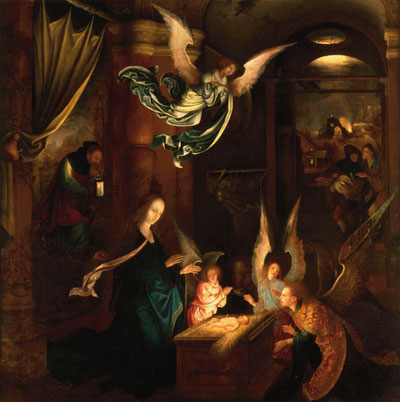
I wonder how the angels reacted to the Incarnation! Some went to the shepherds near Bethlehem, but what of the legions not present there? The awe of God, the amazement at His action, the joyful acceptance of His infinite wisdom in carrying out this plan – what a chorus must have been sung! Some theologians speculate that the tipping point of Lucifer’s and the rest of the fallen angels’ rebellion came when all the angels were given knowledge of the plan of salvation and asked to choose whether they would or would not serve that plan. Lucifer’s pride could not accept the plan. It was scandalous that God would become man! That He would take on a created human nature, live among the poor, work for His bread, be rejected by His own people and be put to death! Considering the stir He creates here, Jesus Christ must have caused quite the stir amongst the angels too.

Yet what is my own reaction to the plan of salvation, to the Incarnation? It is comforting and encouraging, if I slow down enough from the nonsense of the ‘holiday season’ and focus on it. It is cause to rejoice, to give thanks, to be kinder to others, and so on. Not bad reactions, certainly, but they fall so short! My prayer this Advent is for awe and amazement to fill me to my fingertips, and that in this reaction may come the seeds of childlike and willing faith, unceasing joy in God’s incredible outreach to me, humility in the face of the humility of the Divine veiled by a human nature, and eager, earnest repentance out of love of the God who set this “grand miracle” in motion for the sake of making a way for us into His presence.


Faith, Family

Please?

I don’t normally make requests on this blog. I have no idea if there’s any point since there’s no way to know who reads this or how many views it receives. But I’m going to take a leap of faith and put a request out there, trusting that God works in hidden ways and maybe this blog can be part of that.

I have a friend who is dying. I can’t help but begin to cry as I type this. Amy, who is in her early thirties, has been living with a brain tumor for the last few years. Every day that she’s had since the tumor took hold has been a true miracle as the tumor is inoperable. With treatments and a great deal of prayer, the tumor had stopped growing for some time. However this is no longer the case and it has begun spreading significantly. All that is left to hope for is a miracle. Be it God’s will, He is more than capable of providing that miracle. His will is so often hidden though.

These circumstances have me consumed with thoughts of loss and hope and the insufficiency of our own strength to sustain our own lives. As the person in Amy’s family that I am closest to is her younger brother, I look upon the situation with the eyes of a sibling and my heart breaks for my dear friend, Mike. Even the imagining of losing one of my sisters is too much for me to dwell on for more than a few seconds.

Would you pray for Amy? Pray for a miracle, if it be God’s will to continue her earthly life, to happen soon; for acceptance of God’s choice in Amy’s heart and the hearts of all of her family , whatever that divine choice ends up being; for consolation for Amy as she suffers, for her husband as he suffers at her side, for her dear and wonderful parents and siblings. They all need to be buoyed by prayers.

Advent, Catholicism, Faith, Hope

What’s Your Compass?

As a Catholic I get to celebrate two New Years. This past Sunday signified the end of the Church year (the liturgical cycle of feast days and seasons commemorating the great truths, events and mysteries of Christ and the Church). With this coming Sunday, the new Church year is inaugurated by the 1st Sunday of Advent. Advent: that holy season of preparation, waiting, anticipation, contemplation. During Advent we have a two-fold focus in our liturgies (and are invited to have them in our personal prayers as well) of the Incarnation, when the Son of God assumed a human nature to dwell among us for our salvation, and the Parousia, when that same Person shall return at the close of time for the final judgment of all men and women ever created. It’s a rich set of weeks, easily missed in the bustle of the “holiday season” celebrated by shopping centers and television programming.

Lately I’ve been troubled by how few things there are that I can count on, especially how few events or experiences I can count on happening. At any given moment, I could probably think of a dozen things that I want to happen, even that I have genuine hope of happening, but there is truly only one event left that I can count on happening. That is the coming of Christ. The 2nd Coming, to be specific. The glorious return of the King of kings, the Lord of lords, triumphant and final. Nothing else is guaranteed.

Is this a pessimistic, negative, ‘to hell with all my work and plans’ sort of perspective? Or is it a realistic, positive, ‘everything only matters in light of Christ’ perspective? I suppose it’s neutral in itself. But how do I apply it? How am I influenced by it? That’s where the rubber meets the road. Accepting and grasping this truth can shape those wants and hopes I have from day to day, year to year, as well as my reactions when they either do or do not come to fruition. The lasting weight of anything that happens in this life is only measurable in terms of eternity, e.g. did this loss unite me more closely to Christ? Did this gain incline me toward praise of and thanksgiving to God? “God works all things for the good of those who love Him,” assuming I freely submit to His divine Providence.

In a recent discussion with some fellow Catholics, the question came up of whether or not we were wasting our time to be pondering Heaven. What can we know of it? What can we hope for? What will it be like? Admittedly, we are almost laughably limited in our capacity to understand or grasp the reality of Heaven. So do we waste our time by thinking about it? I argued vehemently, no. Pondering Heaven (or likewise, the end of time when Christ will return) is not a waste of my time. To explore the reality of Heaven is to explore my destination, my eternal homeland. To contemplate the return of Christ in all His victorious glory is to contemplate the final, definitive consummation of love. All that was begun when God, out of the abundance of His love, created the heavens and the earth and all who dwell there, all that was redeemed and reconciled by the sacrifice of perfect, divine love in Jesus Christ on the Cross, all that is hoped for and sought by the generations of faithful believers since will be completed by His return. The Kingdom of God, that mysterious ‘now but not yet’ reality of what Jesus has done and what we are cooperating with by grace and free will, shall then be everything there is and ever will be.

The mind boggling truth that I get to contribute to this coming of the Kingdom has the power to shape every day that I live on this earth. Contemplation of the adventus, the coming of Christ at the end of time, does not cause me to neglect the things that make up my earthly life. Rather it informs that life, contextualizing it and directing it. Heaven is our true north.

Come, Lord Jesus, come.

Catholicism, Faith, Gratitude

Old Friends

In preparation for a talk I’ll be giving in December, I am revisiting some dear old friends-in-print: Lumen Gentium, Gaudium et Spes, the Didache, Loving the Church by Cardinal Shonborn. It all has me remembering a lot of things. Why I got into Theology; why I loved every day that I was able to study it at Franciscan U; why I thrill with elation in the moment of catechesis… I can hear Sr. M. Johanna’s voice as she lectures on christocentricity, and Fr. Pattee’s insightful explanation of each of the seven Sacraments. I remember the excitement of (the attempt at) absorbing the depth of Dr. Hahn’s lectures, and the giddiness of grasping, after considerable effort, an eternal truth that was new to my mind and heart. Considering how frustrated, impatient and drained I get from the task, the love I have for learning the mysteries of the faith must be what keeps me teaching it. I complain because I get worn out; I weaken because I neglect prayer; I am discouraged because my calling to adult catechesis doesn’t translate into a full time gig in the Church. None of this stands much of a chance though in the face of becoming a theology student once again, be it in my bedroom with a book in my hands or at a lecture or Bible study. On such occasions, I am renewed in both the joy I am gifted with when I study the faith and in the commitment previously made to be a catechist in whatever ways God allows.

I mean, when I read, “There are two ways, one of life and one of death; but a great difference between the two ways,” and realize I have the opportunity to not only learn but also share the very faith that the Apostles learned firsthand from Jesus and taught to the first generation of Christians, my heart can’t help but cry out in gratitude to the Lord.

Faith, Scripture

Not Go Empty

Chalk it up to a combination of pregnancy brain and overtiredness but when my sister explained, “I don’t have my contacts in so I can’t hear what you’re saying,” I knew it was time for her to get some sleep.

And when I left home for the weekend without a scrap of work along, resulting in a 48 hour fight against a flood of anxiety, I knew it was time to run to Jesus. It was time to remember why I serve Him. It was time to believe He could (and would) supply whatever was necessary to do the work He had given me. There was a feeling of childish foolishness as I bent my head before my Lord. In His wisdom, He did not respond with comforting, coddling words. Often when I pray in the midst of stress, I am lulled into peace of mind by His invitation to rest in Him. Yesterday though, the Lord took a different approach.

The Gospel and homily at yesterday’s Mass spoke of the poor widow who gave all she had to God: two small coins amounting to a greater gift than all the donations of rich men and women who gave from their surplus. In the minutes after the homily though, it was not this story or its lessons that resonated in my mind. Instead, the 1st reading stayed with me. It’s one of my favorite passages from the Old Testament.

In those days, Elijah the prophet went to Zarephath. As he arrived at the
entrance of the city, a widow was gathering sticks there; he called out to
her, “Please bring me a small cupful of water to drink.” She left to get it, and
he called out after her, “Please bring along a bit of bread.” She answered, “As
the LORD, your God, lives, I have nothing baked; there is only a handful of flour
in my jar and a little oil in my jug. Just now I was collecting a couple of
sticks, to go in and prepare something for myself and my son; when we have eaten
it, we shall die.” Elijah said to her, “Do not be afraid. Go and do as you
propose. But first make me a little cake and bring it to me. Then you can prepare
something for yourself and your son. For the LORD, the God of Israel, says, ‘The
jar of flour shall not go empty, nor the jug of oil run dry, until the day when
the LORD sends rain upon the earth.'” She left and did as Elijah had said. She
was able to eat for a year, and he and her son as well; the jar of flour did not
go empty, nor the jug of oil run dry, as the LORD had foretold through Elijah. (1
Kings 17:10-16)

My heart trembled to hear the Lord speak to me, sternly but lovingly.

“Do you suppose I will not do likewise for you? Will I not supply what you need when I ask something of you? Do the work I have given you! Do it well; do it faithfully. Have I asked you to do it based on your own merit? On your own skill and talent? Assuredly, no. I have asked it of you on the basis that I am able, and I will, give what you need to do it. The prophet asked for a mere bit of bread and a drink of water, and this was a burden to the starving woman and her child. It was reasonable for her to say she could not give what was asked of her. Without my grace, she’d have been right. She could not give it, but I could. If I will you to give of yourself – to serve- then I will also supply the gift. What is necessary from you is the ‘yes’, the willingness and the effort required to give away what I give to you. As the woman still had to knead and bake the bread from the flour and oil which I gave to her, so there is work to be done if you are to give from what I have supplied to you. Why then do you hesitate? Why do you talk yourself out of the effort? For love of me, you will continue. If no other reward, no other comfort, comes of it, will you continue for love of me, as an act of trust in me? Will you continue with the humble confidence of one who knows that I supply what I ask of you?”

I was struck by that paradoxical truth: that everything God asks of us, He also provides. In every instance that demands from me love or generosity or compassion or patience or courage, my yes will unleash God’s love, generosity, compassion, patience or courage into my own heart. The demands can be challenging and exhausting. They can be downright trying. Yet as I sat there in the church, staring up at the crucifix hanging above the altar, I knew that I could not stand my ground on one single excuse or argument against believing that God will faithfully supply for my needs as I serve Him. He will not allow my jar of flour to go empty, nor my jug of oil to run dry.

Faith, Personal Reflection

Faith Comes With the Morning

I know the common phrase is “joy comes with the morning,” but I think mornings are capable of variety. Or rather grace is capable of variety, especially in the morning.

Last night brought on a little bit of a breakdown. The mental efforts of teaching RCIA last night and sorting out what each individual needs as they prepare to enter the Church, piled onto tiredness from a string of late nights, piled onto the 14 more classes to write, piled onto the manuscript synopsis I have yet to complete, piled onto the fact that I haven’t written any new pages in the new novel in several weeks, piled onto a little loneliness and a little “what the heck are you doing with my life, Lord?”… the layers set me up for a rough night. I just wanted to pull myself out. Remembering the shape of my life a few years ago, when I was still too new to the area and my church community to be very involved in anything, I had nothing to stop me from filling my hours with writing and reading and adequate hours of sleep. And I was happy; I was grateful. My spirit came alive in an entirely new way as I wrote my first book. I thought it would last. I thought, “this is what God had in store for me and I had no idea until now.”

That life ebbed until it is all but gone and I’m left asking myself why I let it happen. Was it my own doing? Or did God ask me to sacrifice for the sake of serving in His Church? I don’t know the answer. I fell asleep praying for renewed faith in God’s directing hand. I awoke with the same questions on my mind but a seedling of bolstered faith taking hold beneath the troubled surface.

But you, LORD, are a shield around me;
my glory, you keep my head high.
Whenever I cried out to the LORD,
I was answered from the holy mountain.
Whenever I lay down and slept,
the LORD preserved me to rise again.
Psalm 3:4-6