Catholicism

The Pope Gets It

Adding to my appreciation of Pope Benedict XVI (which is already at a significant level), this is from an address he gave after a recent piano concert.

“This concert has, once again, permitted us to taste the beauty of music, a spiritual and therefore universal language, a vehicle so importantly suited to understanding and union between persons and peoples. Music is a part of all cultures and, we might say, accompanies every human experience, from pain to pleasure, from hatred to love, from sadness to joy, from death to life. We see how, over the course of the centuries and millennia, music has always been used to give a form to that which we are not able to speak in words, because it awakens emotions that are difficult to communicate otherwise. So it is not by chance that every civilization has placed such importance and value on music in its various forms and expressions.

Music, great music, gives the spirit repose, awakens profound sentiments and almost naturally invites us to lift up our mind and heart to God in every situation, whether joyous or sad, of human existence. Music can become prayer.”

You can read the whole address here.

Catholicism, Faith, Music, Personal Reflection, Writing

Catching Up

Several days in a row, one thing or another has made me think, “I should put that in my blog.” Yet, it had to wait. So let’s see if I can catch this blog up with my thoughts.

First of all, if you like riesling even a little bit and you have the chance to try Chateau Grand Traverse Late Harvest Riesling (from the Chateau Grand Traverse winery on Old Mission Peninsula, MI), please do so. You will thank yourself for this treat. I tried it on Saturday night and it was by far the best riesling that has ever touched my lips. I could easily have consumed the whole bottle, but restricted myself to 2 glasses. It’s not really sold outside of lower Michigan so I wanted the chance to savor the taste more than once since it’ll be a while before I can purchase it again.

Last night was a historic night for me: I saw U2 in concert! Seeing a live show of U2 has been on my ‘do before I die’ list since the first time I put together said list. I finally can cross something off! The show was amazing. They played Soldier Field (while the Bears were away being beaten by the Packers). Everything about the night was fantastic. If the videos or pictures turned out alright on my humble little camera, I’ll post some here.

I keep meeting cute boys… and not dating the cute boys I meet. Oh the infuriating pattern of my singleness… But I continue thanking God for His reminders that there are some great men out there, even if so far they only come in the form of friends. Must be thankful in all things, must be thankful in all things, must be thankful…

The ball is rolling with this year of ministry. I’m already having to pray my way out of feeling overwhelmed. It’s all so exciting! I am officially the RCIA Coordinator at my parish; a role I hoped to eventually have since my junior year of college. The season of volunteering is beginning too, with Adult Faith Nights, 40 Days for Life vigil and Frassati Society topping the list. A few months ago, I was trying to give some concrete form to the extent of and ways in which I volunteer. Like most things I try to handle by myself, I actually needed to wait on God to direct me and place me in the situations in which He desired me to serve. I’m trying to roll with it and realize the goodness of not being in control; trying to have confidence in all the ways God reaches out, takes my hand and says “Go with me here.” Rolling with it requires a lot of fear-conquering prayer and trust. And some self-discipline in spending my time on the right things and not usually the easiest things. (Can I help it if I go into withdrawals when I can’t watch a few Brewer games each week? Or if I am hooked on CSI:NY reruns? …Yeah, I suppose I probably can help it… At least the baseball season is nearly over for the Crew.)

And the books. I have to write an update on the books, right? Right. Unfortunately nothing substantial to report. Still no final word from Moody Publishing. “How long, O Lord?” Yes, yes, I’m being overdramatic. It is endlessly difficult to patient though, as well as to not get caught up in the fearfulness of questioning what I should do next if Moody turns it down. At times, the only thing that keeps me going is to focus all my mental energy on writing the new book but everything else that has been going on has kept me from that endeavor lately. This leaves my mind to wander down paths of doubt that are both pointless and painful. I think I’ll need to get back into scheduling mode for my writing. I did that when I was in the home stretch of finishing Full of Days, writing blocks of time into my calendar that were set aside for the work instead of counting on finding time here and there in the course of the week. I’m nowhere near the home stretch of writing The Mercy Hour but the scheduling might be a must at this point. It either has to be a priority alongside of the other top priorities or it has to be set aside in favor of the others. Any time I consider setting it aside, my friend’s incredulous questioning of my honest dedication to being a writer ring yet again in my ears and I know I have to follow through.

Undeniably, I’ve become one of those girls who lives by her daily planner and yet strives to be open to the unexpected and spontaneous. It’s an adventure. Would it be possible to just plan on the unexpected and spontaneous? I do like to at least feel prepared, and like Tolkien pointed out, “It will not do to leave a live dragon out of your plans if you live near one.”

Catholicism, Faith, Hope, Jesus

What It Means

I’ve just finished reading What It Means to Be a Christian by Joseph Ratzinger, who is now known as Pope Benedict XVI. This is a book of 3 sermons he gave one Advent season a few decades ago. The beauty of this book, in my opinion (formed by reading some of his other writings though far from all of his writings), is the applicability to all of us. While many might struggle with some of his other work (I like to think I’m an intelligent human being but sometimes the level of his intelligence and insight makes me feel like an uneducated child), this book is straightforward, simple to read and easy to internalize and contemplate. What better matter to internalize and contemplate than the meaning of being a Christian? Anyway, I had so many page corners folded over so that I could go back and reread passages and think them over properly that I couldn’t pass up the temptation to blog some of my thoughts. This may take a while…

p. 19 (regarding the evils in the world; all that seems as if it shouldn’t occur in a supposedly redeemed world) – “we quite often run a particular risk: that of not wanting to see these things. We live with shades down over our windows, so to speak, because we are afraid that our faith could not stand the full, glaring light of the facts… But a faith that will not account for half of the facts or even more is actually, in essence, a kind of refusal of faith, or, at least, a very profound form of scepticism that fears faith will not be big enough to cope with reality… In contrast to that, true believing means looking the whole of reality in the face, unafraid and with an open heart, even if it goes against the picture of faith that, for whatever reason, we make for ourselves.”

  • This was the first passage to jump from the page and into my thoughts for hours afterward. It is true that I often live this way, keeping the blinders on or downplaying the evils that exist and that I even personally encounter. I succumb to it often. My faith is strong, I might claim. My faith is steady. But does it maintain its strength and steadiness because I do not expose it to such tests as the world makes readily available to me, or because that faith has faced – openly, fervently, confidently – all that contradicts it?
  • The author doesn’t bring it up, but I think also of the pitfall of living in a constant test of faith. There are those who are consumed by all that isn’t well, all that ‘ought’ to be different. Their faith becomes desperate; never at rest in God’s peace, never reassured by hope. Though it may compel them to work for the common good and combat evil, they might not be able to slow down and explain to themselves or others why they are doing any of it. They might not trust in the surpassing power of grace and love that is our cause for hope.
  • I am also reminded of the words of John Paul II when he stated that teachers of the faith are called to teach Christianity “in all its rigor and vigor.” Whole, without fear, not balking at the risk of rejection or challenge.

pp. 35-37 – “Advent is a reality, even for the Church. God has not divided history into a light half and a dark one… There is only one, indivisible history, and it is characterized as a whole by the weakness and wretchedness of man, and as a whole it stands beneath the merciful love of God, who constantly surrounds and supports this history… for all of us God is the origin from which we come and yet still also the future toward which we are going. And that means, furthermore, that for all of us God cannot be found except by going to meet him as the One who is coming, who is waiting for us to make a start and demanding that we do so. We cannot find God except in this exodus, in going out from the coziness of our present situation into what is hidden: the brightness of God that is coming.”

  • This is part of the chapter entitled “The Hidden God”. Talk about perspective! All of time is an Advent season. I suppose I’ve already learned this, but I don’t think of it outside of the weeks preceding Christmas. To consider all of our days as Advent days, days of preparing and moving out from ourselves and toward God, is an enlightened understanding of history. The question of why there are such evils, such atrocities in a world that has been visited by Christ, a ‘redeemed’ world as we wish to categorize it, becomes a null question. Yes, this world has received Christ, has access to His grace and divine life, but we cannot forget that we are still not at our destination. Every generation, whether before or after Christ’s Incarnation and Paschal Mystery, is a generation of individuals beckoned to move toward a hidden God – individuals who have to choose.
  • The chapter goes on to speak of this hiddenness. In all His ways, God has remained hidden. Not entirely so, for do we not have Divine Revelation and above all, the Incarnation? Yet even in those events, speaking by human hands and voices, coming in human form; so humble, so veiled in His great glory. I demand signs and answers to prayers and declarations of His will; I wonder why He doesn’t make Himself more obvious. Who am I, though, to demand that He act differently for me than He has always acted toward humanity? And who am I to suppose I could handle Him without the veil of mystery?! He does come; He does reveal. I must seek Him in the hiddenness He employs.

pp. 39-40 “God’s incognito is intended to lead us onward into this ‘nothing’ of truth and love, which is nevertheless in reality the true, single, and all-embracing absolute, and that is why in this world he is the hidden One and cannot be found anywhere else but in hiddenness.”

  • This passage follows Ratzinger’s summary of Pascal’s teaching that there are 3 orders that exist – the quantitative order that is the object of all science, that is inexhaustible; the order of the mind, which doesn’t seem like much compared to all that exists in the quantitative order but is truly greater than that order because it is by the mind that we are able to “measure the entire cosmos”; thirdly, the order of love, of which he says “a single motion of love is infinitely greater than the entire order of mind, because only that represents what is a truly creative, life-giving, and saving power.”
  • God’s hiddenness compels us to move forward in faith, to dive into the reality of His love and mercy which cannot be fit into any of the categorical, measurable parameters a human mind is capable of using and understanding. We have to humble ourselves and seek Him in His veil of mystery, in His subtlty.
pp. 53-55 (regarding the “breakthrough” moment in the history of creation when Creator and creature meet, when God becomes man and enters human history) – “it becomes apparent that what seems at first to be perhaps just some speculation or other about the world and things in general includes a quite personal program for us ourselves. For man’s awesome alternative is either to align himself with this movement [toward God and toward becoming like God], thus obtaining for himself a share in the meaning of the whole, or to refuse to take this direction, thereby directing his life into meaninglessness… Becoming a Christian is not at all something given to us so that we, each individual for himself, can pocket it and keep our distance from those others who are going off empty-handed. No: in a certain sense, one does not become a Christian for oneself at all; rather, one does so for the sake of the whole, for others, for everyone… It should be enough for us to know in faith that we, by becoming Christians, are making ourselves available for a service to the whole… it means moving out of that selfishness which only knows about itself and only refers to itself and passing into the new form of existence of someone who lives for others.”
  • The great paradox of Christian life, of knowing God’s love and offer of salvation for you personally while realizing He does not offer it for your sake alone but for the sake of the whole of humanity. Is it not incredible that by becoming a Christian we are made able to serve God in whatever way He chooses?
  • Ratzinger mentions that it is not always for us to understand how God is using us or why He asked a service of us at a particular time or in a particular way. I see in this the reality that by faith we actually become enveloped by God’s hiddenness. Our lives are given an aspect of mystery, of ‘incognito,’ like God! It is a thrilling prospect.
p. 74-75 – “For what faith basically means is just that this shortfall that we all have in our love is made up by the surplus of Jesus Christ’s love, acting on our behalf. He simply tells us that God himself has poured out among us a superabundance of his love and has thus made good in advance all our deficiency. Ultimately faith means nothing other than admitting that we have this kind of shortfall; it means opening our hand and accepting a gift… [this reception of the gift] is grasping at nothing unless there is someone who can fill our hands with the grace of forgiveness. And thus once again everything would have to end in idle waste, in meaninglessness, if the answser to this, namely, Christ, did not exist.”
  • I am unsure how to comment on this. The starkness of this truth hits me hard enough. The prospect of nothingness, of meaninglessness, is dark; it is terrible. Consider that every moment for us is a pivot point. There is always a turning, always a movement: toward Him to receive Him and follow Him, or away from Him into meaninglessness. But faith, oh that great, great gift of faith! Faith places into our hands the truth, the reality of Christ, which lends all meaning to all of life.
Catholicism, Faith, Scripture

Listening to the Apostles

I feel like blogging but I don’t feel much like thinking. The light above my desk is particularly bothersome today. It seems brighter than usual, glaring off my screen and making me wish I could close my eyes… or at least wear a dorky visor cap.

Over the weekend, I decided to begin reading the catholic letters of the New Testament. I’ve read them all before, but in pieces and for various reasons, never straight through and with a single mindset for all seven of them. The ones I’m referring to are the Letter of St. James, the Letter of St. Jude, the 2 Letters of St. Peter, and the 3 Letters of St. John. They’ve come to be known as the catholic letters, as in, written for the universal church (the word catholic means universal), as a way to distinguish them from St. Paul’s letters and the Letter to the Hebrews which are written to more specific groups or individuals. This term is not intended to separate them as Catholic vs Protestant. St. Paul was Catholic, folks. All Christians were Catholic during the time of the New Testament writings and for centuries upon centuries afterward.

The nature of my faith and life in the Church as apostolic has been on my mind. Every time I recite the Creed, I declare that I believe in an apostolic Church. The heritage of the Church, with its ordained bishops and priests able to trace themselves back to the original Apostles, and its teachings arising from the earliest days of the Christianity and never departing from the teachings of Christ and the Apostles (developing in understanding, yes, but departing, no), this heritage is immensely important and wonderful. There is such security in it; security in truth. So I greatly value the apostolic Church, but do I recognize the need for my own faith, the way I understand it and live it, to be apostolic as well? This question reaches me from two angles. One is that I am to be rooted in the apostolic teachings, never weakening or compromising the fullness of truth for my own convenience, but taking full advantage of the deposit of faith that was entrusted to the Church by Christ and passed down faithfully over generations by the Apostles and their successors. Two, I mustn’t forget that to be an apostle one must be sent out on a mission. The switch between disciple and apostle came when the men were commissioned by Jesus to go into the world and preach the Gospel and build up the Church. They are no longer only followers of Christ but also emissaries of His teachings and life. The Church is apostolic in both of these ways (faith & mission), and the Church is made up of its members. The members must be apostolic in both ways too. I must be apostolic.

So as all this inhabits my thoughts and challenges my heart, I figure a good place to start is with the catholic letters. What did the apostles want to say to the Church in those first decades of Christianity? That same Church is the one of which I am a member, the one that provides me with the Sacraments and the fullness of truth, so I would gain much by listening to those first ministers of the Sacraments and teachers of the truth.

Catholicism, Friendship

Fr. Mike Chenier

Time to attempt this. I know my words will fall short of capturing all that Mike’s ordination meant to everyone there, and especially all that it meant to him.

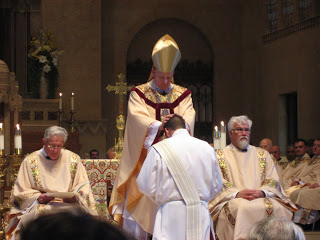
On Friday afternoon, Jessica, Amy and I took our seats at St. Peter’s Cathedral in Marquette, Michigan for the ordination to the priesthood of Mike Chenier and Ben Haase. We arrived early enough to sit near the front. Approximately a thousand people attended the Ordination Mass. With the cathedral seating around seven hundred, the walls were layered with the additional hundreds of men and women in attendance. In the minutes prior to the great, dignified procession, after the prelude music and before the magnificent choir began singing, I felt the same anticipation and eager joy that hangs in the air at the start of a wedding. We were so like the family and friends awaiting the entrance of the wedding party and the bride. I thought how fitting that atmosphere was, for something much like a wedding would occur. Mike would be conformed to Christ, the Bridegroom, and the Church would be his bride. He would commit himself to serve, to honor and to support the Church after the pattern of Christ’s own sacrificial love. As the Mass began, the only way to describe the presence of that huge congregation is thunderous. In our fervent responses during the penitential rite, in our heartfelt songs reverberating between the pillars of the cathedral, and in our applause when Mike and Ben were presented to Bishop Sample for the Sacrament of Holy Orders, the thousand of us made our joy and thankfulness known.

Every bit of the Mass was beautiful in the truest sense of beauty. My first tears came with the first reading. The passage from Jeremiah, Chapter One spoke of God’s holy plans for his servant Jeremiah, plans made even before Jeremiah was created. God stops Jeremiah’s objections of youth and meager ability, assuring him that he will be able to do all that God calls him to do. A familiar passage, surely, but fresh to my ears as I considered Mike. Youth was never his obstacle, as far as I knew him. Youth was his gift. Out of his childhood years with faithful parents, his teenage years of searching and finding and enjoying life, and his young adulthood marked by missionary service, college and seminary – from this youth came the willingness and joy for the call of Christ upon his life. I have loved Mike from the time we were thirteen, my brother and friend in the Lord. As I think of our friendship – how it began, how it grew, how it changed – I smile over how fitting it is that the gifts and strengths in Mike that blessed me in our years of knowing each other will be, over time, the means for Christ to bless so many others through Mike, the priest. If I am to choose one aspect of this, it must be his generosity in love. The love Mike has always offered has been marked by an eagerness to share life. Whenever Mike loved something, if he found joy or beauty or blessing in it, he had to share it. A song, a book, a scenic sight, a passage of Scripture – if Mike loved it , it had to be shared. I cannot succinctly summarize the occasions I was blessed by this. When I attended Mass on Sunday, celebrated by Fr. Mike, he confirmed in my mind and heart this impression he has made on me with his generous spirit and the goodness he finds in living for Christ. He spoke of finding something you love so much that you cannot stand not to share it, not to bless others by it, not to live for it and be willing to die for it.

Returning to the Ordination Mass, another notable aspect of the joy I had in attending was in seeing the lasting fruit of our years among the youth groups in the Diocese of Marquette. I saw faces on Friday that I have rarely seen, if at all, in the last seven or eight years. Faces of faith and friendship that became so dear to me as God was forming me into a woman of Chrsit. Each of their lives is a testament to the formation we received as teenagers, and Mike’s ordination to the priesthood is a pinnacle among them.

The beauty I witnessed on Friday, and again as I attended Sunday Mass with Fr. Mike as celebrant, was due to a very simple truth. There were many contributing factors to name and describe, but at the heart of it is this: here was a man doing God’s will in a precise, committed, humble but confident manner. Here was a man living the life to which God called him, the life that the Lord planned and knew even before Mike was born. There, in that, is happiness.
Catholicism, Faith, Family, Holiness, Love

In This Way The Love of God Was Revealed

This morning, I read this great reflection by Father Thomas Rosica on the nature of the Trinity as a divine community. A snippet toward the beginning sums up the author’s intent in drawing our attention to that nature: “If our faith is based in this Trinitarian mystery that is fundamentally a mystery of community, then all of our earthly efforts and activities must work toward building up the human community that is a reflection of God’s rich, Trinitarian life.”

As a lifelong Catholic, I’ve heard much talk of human dignity, of every man and woman’s unique possession of the image of God within themselves. This great dignity constitutes a call to reflect God, to be formed more perfectly into His image by the thoughts we have, the words we speak, the actions we take. This individual imaging of divinity is of inestimable importance if a person is to every grasp the meaning and purpose of life. It cannot be emphasized enough. What I cannot claim to have heard a lot about is the manner in which the human community is called and is able to image the community of Persons of the Trinity. Every family, every church community, every small group Bible study, every ministry group, every intimate community of friends; the list is unending as we are a people who functions in the setting of community. Like each person possesses the dignity of being made in God’s image and the potential of reflecting Him in the world, so every community of human persons possesses dignity and potential of reflecting the Trinity. I still remember this dawning on me as a brand new understanding of the purpose of family when it was explained to me in my Marriage & Family course at Franciscan U. This call to be an image of the Trinity has become my primary weapon against the fears that would hold me back from giving myself as a spouse and a parent someday.

The author of the article makes a significant point when he explains that the language of the Trinity, that is, the manner in which we understand this great mystery, is relational. “For God, as for us, created in God’s image, relationship and community are primary. God can no more be defined by what God does than we can. God is a Being, not a Doing, just as we are human beings, not human doings. This is a point of theology, but also, with all good theology, a practical point.” In fact, this point is not only practical but also fundamental. It is fundamental to the Christian understanding of the dignity and worth of each human life, measured not in what that life is able to do or contribute or accomplish but rather in the glorious fact of that life being another instance of God’s image and likeness existing in this world. God’s image and likeness! That is what we are. What we do and say is our means for communicating that image and likeness in the world, but it is not who we are as human beings.

What I am trying to come around to is that the individual is made in the image of a community, for God is a community of divine persons, and therefore the individual cannot live up to his or her dignity without living in relationship. As such each talent, strength and ability possessed by an individual is not possessed for their sole benefit. No, it is for the community; for the family. Whether that family is your own by blood or by marriage, or that family is your closest friends or your church community, the answer to your individual call to be God’s image in this world is played out in relationship with others. Holding yourself back from such relationships is a two edged blade, cutting into your individual strength of faith and into the community’s. You deprive yourself of experiencing the reflection of the Trinity, and you deprive others of your contributions to that reflection.

I return to the earlier quotation: “all of our earthly efforts and activities must work toward building up the human community that is a reflection of God’s rich, Trinitarian life.” Sounds like something straight from St. Paul or St. John, doesn’t it? Maybe that’s why I’m loving it so much. I read those words and the natural instinct (‘natural’ insofar as our nature is fallen) to look out for myself pushes itself to the surface. Am I simply to spend myself entirely for others? Have I not also learned the value of an intimate one on one relationship with God? Have I not felt the strain of being too involved, too busy with my faith community? Ah, yes, valid objections. Valid, but signs of immaturity. Mature faith understands how the one on one intmacy with the Lord does contribute to the building up of the family of God. Mature faith trusts that if I pour myself out for others in the name of Christ, there will be others pouring themselves out for me in the name of Christ. Mature faith causes me to love without worry over the vulnerability of loving, to serve without the aim of gaining praise, to pray never only for myself.

One of my absolute favorite movie lines is from “Diary of a Mad Black Woman”. In a convincing speech, Orlando explains to Helen how he knew he was in love with her: “Helen, if I’m away from you for more than an hour, I can’t stop thinking about you. I carry you in my spirit. I pray for you more than I pray for myself.” It is not just the romantic in me who loves that speech (and its repetition when Helen finally realizes she loves, and is free to love, Orlando), it is also the Catholic in me. Orlando’s love, when it has been purified by the tests placed upon it and the patient compassion he has had to practice toward Helen, is not about him but about her. It is the case with every person who learns to love how God loves. God exists in a constant, uninterrupted relationship of perfect love: the Father, the Son and the Holy Spirit. The Father eternally begets the Son in an outpouring of love; the Son eternally offers Himself back to the Father in love; the Holy Spirit is eternally begotten of the Father and the Son by the communication of their love for each other. All of this is contained in that mystery of faith, the Trinity; and all of this is reflected in human love. It is reflected in both our need for relationships and communities rooted in love and our capability of loving. I refer to agape love, to be specific, but I’m not going to try to explain all that here. Check out The Four Loves by C. S. Lewis.

At the end of this lengthy, rambling collection of this morning’s thoughts, I have a Jars of Clay song in my head. It’s the first track off their “Good Monsters” album, “Work.” I got to sit in on a Q&A session with the band one time and they explained the meaning behind that song. One thing they touched on was the need for community. Dan, the lead singer, talked about the human person being dragged down by the world, especially when that person is trying to live a life of faith, hope and love. A person can end up feeling like they need help just to keep breathing. That is what community is for; relationships with those whom God has given to you is His way of carrying you through. Likewise, you are someone He gives to others to carry them through.

I often pray the Glory Be, hoping that whatever I am doing at the moment will glorify Him. I cannot live out that prayer, giving “glory to the Father, to the Son and the Holy Spirit” if community and relationship are not primary in my life. I cannot honor the community of divine love that is the Trinity if I do not give myself to and receive from the community of that divine love on this earth, the Church.

“In this way the love of God was revealed to us: God sent his only Son into the world so that we might have life through him. In this is love: not that we have loved God, but that he loved us and sent his Son as expiation for our sins. Beloved, if God so loved us, we also must love one another. No one has ever seen God. Yet, if we love one another, God remains in us, and his love is brought to perfection in us. This is how we know that we remain in him and he in us, that he has given us of his Spirit.” (1 John 4:9-13)