



Advent, Christmas, Photography

Let’s Find a Christmas Tree!

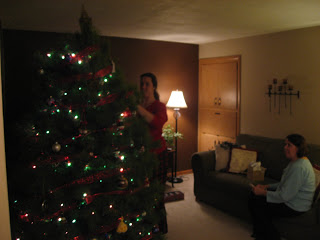
As we do every year, my sister and I (with our niece too this time) went tree hunting. It’s a lovely process. Taking our time, picking out our favorites, tramping through the snow to compare the possibilities, realizing we aren’t lumberjacks when our shoulders are aching after sawing through half the trunk. Good times are had by all. This year’s tree is decidedly plump, overtaking half the living room. I’m growing more fond of it each day.
Advent, Faith, Jesus

Advent Amazement

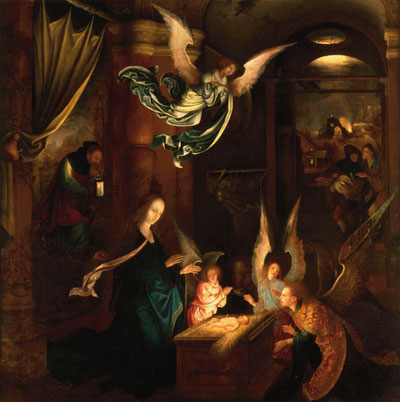
This Advent I’ve been reading a collection of meditations on quotes from C. S. Lewis. Lewis had a very worthy grasp of the the grandness of the miracle of the Incarnation, of the greatness of God becoming man in Jesus Christ. His awe of God’s actions on that first Christmas night is unmistakable. It casts light on my lack of awe and has me thinking about the vast difference between the greatness I attribute to God and His actual greatness. I think of Moses, who had to veil his face after seeing the glory of God because he shone with blinding radiance; of King David, who sought to contemplate God, His works and commands all day and all night; of the Prophet Isaiah, who saw a vision of the Lord on His throne, surrounded by worshipping Seraphim; of St. John, who wrote an entire mystical account of the heavenly visions he received; of St. Francis of Assisi, who went into a coma-like state for a few days after hearing a single note of the music of heaven… these men had a much deeper awareness of God’s divinity than I do. I’d even warrant that most of this era’s Christians don’t come close to such an awareness as used to characterize the great figures of the Church. It is why the mystics fascinate me more and more with each passing year. In this time we prefer to have everything figured out. We like to fully grasp the thing that is before us, to give it boundaries and know exactly how it works and what it means. I see it in the way the faith is taught, as well as the willingness of people to make acts of faith in truths that they haven’t fully grasped yet. I see it as well in our worship. The individualistic nature of our culture has crept into our worship. Though there is great worth in the individual’s worship of God, in the singular communication with and listening to God, there has been a loss of comprehension in how liturgy unites us with all the saints and angels of heaven, as well as all the Church on earth, in the worship of our King.

Basically, I find myself questioning these attitudes and tendencies that characterize the present. I don’t doubt the goodness of knowing what we can know, of grasping what we can grasp; God wouldn’t have revealed so much and commanded the Church to continuously teach it all if He didn’t desire that we know all of it. It’s all that we don’t fully know or fully understand that I’m concentrating on here. What is so wrong about being baffled with amazement? About sensing the infinite depth of the mysteries of God and concluding that I truly know so, so little. I cannot hit the bottom of the well with my bucket. At the end of his years, St. Thomas Aquinas, one of the greatest minds to ever encounter and expound upon the Christian faith, said this: “All that I have written appears to me as much straw after the things that have been revealed to me.” The more insight he gained into the truth of who God is, what He has done, who we are in light of Him, the more he realized how much there was still to know and understand.

How I react to the Incarnation is an excellent test of my heart’s capacity for amazement at the mysteries of God. The Incarnation is absurd, scandalous, bewildering, incredible! It is awesome in the truest sense of that overly used word. I’ve heard before that to get an idea of how much God humbled Himself to become man, we should imagine ourselves becoming an amoeba or a worm. But even that is a terribly weak analogy for I and a worm are both creatures; not equal creatures, but creatures nonetheless. What God did by becoming man, indeed an infant born expressly for the purpose of dying for mankind, is beyond any comparison we can make. This is not meant to belittle or devalue us as human beings. Rather if I develop a proper sense of awe at the Incarnation, my sense of human dignity will likewise develop. For in the face of this immeasurable difference between God and man, God still became man!

I have a feeling that this awe and bafflement at God, at the mysteries of God, are key to having faith like a child. Too much of our accessible knowledge of God has been gained at the expense of our certainty that we have only glimpsed into all that there is to know and experience of Him. Both must be nurtured in my heart and mind: the accessiblity of God (which is due only to His initiative over the course of salvation history, especially in the Incarnation) and the inexhaustible depth of His mysteries. Neither should be sacrificed. It’s difficult though not to give up one and cling only to the other.

“The Christian story is precisely the story of one grand miracle, the Christian assertion being that what is beyond all space and time, what is uncreated, eternal, came into nature, into human nature, descended into His own universe, and rose again, bringing nature up with Him. It is precisely one great miracle.” (C. S. Lewis) Do I even have a concept of what miracles are? I do, but I don’t recognize them enough. I don’t fall down on my knees in worship of the infinite God when He takes heed of the individual and intervenes in space and time for the sake of His sons and daughters. The divine intervention that is the Incarnation… well, I ought to be struggling for words to describe it, so great is this miracle! And the more I contemplate it, the more that is the case.

I wonder how the angels reacted to the Incarnation! Some went to the shepherds near Bethlehem, but what of the legions not present there? The awe of God, the amazement at His action, the joyful acceptance of His infinite wisdom in carrying out this plan – what a chorus must have been sung! Some theologians speculate that the tipping point of Lucifer’s and the rest of the fallen angels’ rebellion came when all the angels were given knowledge of the plan of salvation and asked to choose whether they would or would not serve that plan. Lucifer’s pride could not accept the plan. It was scandalous that God would become man! That He would take on a created human nature, live among the poor, work for His bread, be rejected by His own people and be put to death! Considering the stir He creates here, Jesus Christ must have caused quite the stir amongst the angels too.

Yet what is my own reaction to the plan of salvation, to the Incarnation? It is comforting and encouraging, if I slow down enough from the nonsense of the ‘holiday season’ and focus on it. It is cause to rejoice, to give thanks, to be kinder to others, and so on. Not bad reactions, certainly, but they fall so short! My prayer this Advent is for awe and amazement to fill me to my fingertips, and that in this reaction may come the seeds of childlike and willing faith, unceasing joy in God’s incredible outreach to me, humility in the face of the humility of the Divine veiled by a human nature, and eager, earnest repentance out of love of the God who set this “grand miracle” in motion for the sake of making a way for us into His presence.

Advent, Catholicism, Faith, Hope

What’s Your Compass?

As a Catholic I get to celebrate two New Years. This past Sunday signified the end of the Church year (the liturgical cycle of feast days and seasons commemorating the great truths, events and mysteries of Christ and the Church). With this coming Sunday, the new Church year is inaugurated by the 1st Sunday of Advent. Advent: that holy season of preparation, waiting, anticipation, contemplation. During Advent we have a two-fold focus in our liturgies (and are invited to have them in our personal prayers as well) of the Incarnation, when the Son of God assumed a human nature to dwell among us for our salvation, and the Parousia, when that same Person shall return at the close of time for the final judgment of all men and women ever created. It’s a rich set of weeks, easily missed in the bustle of the “holiday season” celebrated by shopping centers and television programming.

Lately I’ve been troubled by how few things there are that I can count on, especially how few events or experiences I can count on happening. At any given moment, I could probably think of a dozen things that I want to happen, even that I have genuine hope of happening, but there is truly only one event left that I can count on happening. That is the coming of Christ. The 2nd Coming, to be specific. The glorious return of the King of kings, the Lord of lords, triumphant and final. Nothing else is guaranteed.

Is this a pessimistic, negative, ‘to hell with all my work and plans’ sort of perspective? Or is it a realistic, positive, ‘everything only matters in light of Christ’ perspective? I suppose it’s neutral in itself. But how do I apply it? How am I influenced by it? That’s where the rubber meets the road. Accepting and grasping this truth can shape those wants and hopes I have from day to day, year to year, as well as my reactions when they either do or do not come to fruition. The lasting weight of anything that happens in this life is only measurable in terms of eternity, e.g. did this loss unite me more closely to Christ? Did this gain incline me toward praise of and thanksgiving to God? “God works all things for the good of those who love Him,” assuming I freely submit to His divine Providence.

In a recent discussion with some fellow Catholics, the question came up of whether or not we were wasting our time to be pondering Heaven. What can we know of it? What can we hope for? What will it be like? Admittedly, we are almost laughably limited in our capacity to understand or grasp the reality of Heaven. So do we waste our time by thinking about it? I argued vehemently, no. Pondering Heaven (or likewise, the end of time when Christ will return) is not a waste of my time. To explore the reality of Heaven is to explore my destination, my eternal homeland. To contemplate the return of Christ in all His victorious glory is to contemplate the final, definitive consummation of love. All that was begun when God, out of the abundance of His love, created the heavens and the earth and all who dwell there, all that was redeemed and reconciled by the sacrifice of perfect, divine love in Jesus Christ on the Cross, all that is hoped for and sought by the generations of faithful believers since will be completed by His return. The Kingdom of God, that mysterious ‘now but not yet’ reality of what Jesus has done and what we are cooperating with by grace and free will, shall then be everything there is and ever will be.

The mind boggling truth that I get to contribute to this coming of the Kingdom has the power to shape every day that I live on this earth. Contemplation of the adventus, the coming of Christ at the end of time, does not cause me to neglect the things that make up my earthly life. Rather it informs that life, contextualizing it and directing it. Heaven is our true north.

Come, Lord Jesus, come.